


See our AI Impact podcast episodes on YouTube.
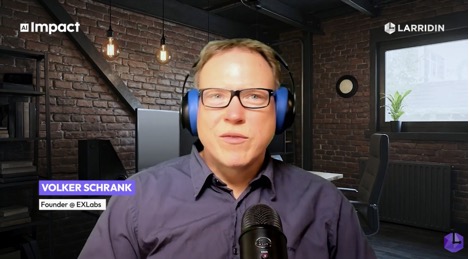
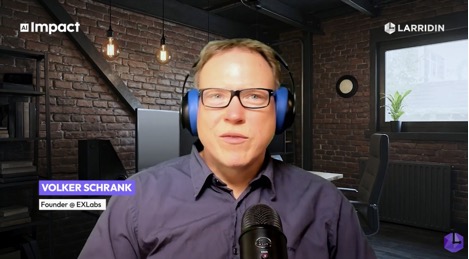
Technology isn't the limiting factor for enterprise AI. Readiness is. In the latest episode of AI Impact, Volker Schrank, an HR and HR technology leader with more than 25 years in the field and founder of EX Labs, joins Larridin co-founder and CEO Russ Fradin. They break down the difference between AI for HR and HR for AI, why most HR functions are still watching from the sidelines, and what happens when AI frees up time nobody planned for.
Key points
This was a warm and engaging conversation between two professionals with decades of experience, considering how AI is changing the way work gets done. (Russ had addressed some of these topics in his recent interview with MTS.) Several key points emerged.
HR for AI is the bigger job
Volker draws a line between AI for HR—that is, using AI to run the HR function better—and HR for AI, getting the whole organization ready to work alongside AI. The first is shorter-term and is the must-do. The second is where the real stakes are, because AI will change what skills companies need, how teams are built when some members aren't human, and how new talent gets started when AI takes over entry-level work.
In his view, most HR functions haven't picked up that responsibility yet, so the CIO runs AI as a technology project by default. But the technology is now a commodity. The value comes from how it's integrated and used, and if the organization isn't ready to absorb it, the AI investment is lost. He also notes that many companies still report AI uptake the way they reported e-learning a decade ago: how many people logged in, and for how long.
Adoption starts at the top
Asked how to move managers up the AI learning curve, Volker lays out three steps:
-
Address the fear that AI will take people's jobs, because nothing else works until that's handled.
-
Do the foundational enablement: show people what the tools can do and how to use them.
-
Get leaders visibly using AI themselves. When a boss shows up on Monday with an agent they built over the weekend, people want to catch up.
Russ adds that this matters because the heaviest AI users tend to be younger and more junior, while the managers who set the pace often aren't. Login counts don't show progress; productive work does.
Freed-up time needs a plan
Once employees are trained and genuinely good with the tools, Volker says, companies run into the "walk the dog problem." Agents do the work, people have time on their hands, and the organization has no mechanism for using it.
Russ points out that the gains won't simply turn into shorter weeks, because the colleague competing for your promotion will put in the extra hours with AI. Volker expects what has happened after every economic revolution: more work, not less, with the gains going into growth rather than savings.
Either way, leaders need to decide where that capacity goes before it disappears into dog walks.
Automate the admin, not the relationship
Volker's advice is to automate administrative HR processes aggressively, but to protect the processes where the manager and employee working together is the point. Performance management is his example. An AI that reads a manager's email and Jira, writes the reviews, and stack-ranks the team takes away the work, and with it all the value the process is supposed to create.
Russ contrasts this with AI-driven expense review, where a consistent system applying policy is better for employees and managers alike. The line, as he puts it, is the one-on-one: if your boss sends an agent to it, something has gone wrong.
Conclusion
See the full episode on the AI Impact Podcast playlist on the Larridin YouTube channel, or see the full transcript. To get a demo of Larridin, contact us.
Key Quotes
- "I don't think we need to talk about 2030, 2035. It's 2028, 2029 that we need to talk about." (Volker Schrank)
- "Your top people are 10x more productive than they've ever been. They're not 1.2 times more productive. They're 10 times more productive." (Russ Fradin)
- "Leading from the top means being not only the one talking about it, but showcasing that you are doing it." (Volker Schrank)
Q&As
Russ had questions; Volker had answers.
Q: How should companies think about ROI from AI?
A: I think you need to truly think about it as the hard savings or the hard growth that you get from it. The last few years were a lot about testing and learning, and I think that's fine, but we are now at a stage where you should have sufficient understanding to know what works, what doesn't work, and how to scale this into a state that truly delivers the value. ... Now you can employ your own agents. You can take your own agents, replace the shared service center, and automate the back office of HR.
Q: You have quite a lot of frontline workers all around the world. How have you thought about AI for those types of workers?
A: When it comes to production planning, when it comes to smart scheduling, this is where it is big. ... In the past you were very rigid around shift planning and around who can do which job. ... But with the enablement of technology, you can do the shift planning almost in a democratic way and put it into the hands of your employees, and say, "Hey, guys, we know exactly what you can and cannot do. These are the shifts where we need your capabilities. Which one do you want to take?"
Q: Where have you seen this go wrong? What should companies watch out for?
A: When I look into the logs and how many people use unsanctioned AI at work, they should be a little more scared. ... Particularly when I think about the HR use cases, because all of the data we have is very sensitive. ... I've seen people uploading everything about themselves, meaning their psychological profiles, their CVs, everything, to an AI and saying, "Okay, now you know me, and now you need to be a coach for me." ... You don't know exactly where this has landed now, where it will be, and what will happen there.
Q: What do you think HR really looks like in 2030, 2035? How do the best HR folks prepare themselves to be important in the future?
A: We will have business partners, we will have centers of expertise, and we will have an operational entity. But that operational entity will be much, much smaller than it is today, and it will operate a body of AI agents to execute the processes. ... More focused on context, less focused on execution, more focused on judgment, less focused on the number of tickets. ... And the big one is the business partners. They will finally have at their fingertips all the information about the workforce that they need to answer any question that gets asked in the meeting.
Volker Schrank Full Transcript
Chapter 1: AI reshaping enterprise work (0:00)
Volker: AI will reshape how an enterprise works. It will reshape what kind of people you need, what kind of skills you need. How do you define teams when you have nonhumans as active team members? How do you think about getting new fresh talent in if all of the entry jobs, or how I call it, the AI trainee, is taking over that path? Technology, for the majority of what you can do with AI today, is the commodity. It's no longer the limiting factor. It is how you integrate it, how you use it, and how you make value out of that. You have to do the foundational enablement. You have to really showcase: how does it work? What can it do? How capable is it? And from there, I think the real difference is leading from the top.
Russ: Welcome back to AI Impact. Today I'm joined by Volker Schrank. Volker, thank you so much for joining us. Why don't you give the audience a little bit about yourself and your background?
Volker: No, thank you, Russ. It's such a pleasure to be here with you today. I was looking forward to today. Why should I start? I'm Volker, as you have said already. Based out of Munich, Germany. It's a little city in southern Germany. I think everyone knows it for the Oktoberfest.
Russ: Everyone knows it. The cool clothing, the cool October stuff.
Volker: Yeah. Apologies that I have just a lame shirt today. And I'm an HR and HR technology practitioner for, I don't know, 25-plus years, something like this. Currently across a multitude of different topics. On one hand, I'm doing something similar to you, right, podcasts. I have my Employee Experience Lab, where I'm talking to peers and startups about what's cool, what's new, how to think about HR, innovation, AI, and technology in the HR space. And I'm also running the HR technology and employee experience function for Mondelez International.
Russ: Very cool. Yes, I know we've talked a little bit about Mondelez and what a very old, iconic company it is, and so I'm sure a lot's going to come up on both of the things you do during the chat today. So, as we dive right in, everybody loves talking about AI and what's going to happen, and predictions. You've kind of made a big distinction between AI for HR and HR for AI.
Chapter 2: AI for HR explained (2:30)
Russ: How do you think about your role, HR leaders at large organizations, in AI, just to set the framework?
Volker: Yeah, I want to say that I was probably one of the early ones making this distinction. By now, I have seen it; you can read this with McKinsey and others. But we have been driving this for over a year now already. And the distinction is, quite frankly, what I'm doing is AI for the HR function. How can we improve the HR function and what it delivers with the help of AI, right? Maybe around administrative activities, just getting to a zero-touch back office. Maybe in the front office, to say, hey, how can we improve the experience for employees and for managers or candidates? But also, how can we actually superpower our business partners and our CoEs with the help of technology? This is my daily life, if you will, where I'm also on a project trajectory with Mondelez to make this happen every day. However, this is the small piece. This is the small thing. That's the must-do. I feel the much bigger one is HR for AI, right? And you know this, as do many of the listeners: AI will reshape how an enterprise works. It will reshape what kind of people you need, what kind of skills you need, how you define teams when you have nonhumans as active team members, right? How do you think about succession? How do you think about getting new fresh talent in, and scaling it up to be experienced talent, if all of the entry jobs, or how I call it, the AI trainee, is taking over that part? And this is the big one, because without doing that piece right, HR for AI, all of the investments that any enterprise does in AI are lost, because you will not be able to realize them if your organization isn't ready to absorb it and work in an AI-native way.
Russ: As you've talked to folks, either at your current organization or when you interview folks, who's going to... I guess "own" is kind of a lazy way to phrase the question, so I can start with "own." But how do you see things evolving? For a long time you had the CIO over here and you had the head of HR over here, and frankly they didn't really overlap, except around maybe a Workday implementation and SSO, and a little bit of employee privacy policies.
Chapter 3: Who owns AI strategy (5:14)
Russ: But in a world where you are going to have humans doing work, humans doing work using technology where there's a training component, right, since AI is such an important part of work now, and will you have nonhumans doing some amount of work? What does that organization look like? What does the collaboration look like between the head of HR and the CIO? It's not really about who's the boss. It's: do they become one organization, or how does that then happen?
Volker: That's an interesting one, and I think this is where it still needs some settlement. The unfortunate thing, Russ, to be honest, when I look outside, is that most HR functions haven't taken that ball at all. They're not part of the game. They are still watching from the sidelines. And where you have that, it's easy: it's the CIO, because nobody else is there. They're doing it.
Russ: Sure. Sure. Sure.
Volker: Yeah. But how are they doing it? They're doing it as a technology project. And I'm not sure how you see this, but from my perspective, technology, for the majority of what you can do with AI today, is the commodity. It's no longer the limiting factor. It is how you integrate it, how you use it, and how you make value out of that. Just for example, earlier today, I was reviewing some KPIs around AI uptake. And what are we reporting out? We're reporting out the same things that we reported out 10, 15 years ago when it comes to learning. How many people have used AI? How many hours have they spent? How often do they come back? Where's the value in that? There's nothing. You could even argue it's the opposite, right? It's wasted.
Russ: Sure. Look, we never try to turn these podcasts into Larridin commercials, because nobody wants to hear that. They can check out our website, and we love business all day long. But of course, this is so much of what we talk about, and actually I think an area where you and I have a lot of overlapping interests is all around the AI divide, as you think about AI across the workforce. My quick way of talking about this is always: if you had 10,000 employees in your company and you roll out ChatGPT, Claude, Copilot, pick whatever it is, you're going to have 500 people living in the future, building agents to manage their other agents doing the other agents' work. You'll have 1,500 people using it to check, since you're from Munich, the Bundesliga schedule for the weekend. I generally say the Premier League schedule, but we'll say the Bundesliga schedule for the weekend. And you'll have 8,000 people really kind of doing nothing and just assuming it's all a bubble. And that's going to truly impact people's performance, but it's also going to impact people's promotion, right?
Chapter 4: The AI skills divide (8:00)
Russ: You've heard people say many, many times, to the point where it's become a cliché, that AI is not going to take your job; someone who's great at using AI is going to take your job. And so how do you think about that AI divide in the organization, and training the middle of the organization to move that fat part of the bell curve over?
Volker: Yeah. Russ, before I answer that one, let me come back to your previous question, because there's one great, I think I can call it, experiment. Have you heard about Moderna, who have basically merged the CHRO and the CIO? They are running it as one. And I think this is an interesting experiment, in the days that are following, to see how much overlap there is and how much more there will be.
Russ: I think that's a great one. Whatever the organization is going to look like, it is very clear that AI is going to drive a lot more collaboration between the CFO, the CIO, and the head of HR, more than ever before. Who reports to whom? That's going to differ by company. Of course, people will figure that out. But at the end of the day, how much budget do I put into headcount in Germany, of Germans, and how much budget do I put into headcount in, pick my cheaper labor market, outsourced country, and how much do I put into agents? That's a question that people weren't thinking about two years ago. And that's going to be some part CFO, some part HR, some part CIO.
Volker: And how much do I put into the right enablement?
Russ: Sure. Right. Sure, we have to train these people, of course. As I say to people all the time in my 500, 1,500, 8,000 example: look, you're not just going to fire everyone in your organization over 40. You're not going to. It would never work. It's not legal. But you do need to figure out how to upskill all of those folks and turn them into heavy AI users, skilled in using these tools that are constantly changing. By the way, this isn't like learning to use Excel.
Chapter 5: Walk the dog problem (10:02)
Volker: Exactly. And the next step you have to deal with is, okay, if I have them all trained and a good portion of them are actually great at utilizing the tools, you run into the, not sure if you've heard this, Russ, the so-called walk the dog problem. Suddenly those people have so much time, because all the agents are put to work, and the organization does not know what to do with that time. They don't really have a mechanism. They are not set up for that. So those people can just walk the dog, come back. The agent has done the work. Fantastic. Let's review that and initiate the next session. And oh yeah, the dog needs to go again.
Russ: My friend, one of our investors at Andreessen Horowitz, Alex Rampell, has talked about this quite a bit: where will all of the productivity gains from AI go? It's probably not all going to go to Mondelez, right? You're not going to actually need your employees to work as much as they were. But it can't all go to the employee, because, by the way, the guy next to you who's competing for the promotion will just work more hours with the AI, right? So there's an element of: people like getting recognition, they like getting rewarded, they like getting promoted. That's a lot of what drives organizations, obviously. And so you're not going to have a world where I can get my 40-hour-a-week job done in five, and I spend 35 hours watching more Premier League. But how we share in those savings is an interesting question at a company level.
Volker: It indeed is. And not only how you share it, but what you do with it, right? Because in the end, if you think about all of the different economic revolutions that we've had throughout time, after every revolution we had higher employment than before. So the same will happen here again. There will be different jobs, but there will be more work. And that more work will not really come to savings; it will come to growth, right? Companies will grow stronger, will grow faster, and create more value, rather than having a 30-hour week or whatever. I mean, people want that, and I think we have that dream every time there is an economic revolution. We have that dream: ah, fantastic, the computers, the internet, we can work less. No. We've always worked more, and more people have worked more. So that will happen here again.
Russ: Look, I tend to agree with you that that's likely where this goes. But frankly, only if we can get people using all of these tools. And so what have you seen work best in terms of training folks? Is it direct examples? Is it peers? How do you actually, from a learning and development standpoint, take managers up that AI learning curve so they can push their own folks?
Chapter 6: Leading adoption from top (12:58)
Volker: I think there are multiple steps that you have to take. The first one is, of course, making sure that the messaging is clear, because we do have a big portion of the workforce that is afraid of AI, that doesn't want to do AI, because there's this narrative that AI will take my job away. That's the first one you have to manage. If you don't manage this, nothing else will work. And then the next step, you have to do the foundational enablement. You have to really showcase: how does it work? What can it do? How capable is it? How can I actually use it? So that the understanding is there and the curiosity gets sparked. And from there, I think the real deal, the real difference, is leading from the top. So if your boss...
Russ: Well, by the way, everyone has a boss. I have a wife. I have a board. I have multiple bosses.
Volker: If they come into the room tomorrow and say, "Hey, listen, guys, just so you know, over the weekend I had some time. I was building this fantastic agent with, I don't know, Claude, ChatGPT, whatever, to do that thing that I'm using now with the local children's football team, to manage who brings what kind of food and marketing and whatever to the games, yada yada yada." When you see your bosses doing this, this is when you get this FOMO: "My god, my boss is doing that. I think I need to jump on that train." So leading from the top means being not only the one talking about it, but showcasing that you are doing it.
Russ: It's pretty amazing to think about. It's this interesting challenge in the organization, where in a lot of the big companies, obviously, the people that are really using these technologies tend to be the younger folks. Younger folks tend to be more junior, so you do have an interesting management challenge: the managers tend not to be the younger, AI-native folks. And the only way you're going to drive 50,000 people using these tools at Mondelez, or wherever, is really getting leaders to actually use it, with some amount of top-down, like you said, leading from the front. It's not forcing people. It's not silly numbers about what percent of people logged into Copilot last week. Who cares? A lot of the usage is planning their Vegas weekend, which is fine. People use the internet for all sorts of things during the day. There's nothing wrong with it, but your goal is productive work. So if you think about productive work, businesses aren't going to invest in this stuff forever with no return. How do you think people should measure ROI? HR is a part of it. Obviously finance is a part of it, and the various business leaders and department leaders are a part of it. How should companies think about ROI from AI?
Chapter 7: Measuring AI ROI (15:56)
Volker: I think you need to truly think about it as the hard savings or the hard growth that you get from it. The last few years were a lot about testing and learning, and I think that's fine, but we are now at a stage where you should have sufficient understanding to know what works, what doesn't work, and how to scale this into a state that truly delivers the value. When you think about the HR function, my own home turf, for the last 20-plus years, almost 30 years, the big drive was toward the so-called Ulrich model and HR shared services. And you have huge organizations out there, the Accentures, the Genpacts, the Infosyses, whoever, who have huge centers. They're not doing anything other than delivering HR services for other companies. That's a big business. But now you can employ your own agents in that. You can take your own agents, replace the shared service center, and automate the back office of HR. That is value, in the case where it actually offers up immense cost savings, but also offers up additional powers to the remainder of the HR organization to focus on the things that truly make a difference. And just to continue that story, not everything is about the savings, even when you think about HR shared services. When you look into what makes a company successful, and that's true for almost every company, you always come down to the main topic, the main spot that is different from company to company, and that's your workforce and your culture. Who is having the biggest impact on the employee? It's their manager, for sure.
Chapter 8: Manager coaching at scale (18:00)
Russ: Yeah. The actual people around them.
Volker: Exactly. And do we have good managers? Do we have managers that truly can manage their teams and make the best out of their teams? If I want to be very positive here, I would say the vast majority of managers are not good at it, because they're not born to do that. They were not helped to be in that job. They were just the best at what they were doing; therefore, they were promoted to be a leader. But if you now use AI to do manager coaching at scale, in the moment, right at your fingertips as a manager, then you as a manager will be better at your job managing your team every day. Just 1, 2, 3%. And then every manager will be better by this 1, 2, 3%. What will that mean for the growth of the company?
Russ: Well, look, a big thing we talk about at Larridin is just understanding the data, to understand what the workflows of your best users of AI actually look like. How do we take that info and feed it back into HR and learning and development? Feed it back to managers, because there is an element of: even if I'm an eager manager, I don't know what great looks like, because these tools haven't existed before. These tools are effectively brand new. Most large companies have been doing nothing but experimenting with them for maybe six or nine months. It takes a very long time. It's very early. And so frankly, even if I'm the most eager manager, the most talented manager in your entire organization, I don't know what good looks like here. This is brand new. And so how do you feed that back? So if you think about that, I'm curious, and again, it doesn't have to be about Mondelez specifically, but I'm sure you've thought about this given the org. You guys are unique compared to a lot of companies that are 95% laptop workers, in that you have quite a lot of frontline workers, obviously, all around the world. How has AI transformation impacted those workers, that world, the factory side? On the one hand, you can say technology has been impacting those workers more than knowledge workers forever, right? There's no place where that's more obvious than when you go into a manufacturing facility. But how have you thought about AI for those types of workers? Again, whether it's Mondelez-specific or not.
Volker: Yeah, I think the interesting fact is that in the business we are in, snacking, a lot of what is happening in production is still very much manual and very much focused around the individual, the human. The level of automation that exists is different for our products than for, say, an automobile or a computer or a smartphone, things like that. So it's a bit further removed from the actual workforce that is making and baking our product every day, and also the people selling our product, because we still need humans to drive our products around and shelve them in the supermarkets.
Chapter 9: Frontline worker shift planning (21:14)
Volker: But when it comes to production planning, when it comes to smart scheduling around this, this is where it is big, and where it actually has a fantastic, positive impact on our workforce. In the past you were very rigid around shift planning, for example, and around who can do which job. You needed to rely on what you had on your piece of paper, or what you remembered that Joe and Jane can and cannot do. But with the enablement of technology there, you can do the shift planning almost in a democratic way and put it into the hands of your employees, and say, "Hey, guys, we know exactly what you can and cannot do. These are the shifts where we need your capabilities. Which one do you want to take?" And this is where it has an absolutely positive impact.
Russ: I get your point: much less around baking Oreos, or, actually, I don't know how you make Swedish Fish. I guess it's not baking, but whatever the correct term is for forming Swedish Fish. There's less AI there, but sure, improving the actual lived, on-the-ground experience of the worker in terms of scheduling and vacation and seniority and all of that. Sure, if you can do that better. And actually, to go back to something you said early on, if you can use AI well in HR, you should be able to really improve the impact of HR on the organization. You should be able to give employees much better individualized coaching and business partnership at scale, because there's no way to have truly wonderful, proactive HR experiences when you have 100 business partners and a thousand factory workers. I don't know the ratio at a place like Mondelez, but it's not one to one. It's not 10 to one. You've just got a lot of people. And so fundamentally, you just can't know people well at that scale. But theoretically, people plus AI plus a very strong culture can really partner with your employees quite well.
Volker: Exactly. You have two choices for how to make this happen: either you go back to the 60s or you apply AI. I think we are clear that, at the moment, we are not able to go back to the 60s. So if you want to have white-glove HR service that enables a lot of productivity, you need to drive it via AI at scale.
Russ: So I'm curious. I have a couple of final questions for you, and thanks again for joining me. Without getting company-specific, because you also talk to a lot of people, so feel free to draw from someone else: what are one or two, I don't want to say horror stories, but cases where it's clear that companies are using this stuff incorrectly, or measuring it incorrectly? Where have you seen this go wrong? One of the things I see a lot is just employee fear. That's a big driver of adoption. It's less that employees are worried AI is going to take their job. That's kind of a nebulous concern that you see on television, but you don't feel it so much day to day. But there is an element of: this is a very powerful tool. I don't want to use it wrong. I don't want to get fired because I used AI wrong, because I accidentally leaked all our data because I didn't know what I was supposed to do. So what are the kinds of things you've seen that companies should watch out for, maybe mistakes people have made that others can learn from?
Chapter 10: When not to automate (24:56)
Volker: Yeah, to be honest, Russ, I'm not sure how nervous people are about what you just shared, but when I look into the logs and how many people use unsanctioned AI at work, they should be a little more scared.
Russ: I think so.
Volker: Particularly when I think about the HR use cases, because all of the data we have is very sensitive. But some people are a bit too open. I'm not sure if this is a horror story, but I've seen people uploading everything about themselves, meaning their psychological profiles, their CVs, everything, to an AI and saying, "Okay, now you know me, and now you need to be a coach for me. Coach me every day." And it's like, this is maybe a bit too much to give. You don't know exactly where this has landed now, where it will be, and what will happen there. That's one. But what I also see is that not everyone knows where to draw the line. And what I mean by that is, there are software companies, I don't want to name and shame them, out there that are trying too hard with AI. In HR you have, without any doubt, a lot of administrative burden and processes: automate the heck out of them. But then you have other processes where it is important that the manager and the employee are part of the process, and through being part of the process, the actual value is created. And when you automate that, you basically defeat the whole original idea behind the process. For example, think about performance management. The reason why we invested in performance management is to make sure, A, that everyone is aligned toward the goal of the company and isn't just coding or working away on the other side of the business, but also, B, that what you do, you do in the best way, and I can coach you on that, and I'll also give you a rating on that, so that you know where you stand and can get better. Now, if you say, "No, Russ, don't worry about it. I know you have 10 people that report to you. I'll take care of that. I'll go through your emails. I'll go through the systems, I don't know, Jira, whatever, and just write down the performance evaluation and give each of your 10 employees their rating. You just have to submit that. We'll stack rank them. We'll send them their feedback." What have you done? You have taken away work, yes. But you have also taken away all of the value that this process is supposed to generate.
Russ: Well, and all the relationship. It's great. I met an AI company recently that was automating expense report review, and they said, "Look, it's wildly popular, because frankly managers don't like doing it. They don't like denying out-of-policy expenses to the employee. The employee gets angry with them. It's also a hassle. It's just easier for everyone if it's a fair system applying the policy, as an AI does." So, oh, you accidentally expensed three glasses of wine at that dinner, and we don't allow that. It's not your boss telling you no; it's the company.
Volker: So that's fine. Actually, that's a great use of AI. It's better for the employee. It's better for the manager. Scalable, saves everyone time, great use of tech.
Russ: And it probably does save the company money.
Volker: Frankly, it does. Believe me. Believe me.
Russ: But yes, if I showed up for my one-on-one with my boss and instead it was his Claude agent talking to me, what are we doing? To your point, employees will just have side businesses, right? If your boss can't spend the time with you, then what are we talking about? So, my final question. You've written and spoken a lot about this, but not 100% of the people listening to this have read or heard you before. What do you think HR really looks like in 2030, 2035? Where is this all going from an HR leader standpoint? How do the best HR folks prepare themselves to be important in the future, so it's not just, hey, the CIO is effectively taking over HR with the CFO, and they'll figure it out?
Volker: Russ, first of all, I don't think we need to talk about 2030, 2035. It's 2028, 2029 that we need to talk about. Just remember when we started with all of this and where we are now. The speed is so immense that it will all be different in two years from now. Significantly different. When I think about that, the cool thing is what everyone hates about HR, which is the administrative burden, the complexity. Every damn country has its own labor legislation. Then you have unions that have different labor agreements, with different factories, etc. All of that exists for good reasons, but it just makes this process complex.
Russ: Frankly, whether they're good or they're bad, they're reality.
Volker: Yes, they're reality.
Russ: It's gravity. It doesn't matter. There's no point in debating it.
Volker: Exactly. And today this costs a lot of energy for everyone in HR and outside of HR. So if we can take this complexity away from you, if we can free up your time so that you focus on the things that truly matter, the reasons why you should have an HR department, meaning to manage the workforce, to manage the culture, to manage the operating model of the company, to make it better, that's the direction of travel. And in that, I still believe that we will have a similar shape: we will have business partners, we will have centers of expertise, and we will have an operational entity. But that operational entity will be much, much smaller than it is today, smaller than the other entities, and it will operate a body of AI agents to execute the processes. They will oversee and take the decisions, the judgment around the complex cases or the escalations. They will continue to feed context to the agents, and make sure that context is updated regularly, because legislation changes, collective agreements change, etc. But they will work significantly differently than they do today. They will have a much, much different shape: more focused on context, less focused on execution, more focused on judgment, less focused on the number of tickets. That is something that will go away completely. No tickets anymore, no queue anymore.
Russ: Because you can operate at scale, right? Once you have unlimited ability to answer the basic and medium-level questions, you frankly don't need any stacking or queuing mechanism, because you'll just get the answer you need.
Volker: Exactly. And then you have the centers of expertise, which can think much more freely than today about the different ways to improve talent management, to improve compensation. They have tools at their fingertips to do some A/B testing. They have tools to put their thinking, their policy, into practice with the click of a button, rather than, "Okay, you want to change the performance management approach? All right, we can do this in the next six months, and then you can go for it." No, it's in the next six hours. So you can react much faster to changes that you want to make. And the big one is the business partners. They will finally have at their fingertips all the information about the workforce that they need to answer any question that gets asked in the meeting. It's no longer, "I'll take this away and send you an Excel tomorrow." It's, "Give me a second, I'll query my agent," and it will give me the answer, and then we can have a conversation based on the facts and move forward much, much quicker. And so the enablement will be much quicker.
Russ: People's ability to do things right now, I think, is not broadly understood. To me it's an interesting thing. I have three children, and one of the things I've said to my kids forever, long before AI existed, is, I beat them over the head with: what's the best time to do something? Right now. Right now is almost always the best time to do something. Not always; it doesn't apply to everything, but right now is the best time to do almost anything. And in a world of AI, it's amazing if you're a high-agency person. We see this in our own data, by the way. Your top people are 10x more productive than they've ever been. They're not 1.2 times more productive. They're 10 times more productive. And what they really have in common is not that they're smart. Of course, everybody's smart. It's not that. There's a set of people who need to break themselves of the habit of not doing things right now. We were on a demo the other day with a potential customer, and during the demo the customer asked what a feature might look like if we built something custom for them, and five minutes later my CTO showed it to them. While we were doing the demo, we built a mockup. Now, obviously he's a very high-agency person, but in the old days, pre-AI, you couldn't have done that. If you take that personality trait, if you're the kind of person who can kick your own ass into doing something quickly, and you combine it with mastery of these tools, it's astonishing what people can do. Well, Volker, I really appreciate this. This was a lot of fun. Thank you so much. When this goes live, we'll share a bunch about you and where people can find you. I really appreciate you taking the time.
Volker: No, thank you, Russ. Fantastic. It was a very good conversation. I really enjoyed it. I hope there was something in it for the listeners of your podcast. Thank you so much for the invitation.