

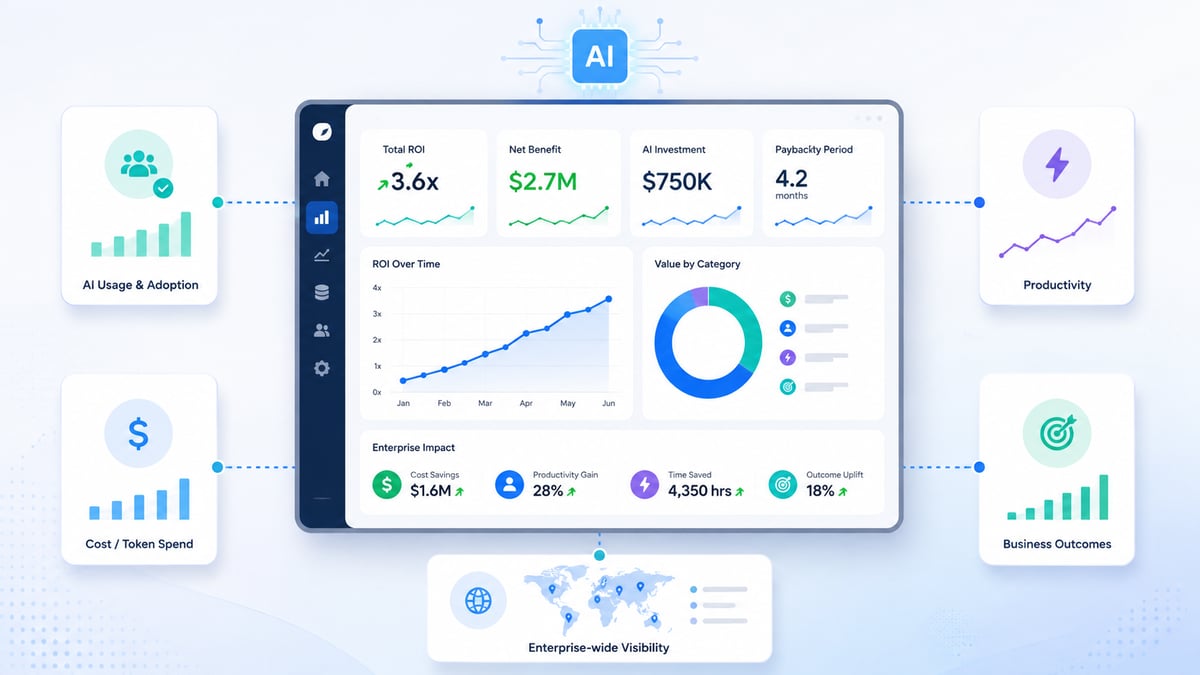

AI investment decisions need evidence of what the spending produces. Tool access, prompt volume, and reported time savings cannot establish a return on their own. Verification, rework, integration costs, and output quality can change the economics substantially.
For CFOs, CIOs, and transformation leaders, choosing an enterprise tool to measure AI ROI starts with scope: company-wide outcomes, GenAI use-case economics, workforce adoption, or engineering delivery. These five tools address different parts of that measurement chain.
What Measuring AI ROI Requires
A useful assessment connects which tools are in use, how effectively people and agents use them, what they cost, and what changes in business workflows. Establish a baseline and acceptance criteria, then assess outcomes alongside verification and correction effort.
- Utilization: Actual use and sustained workflow integration, not purchased access alone.
- Proficiency: Effective task scoping, context grounding, steering, and verification.
- Value: Relevant changes in quality, delivery, cost, or other business outcomes.
These dimensions organize evidence; they are not a literal multiplication formula for financial ROI. Separate cash savings, released capacity, additional output, and quality improvements. Correlation between AI adoption and performance is not proof that AI caused the change.
1. Larridin
Larridin connects enterprise AI adoption, proficiency, workflows, spend, and business outcomes across human and agent work. Its measurement capabilities include AI Fluency, workflow and developer intelligence, and spend intelligence.
Best fit: Finance, technology, people, and transformation leaders who need connected evidence across departments, tools, and workflows.
Evaluation boundary: Confirm coverage and integrations for your specific outcome measures. Specialized engineering benchmarks or pipeline analysis may still require complementary sources.
2. Ascerta
Ascerta focuses on GenAI ROI, cost, and capacity management, including connecting use-case costs to business KPIs and organizing budgets by business unit, team, use case, or agent.
Best fit: Financial accountability for GenAI initiatives, agent workloads, model consumption, and technical capacity.
Evaluation boundary: Check whether its use-case economics model also covers the employee-tool discovery, adoption depth, and proficiency information your broader program requires.
3. Worklytics
Worklytics approaches AI measurement through workforce analytics, aggregating adoption across workplace tools and connecting use to collaboration and productivity signals.
Best fit: HR, people analytics, and operations teams evaluating adoption patterns and their relationship to workforce behavior.
Evaluation boundary: Validate the current cost and outcome integrations rather than assuming adoption benchmarking alone establishes ROI. Autonomous-agent economics and technical capacity may require additional evidence.
4. Jellyfish
Jellyfish focuses on engineering measurement. Its AI Impact offering connects AI adoption and spend with software-delivery signals such as cycle time, throughput, quality, and cost efficiency.
Best fit: Engineering leaders evaluating whether AI coding tools and agents improve delivery and justify their cost.
Evaluation boundary: Its engineering-centered scope should be assessed separately from requirements for sales, finance, support, HR, and other functions.
5. GetDX
GetDX combines engineering productivity and developer-experience measurement with an AI framework addressing utilization, impact, and cost. It uses system data, developer-reported signals, and benchmarking to add context to development outcomes.
Best fit: Engineering organizations that need AI assessment alongside broader developer productivity and experience evidence.
Evaluation boundary: Validate how reported signals and system telemetry are combined. Engineering measures do not automatically translate into company-wide ROI.
These descriptions retain the five-tool scope of this article. They are not a hands-on benchmark. Verify current capabilities, packaging, supported integrations, and methodology before purchasing.
Score Measurement Requirements Before Shortlisting Platforms
Define the decision your buying committee needs to make before comparing the five platforms. The enterprise productivity platform evaluation guide establishes the requirements: organizational scope, integration fit, method transparency, privacy, deployment reliability, and total measurement cost. The seven-question AI ROI platform buyer’s guide turns those requirements into checks you can use during a demo or pilot.
Decide whether your assessment is engineering-only or cross-functional, and map the departments, workflows, financial records, and outcome systems it must cover. Then ask each shortlisted provider the same questions. A convincing demonstration is not evidence that the platform can measure your environment.
1. What AI Activity Can the Platform Actually See?
Request the tools and models supported today, how usage is collected, and which parts of your environment remain outside coverage. Ask what happens when employees adopt a new tool and whether shadow AI can be identified. Distinguish connectors, surveys, browser or desktop coverage, and source-control evidence rather than treating them as interchangeable.
Pilot check: Compare detected tools and workflows with a known inventory. Include useful non-code work where it belongs in scope. Document missing coverage instead of presenting a partial view as enterprise-wide measurement.
2. How Are the Metrics Defined and Calculated?
Ask for plain-language definitions of active usage, adoption, proficiency, productivity, and ROI. A login, an AI-assisted workflow, and a threshold of activity can each produce a different active-user count. Identify which inputs are directly measured, calculated, estimated, or self-reported.
Pilot check: Trace an important result to its sources, population, time period, calculation rules, and missing-data treatment. Require your team to explain or reproduce the calculation. A composite score should not conceal the assumptions behind the financial case.
3. Can It Attribute Usage and Spend to the Work Generating Them?
Ask for breakdowns by team, department, workflow, application, agent, and use case. Reconcile licenses, consumption, infrastructure, and shared costs with the work behind them. Retain explicit categories for unattributed or estimated spending and avoid counting overlapping cost records twice.
Pilot check: Reconcile a known bill or usage record with the platform, then follow a cost increase to the workload and accountable owner. A company-wide total may identify exposure without explaining its cause.
4. Can It Distinguish Human and Agent Activity?
Ask whether the platform separates employee-initiated use from agents and automated workflows. Confirm how it handles human-initiated agent runs, chained execution, and the review or verification that follows them.
Pilot check: Compare a known employee workflow with an automated agent workload. Verify that their consumption and human intervention remain distinguishable without double counting the same execution. Agent activity is not automatically accepted output.
5. Can It Connect AI Use and Spend to a Business Outcome?
Require the provider to show the relationship between AI investment and a metric your organization already uses: cycle time, cost per task, error and rework rates, revenue, cost avoided, or engineering delivery and quality. Confirm the actual delivery, CRM, service, financial, and identity integrations needed to make that connection.
Pilot check: Follow a defined workflow from AI use and cost to accepted results. Keep cash savings, released capacity, additional output, and quality improvements separate. Test alternative explanations for improvement rather than presenting correlation as proof of causation.
6. Can You Validate the Platform With Your Own Data?
Case studies establish what happened elsewhere, not whether measurement will work in your organization. Ask for a bounded validation using known tool usage, invoices, and outcome records before relying on results in finance, executive, or board reporting.
Pilot check: Test identity mapping, historical backfill, missing records, and connector outages alongside normal operation. Record discrepancies and unresolved assumptions. Separate successful setup from credible outcome evidence, and agree on acceptance criteria before the pilot begins.
7. What Data Does It Collect, and Who Can See It?
Clarify whether collection includes metadata, prompts, messages, keystrokes, or document contents. Ask whether individual-level data is available, who can access it, and what access controls, retention policies, and reporting restrictions apply. Metadata still requires responsible governance.
Pilot check: Inspect the collection configuration and access model against your privacy and security requirements. Use the minimum detail necessary for the measurement decision rather than assuming more employee data means better AI ROI evidence.
Compare the Evidence and the Total Measurement Cost
For each of the five tools, record whether every requirement is demonstrated, partly supported, or not yet verified. Keep the evidence, integration dependencies, and limitations beside the assessment. Apply the same checks to Larridin and the other providers rather than substituting product positioning for validation.
Include subscriptions, add-ons, implementation, maintenance, and analyst effort in total measurement cost. A broader measurement layer and an engineering specialist may complement each other, but their identities, reporting periods, costs, and benefits still need to reconcile.
The source guides describe Worklytics’ outcome coverage differently. Treat that as a verification question, not grounds for an absolute claim that the platform cannot assess outcomes. The relevant test is whether its current method and integrations answer your specific financial question.
Engineering ROI: Follow AI Use Through Delivery and Quality
The AI-assisted developer productivity guide contributes five signals that help assess whether engineering spend produces useful work:
| Signal | What It Explains | ROI Caution |
|---|---|---|
| Suggestion acceptance | Whether developers keep AI suggestions | Accepted suggestions may still need extensive rewriting. |
| Code churn and rework | Whether recently produced code persists or needs correction | Distinguish necessary refactoring from avoidable cleanup. |
| PR and review cycle time | Where work waits between coding and delivery | Faster generation can shift the bottleneck into review. |
| Delivery and stability measures | Whether faster shipping remains reliable | Speed and failure or recovery signals should be assessed together. |
| Throughput | How much work moves through the system | Task splitting and complexity can change counts without increasing business value. |
Pair these measures with costs, workflow context, and accepted-outcome criteria. No single acceptance, output, or usage measure proves productivity or financial return.
Separate coding, pickup, review, and deployment time where possible. Use existing delivery-system data if it already meets the need; the missing capability may be linking AI use and spend to that evidence rather than calculating another delivery metric.
Choosing the Right Fit
Choose by the decision the measurement must support. Enterprise-wide investment allocation requires a different scope from engineering bottleneck analysis, workforce adoption assessment, or GenAI capacity management.
A broader measurement layer and a specialist can complement each other when they supply different evidence. Confirm that their identities, cost periods, and metric definitions reconcile, and that combined reporting does not count the same benefit twice.
Run a bounded pilot with a defined workflow, baseline, quality standard, cost scope, and review checkpoint. Assess whether the platform explains what changed and how confidently you can attribute it. Scale the measurement approach only after those requirements hold up.
Frequently Asked Questions
What is the best enterprise tool to measure AI ROI?
The best fit depends on whether you need enterprise-wide outcomes, GenAI economics, workforce analytics, or engineering delivery evidence. Select against documented requirements and test coverage with your own workflows.
Is AI usage tracking the same as productivity measurement?
No. Usage tracking describes access and engagement. Productivity assessment connects use to accepted work, quality, effort, and outcomes. Financial ROI adds a credible cost and benefit calculation.
How should rework affect the ROI case?
Include verification, correction, and downstream cleanup in the workflow assessment. Faster initial generation is not a net benefit if additional effort offsets the gain.
Do engineering metrics establish company-wide AI ROI?
No. They can support an engineering investment case, but other departments need outcome measures suited to their own work. Cross-functional reporting requires consistent financial definitions rather than one universal output count.
What should vendors explain about their scores?
The underlying sources, population, time period, calculation rules, missing-data treatment, and limitations. A composite score should not replace the evidence needed to make an investment decision.
How can we validate an AI ROI platform before buying?
Run a bounded pilot with known usage, bills, and outcome records. Confirm coverage, reconcile costs, trace important results to their sources, and reproduce key calculations. Define acceptance criteria and document gaps before using the results in executive reporting.
Should an AI ROI platform expose individual employee data?
Only when that level of detail is necessary and consistent with your governance requirements. Ask what is collected, who can access it, and whether reporting can be restricted or aggregated. Additional employee data does not automatically improve the investment assessment.
Measure the Return You Need to Defend
AI ROI becomes credible when costs, capability, accepted work, and business outcomes are connected with transparent assumptions. Buying a measurement tool is only the beginning; a defensible assessment requires clear definitions and accountable decisions.
Talk to an expert about connecting AI adoption, proficiency, spend, and outcomes.