

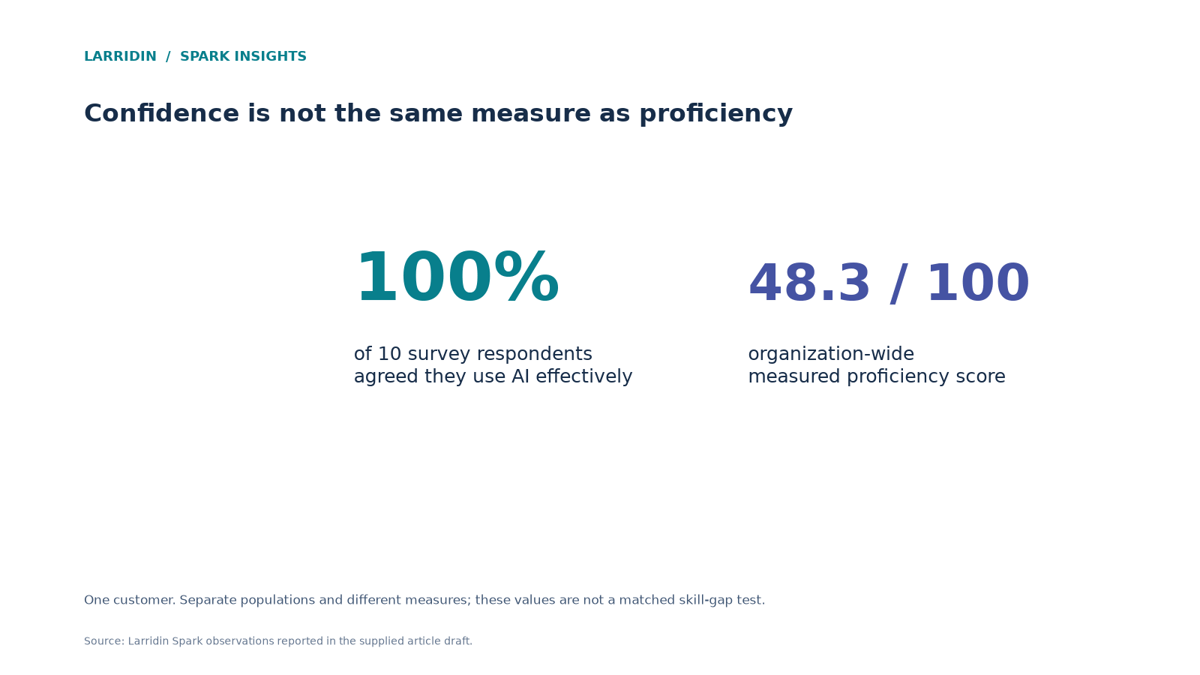

Employees may feel confident using AI, but that doesn't necessarily mean they're proficient. Larridin Spark data shows how self-reported confidence and small survey samples can give leadership an incomplete picture.
TL;DR
The Short Answer
AI confidence surveys measure self-perception, not proficiency. At one Larridin customer, all 10 survey respondents agreed they knew how to use AI effectively, but the organization's measured AI Proficiency Score was 48.3 out of 100. In another customer, an AI Productivity Score of 70.5 was based on just seven survey responses. Use surveys alongside behavioral data, and always check the sample size.
Key Wins
- See why self-reported AI confidence and measured skill can diverge
- Spot small-sample survey scores before they reach a leadership deck
- Pair surveys with behavioral data for a reliable picture of AI skill
What’s a Spark Insight?
A Spark Insight is a data-backed finding Larridin surfaces automatically from how your teams actually use AI, flagging the patterns worth a leadership conversation.
Who This Matters To
CHRO · CIO · People analytics
Quick Answers
| If you’re asking… | The answer | Go deeper |
|---|---|---|
| Are AI confidence surveys accurate? | They capture sentiment, not skill. In one org, every respondent agreed they used AI effectively, while the organization's AI Proficiency Score was 48.3 out of 100. | The data |
| How many responses does an AI survey need? | There is no universal minimum. Assess coverage, response bias, and uncertainty. In one org, two tools scored a perfect 100 based on a single response each. | The data |
| What is better than an AI skills survey? | Behavioral data: how people actually use AI, measured from usage rather than self-report. | What to measure |
| Should I stop running AI surveys? | No. Use them for sentiment and context, and use behavioral data to assess proficiency. | How to combine them |
Surveys can put an AI adoption or productivity number in front of leadership quickly. But confidence isn't the same as proficiency, and small samples can make survey results look more definitive than they are.
What You’re Struggling With, and How to Fix It
| What you’re struggling with | What you actually need | How Larridin helps | Proof from Spark data |
|---|---|---|---|
| “Our survey says everyone is confident with AI.” | A check on self-reported confidence | Measures proficiency from actual AI usage | One org: 100% agreed they use AI effectively; measured proficiency 48.3/100 |
| “We reported an AI productivity score to leadership.” | Confidence in how reliable that score is | Shows the sample behind each score | One org: score of 70.5 based on 7 responses |
| “Some tools scored perfectly in our survey.” | A way to catch outliers driven by single answers | Shows response counts so leaders can spot scores based on small samples | One org: two tools scored 100 on one response each |
| “Response rates are low.” | Data that doesn’t depend on people answering | Tracks AI tool use, including among employees who don't respond to surveys. | One org: 35.7% response rate, 10 responses |
What This Means for You
If you’re a CHRO
The question you’re asked: “How AI-ready is our workforce?”
What to do: Report measured proficiency alongside survey confidence. If they diverge, trust behavior for skill and the survey for sentiment.
For more on evaluating workforce readiness, see AI Monitoring for CHROs.
If you’re a CIO
The question you’re asked: “Which AI tools are most productive?”
What to do: Check the number of responses behind every tool score before acting on it. Rank tools by usage data, not by survey ratings from a few people.
For more on independent AI visibility, see AI Monitoring for CIOs.
If you run people analytics
The question you’re asked: “Can we publish this AI survey result?”
What to do: Disclose sample size and response rate with every score, and set a minimum response count before a score is reported.
For a deeper look at measuring skill, see The AI Proficiency Maturity Model.
What the Sparks Data Shows
- 100% vs. 48.3: Share of respondents who agreed they knew how to use AI effectively vs. the organization's AI Proficiency Score out of 100. Based on 10 survey responses.
- 70.5 from 7 responses: An AI Productivity Score built on 7 survey responses. Two tools scored 100 on one response each.
A note on these numbers: Both examples come from small surveys, and that’s the point. They don’t prove that employees everywhere overrate their AI skill.
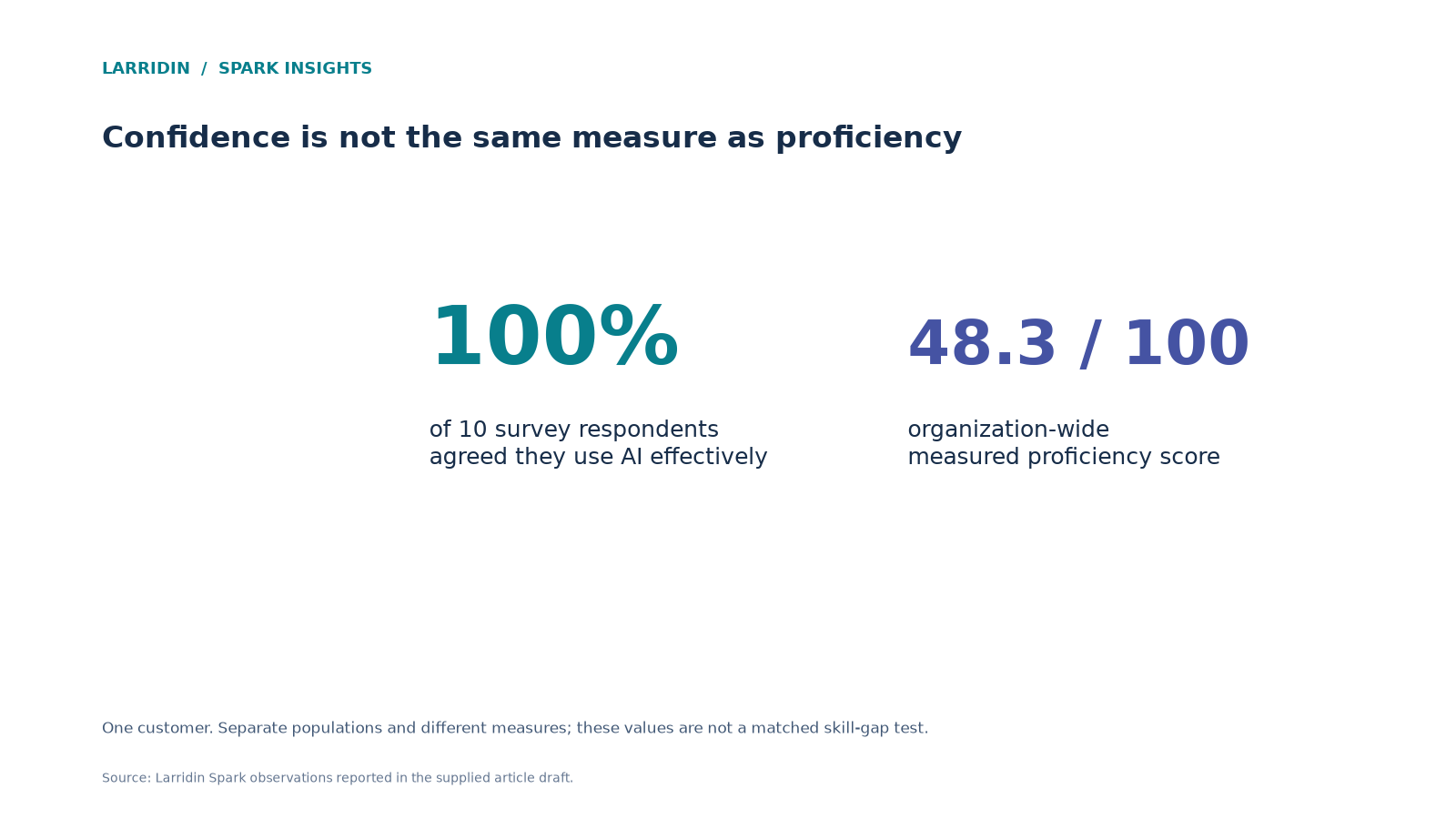
Survey confidence and organization-wide proficiency have different denominators and are not matched measures of the same people. The chart presents them separately; it does not quantify a skill gap.
Why Do AI Confidence Surveys Mislead?
Because confidence and proficiency measure different things, and small survey samples can produce misleading conclusions.
Self-reported confidence captures how people perceive their AI skills. In one Larridin customer, all 10 survey respondents agreed they knew how to use AI effectively. The organization's measured AI Proficiency Score, however, was 48.3 out of 100.
These results aren't a direct comparison of the same employees. They show why leaders shouldn't treat a small confidence survey as a complete measure of workforce proficiency.
Myth: If employees say they use AI effectively, they do.
Reality: In one org, 100% agreement sat next to measured proficiency of 48.3 out of 100.
How Does Sample Size Distort AI Survey Scores?
With few responses, a single person can dramatically affect the score.
In one org, an AI Productivity Score of 70.5 came from just 7 responses, and two tools scored a perfect 100 based on one response each. Numbers like that look precise in a dashboard, but they describe a handful of opinions, not a workforce.
Spark callout: Two AI tools earned a perfect 100 score in one organization’s survey. Each was rated by exactly one person.
What Should You Measure Instead?
Behavioral data for skill and impact, with surveys for sentiment and context.
Behavioral data shows how people use AI tools, including the features they use and the range of tasks they apply AI to. Surveys provide context about confidence, barriers, and training needs. Together, they give leaders a more useful picture of AI proficiency than either measure alone.
How To Measure This in Your Own Org
- Disclose sample size with every survey score. Make response count and rate visible.
- Set a minimum response threshold. Don’t report scores below it.
- Measure proficiency from usage. Use behavioral data for skill.
- Compare survey and behavior. Larridin's AI Fluency capability helps teams assess AI use and proficiency across the organization.
Frequently Asked Questions
How many survey responses are enough?
Set a threshold based on the population, intended comparison, and uncertainty you can tolerate. Report response count, response rate, and possible nonresponse bias. Small samples should be labeled directional.
What is behavioral AI data?
It’s data on how people actually use AI tools, such as which features they use, what tasks they apply AI to, and how often, rather than how they describe their own use.
Are self-assessments useless?
No. They’re valuable for understanding confidence, barriers, and training needs. They just shouldn’t be used as a measure of skill on their own.
Spark a Discussion Grounded in How Your Teams Actually Use AI
See measured AI proficiency next to what your surveys say, and bring both to your next people leadership meeting.