

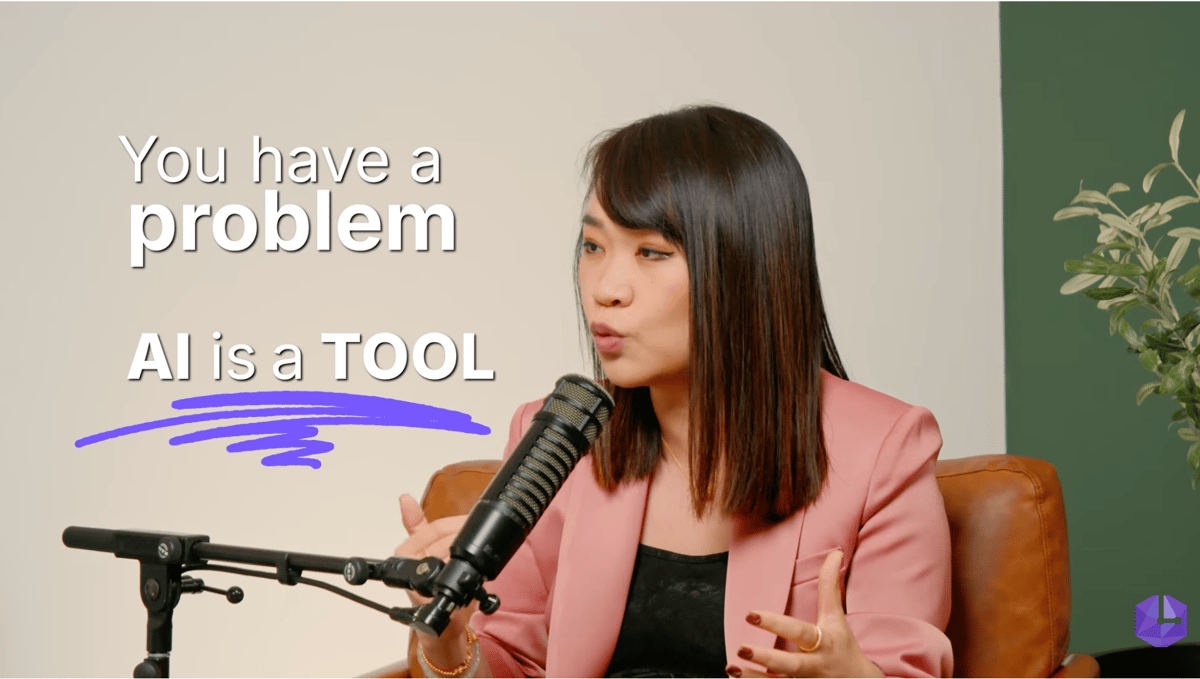

This blog post captures high points from a recent podcast episode on the Larridin AI Impact podcast. Click through to view the full episode.
Dan Zhang has been CFO of ClickUp for five years. In a recent conversation with Larridin CEO Russ Fradin, she offered a grounded, and sometimes hilarious, take on how AI is reshaping the way that companies operate, hire, and spend.
The $100 Sandbox
Zhang sorts AI vendors using a matrix built on two axes:
-
How autonomous the tool is
-
How clearly you can attribute value to it
The "holy grail" quadrant is high autonomy and high attribution, such as a customer support agent that works independently and either closes tickets or doesn't; this is easy to measure.
But the most entertaining quadrant is the bottom left corner: questionable tool autonomy, questionable value attribution.
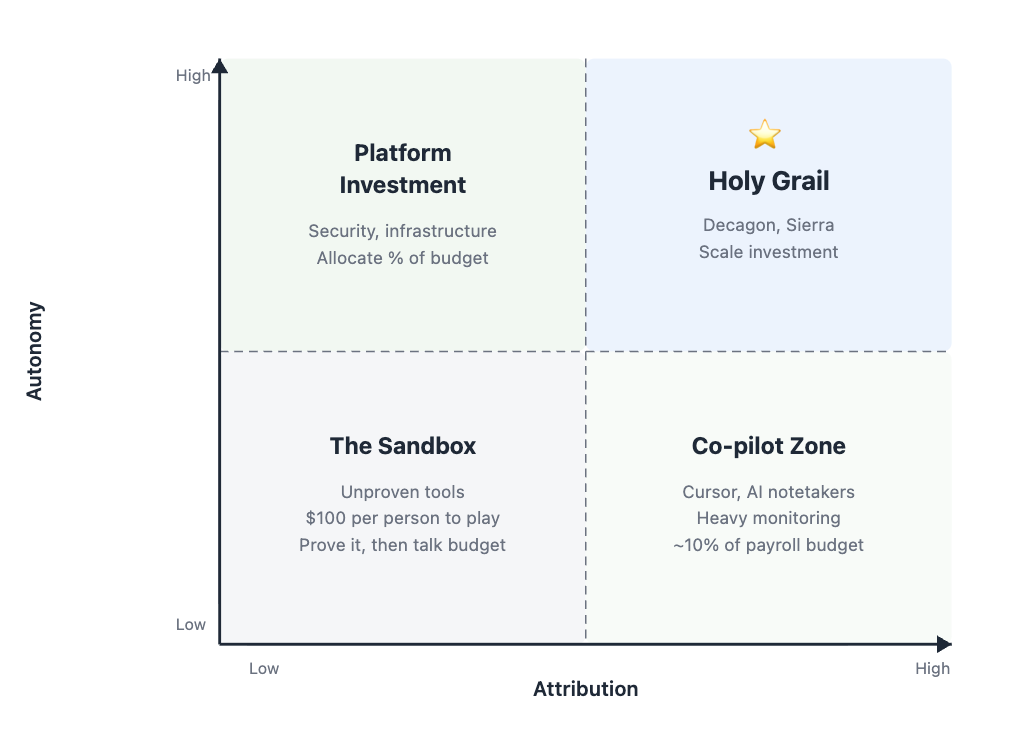
Zhang's prescription? Give teams $100 to play with an AI tool. "It's not going to break the bank," she said.
The company sets aside roughly $100K total for this kind of sandbox experimentation. If something graduates from the sandbox into one of the other three quadrants—high tool autonomy, high value attribution, or both—then they can have a real budget conversation.
Boiling the Ocean Is Back on the Menu
For years, finance teams lived by the mantra "don't boil the ocean." ClickUp is a product-led growth company, meaning they deal with a long tail of small invoices, which no human would ever chase down individually.
Zhang's counterintuitive update: "Now with AI, guess what? You can boil the ocean." AI handles the bottom tranche of investigation and follow-up that was never cost-effective for humans. The phrase that was once a warning is now an invitation.
Corporate Math Is Getting Rewritten
Zhang points out that longstanding ratios in business are quickly breaking down. Enterprise account executives at ClickUp traditionally carried a bit over $1M a year in quota. But with AI handling admin work, and AI SDRs accelerating pipeline, some reps in Zhang's CFO circles are now closing a million dollars per quarter, not per year.
The same ripple effect hits sales engineers, CSMs, and back-office teams; every accepted ratio is up for revision.
Zhang and Fradin both emphasize the growth case: if your people can do four times as much, the winning move is to invest more, not less. "Growing the upside," Zhang noted, "is so much more fun than cutting costs."
And in Closing...
Zhang's advice for young people entering the workforce was perhaps the most counterintuitive point of all: study communication and writing.
In a world where AI can generate anything, the bottleneck is the human ability to articulate precisely what they want. As Zhang put it, watching her own child use AI: "Whenever he struggles to describe what the end state looks like, the AI is bad. But whenever he knows clearly and has a vision, the AI gives wings."