

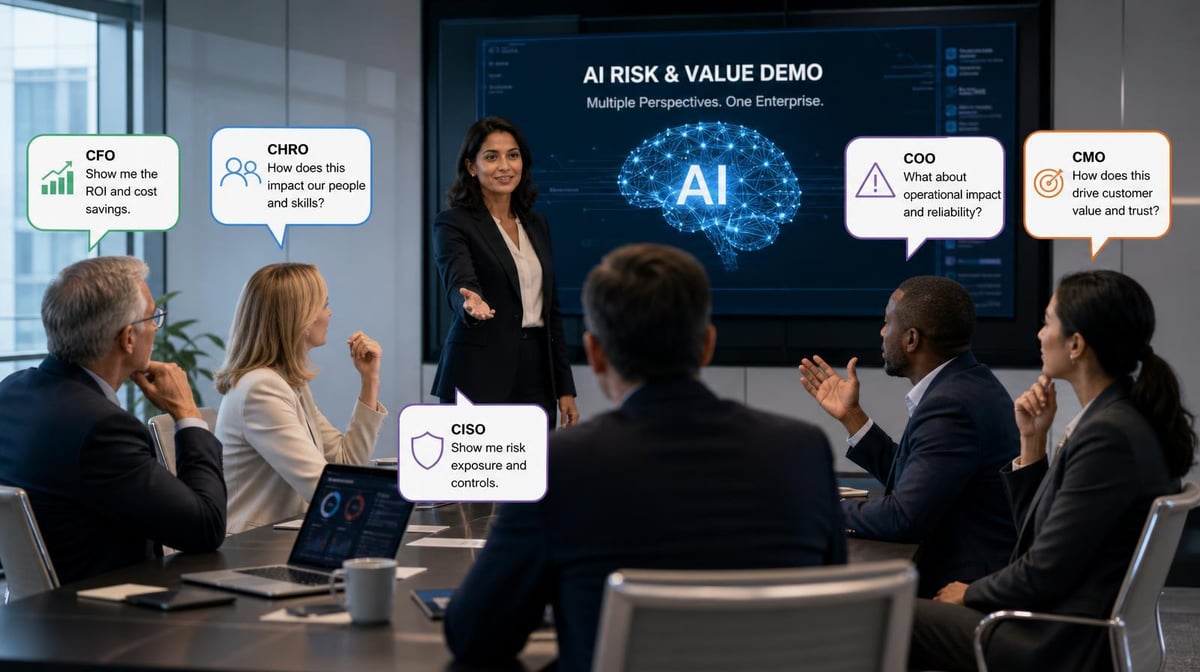

The CISO assembled the C-suite, told them “this will be instructive,” and handed over the floor. What followed was each stakeholder articulating a different AI measurement need without prompting.
Key Takeaways
- In a recent Larridin demo, the CHRO wanted AI Fluency for workforce competency. The CTO wanted Developer Intelligence correlated to merge requests and story points. The CPO wanted Workflow Intelligence and API access. The Principal Engineer asked about MCP. The CISO wanted governance insights.
- The CISO has a natural reason to convene this conversation because AI governance issues — including shadow AI, data exposure, access, and compliance — can cut across multiple functions at once.
- CIO.com reported in April 2026 that 79% of operations leaders lacked a fully developed AI strategy. When AI buying happens in silos, the result can be a fragmented environment that becomes harder to measure and govern.
Why the CISO Is a Natural Convener for This Conversation
Different executives see different parts of enterprise AI. The CHRO is focused on workforce competency, the CTO is focused on engineering systems and outcomes, the CFO looks at the budget, and the CPO sees product workflows. The CISO is responsible for security and governance issues that can cross all of those functions. That makes the CISO well positioned to bring the stakeholders together, even when each person enters the conversation with a different question.
That’s what happened in the Larridin demo. The CISO convened the group and stepped back. Each stakeholder independently identified a different use for the same measurement foundation.
The different buying reasons weren’t a problem to solve. They were evidence that enterprise AI measurement has become a cross-functional need.
What Each Stakeholder Was Actually Looking For
CHRO: AI Fluency for Competency Assessment and Training
The CHRO’s question was about workforce development: who is using AI effectively, and where should training investment go?
Larridin’s AI Fluency capability gives workforce leaders visibility into proficiency patterns across roles, teams, and functions. That helps the CHRO move beyond AI adoption or training completion and identify where additional development may be needed.
CTO: Developer Intelligence Connected to Delivery Outcomes
The CTO wanted to connect AI investment to engineering results.
In the demo, the specific requests included correlating spend to merge requests and story points, understanding adoption across the engineering organization, and identifying where mentorship could help engineers get more value from AI.
Larridin’s Developer Productivity platform brings AI usage, spend, and engineering delivery signals into the same view.
CPO: Workflow Intelligence and API Access
The CPO wanted measurement data that could connect with the organization’s broader AI stack rather than exist only in a standalone dashboard.
That’s where Workflow Intelligence and API access become relevant. The measurement layer can support product and workflow decisions alongside the rest of the organization’s AI infrastructure.
Principal Engineer: MCP Integration
The Principal Engineer independently asked about MCP integration.
That’s a more technical version of the same integration question: can measurement data become an input to the systems engineering teams already use, rather than something people have to check manually?
CISO: Governance Across the AI Footprint
The CISO’s use case was AI governance visibility.
For security leaders, that starts with understanding which AI tools are being used across the organization, including sanctioned and unsanctioned use, and connecting that inventory to usage and governance data.
Larridin’s AI Adoption capability gives CISOs a broader view of enterprise AI usage so they can identify gaps that would be difficult to see from individual functional systems alone.
What This Says About the Measurement Platform
A CHRO, CTO, CPO, Principal Engineer, and CISO don’t need the same dashboard or even care about the same metrics.
They do need the underlying measurement data to connect.
That is the important part of the demo. Each stakeholder has a different question, but they can all be answered from the same measurement foundation rather than requiring every function to create its own isolated view of enterprise AI.
For the CISO trying to build cross-functional support, that changes the conversation. The case doesn’t have to depend entirely on security or governance. Each stakeholder can evaluate the platform against the outcome their own function is accountable for.
Frequently Asked Questions
Why might the CISO convene an enterprise AI measurement conversation?
AI governance concerns often cross organizational boundaries. Shadow AI, data exposure, access, and compliance issues can involve multiple functions at the same time.
That gives the CISO a strong reason to bring the relevant leaders together, even when ownership of AI strategy or measurement is shared with the CIO, CTO, CHRO, or other executives.
How does the CISO build a business case when each executive has a different buying reason?
Start with the shared measurement foundation rather than asking every stakeholder to adopt the CISO’s governance case.
In the Larridin demo, each stakeholder independently identified a different need. That gives the CISO a way to frame the platform around multiple functional outcomes while maintaining one enterprise view.
What does AI governance visibility look like in practice?
It starts with an inventory of the AI tools being used across the enterprise, including sanctioned and unsanctioned use, along with enough usage and attribution data to understand where those tools are operating.
That visibility gives security and governance leaders a stronger foundation for identifying gaps, documenting AI use, and coordinating with the teams responsible for those systems.
Does the CISO always need to lead AI measurement?
No. Ownership will vary by organization.
The lesson from this demo is that the CISO can be an effective convener when governance concerns span multiple functions and each stakeholder needs a different view of the same underlying AI activity.
Give Every C-Suite Stakeholder the View Their Function Needs
Larridin brings multiple enterprise AI measurement needs together on the same data foundation, giving different stakeholders visibility into the outcomes their functions are responsible for.
Book a discovery call to see how Larridin supports AI measurement across the C-suite.