

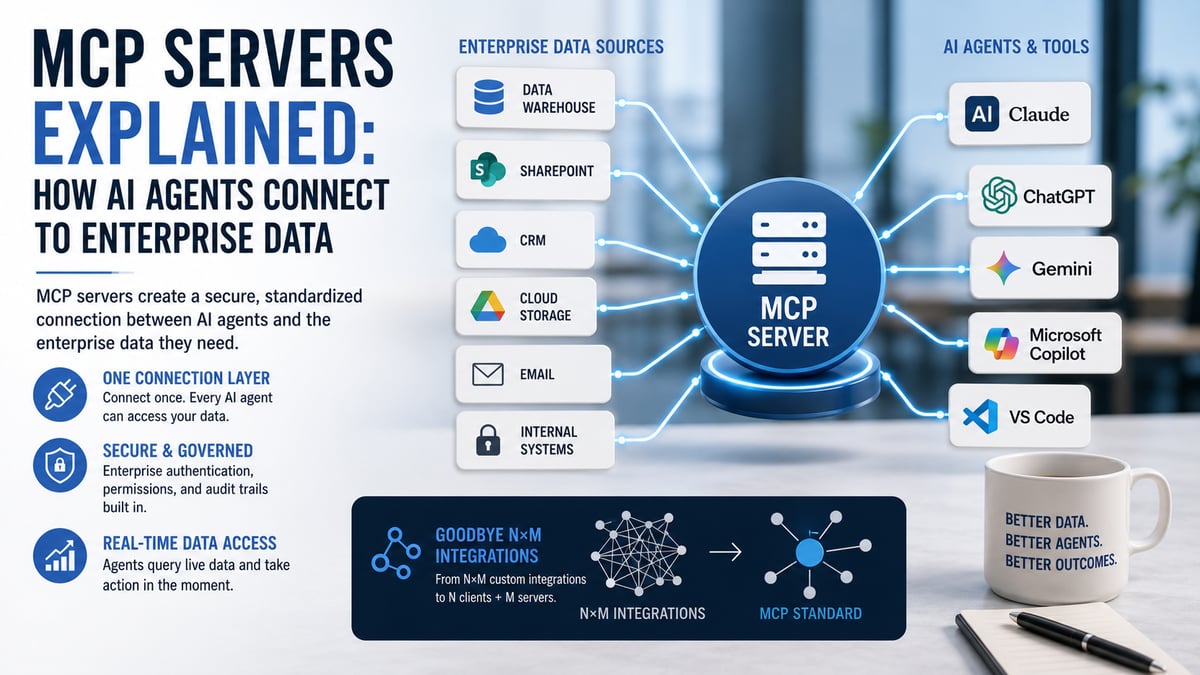

Your AI tools are only as useful as the data they can reach. MCP servers are the infrastructure layer that connects AI agents to live enterprise data. They don’t require custom integration work for every system, switching platforms, or logging in to pull a report.
Key Takeaways
- MCP servers give enterprises a shared connection layer for AI agents, so teams don’t have to build one-off integrations between every AI tool and every business system.
- Gartner predicts up to 40% of enterprise applications will include integrated task-specific AI agents by 2026. MCP is becoming a standard way for agents to access the data they need.
- Larridin’s MCP server supports queries for AI measurement data directly from Claude, ChatGPT, or Copilot, without opening a separate dashboard.
Key Terms
- Model Context Protocol (MCP): An open standard released by Anthropic in November 2024 that defines how AI agents connect to external tools and data. MCP is now supported across major AI clients, including Claude, ChatGPT, Gemini, Microsoft Copilot, Visual Studio Code, and others.
- MCP server: A lightweight process that makes data, tools, or actions to any MCP-compatible AI agent. Build one server per system and every connected AI can use it.
- MCP client: The component inside an AI application that speaks the MCP protocol and manages server connections on behalf of the model.
- N×M integration problem: The old challenge of maintaining separate custom integrations for every AI model and every business system combination. MCP collapses N×M into N clients plus M servers.
- Agentic AI: AI that takes sequences of actions autonomously, calling tools, retrieving data, and making decisions over time rather than responding to a single prompt.
Quick Navigation
- The Problem MCP Solves
- How Does an MCP Server Work in Practice?
- Why This Matters for Enterprise AI Strategy
- How Larridin Uses MCP
- Frequently Asked Questions
The Problem MCP Solves
Before MCP, connecting an AI model to a business system required creating custom integration code for each combination. 4 AI applications x 8 business systems = 32 separate integration surfaces to build and maintain. Every model change could mean new integration work.
MCP collapses that into a hub-and-spoke model: one MCP server per system, one MCP client per AI application, and every combination can work through the same protocol. The common analogy is USB-C for AI: one universal adapter instead of a different connector for every device. Anthropic launched MCP in November 2024 with prebuilt servers for GitHub, Slack, Google Drive, Git, Postgres, and Puppeteer. By late 2025, Anthropic reported more than 10,000 active public MCP servers and 97M+ monthly SDK downloads across Python and TypeScript.
How Does an MCP Server Work in Practice?
An MCP server makes three types of capabilities available to an agent: tools it can call to take actions, resources it can read to get data, and prompts that provide reusable templates. The AI model reads the server’s descriptions at runtime and decides what to use based on what the user asks. No more hardcoded logic or manual report pulling.
Practical example: a CIO asks their AI assistant how much the marketing team spent on AI tokens last month. The agent connects to the relevant MCP server, retrieves the data, and responds inside the AI tool where the question was asked. No dashboard switching required.
Why This Matters for Enterprise AI Strategy
As task-specific agents move into enterprise applications, the integration question gets more strategic. It’s not enough for a vendor to have an API. Enterprise buyers need to know whether agents can access the right data through the right controls inside the tools employees already use.
Vendors are already moving in this direction. Atlassian’s Remote MCP Server brings Jira and Confluence data into external AI tools, Salesforce MCP solutions connect AI applications to Salesforce, Heroku, and MuleSoft. Microsoft has added MCP support in Copilot Studio and Microsoft 365 Copilot declarative agents.
For enterprise leaders, three things shift.
- Vendor evaluation changes. The question shifts from whether a vendor works with your current AI tools to whether it supports MCP. Without that layer, every model switch can mean new custom integration work.
- Data access becomes frictionless for agents. Agents query live enterprise data at the moment it’s needed rather than working from static exports, so insight quality scales with data freshness.
- Governance becomes required infrastructure. Every MCP tool call is a data access event. The MCP roadmap prioritizes audit trails and observability, enterprise-managed authentication, and governance patterns that enterprises can feed into existing logging and compliance systems.
In our work with clients, the organizations moving fastest on MCP treat it as infrastructure, not a feature. They build the server layer once and make it available to every AI tool in their environment rather than rebuilding integrations for each new model they evaluate.
How Larridin Uses MCP
Larridin’s MCP server gives any MCP-compatible AI agent direct access to your organization’s AI measurement and optimization data: utilization by team, token spend by workflow, proficiency signals, and business value attribution. A leader using Claude, ChatGPT, or Copilot can ask a natural language question and get a live answer without opening larridin.com, running a report, or asking someone else to pull the data.
The Larridin MCP server is read-only for reporting queries, with access controls scoped to authorized users and data types.
Book a Discovery Call to see how the Larridin MCP server connects to your AI environment.
Frequently Asked Questions
What is an MCP server?
An MCP server is a lightweight process that exposes data, tools, or actions to AI agents using the Model Context Protocol. It describes its capabilities in a way the AI model can read at runtime, so the agent can discover and use those capabilities without hardcoded integration logic. One MCP server built for a business system works with every MCP-compatible AI model.
What is the Model Context Protocol?
The Model Context Protocol is an open standard released by Anthropic in November 2024. It defines how AI agents discover, connect to, and interact with external tools and data sources. It has since been adopted across major AI products, including Claude, ChatGPT, Gemini, Microsoft Copilot, Visual Studio Code, and others, making it a shared foundation for AI-to-system integration.
Do I need to log in to a platform to use an MCP server?
No. Once an MCP server is connected to your AI client, you access the data it makes available through natural language inside the tool you already use. You don’t need to switch platforms, open a dashboard, or run a manual report. The agent retrieves the data and brings it directly into your conversation.
How is MCP different from a regular API?
A regular API requires hardcoded logic: a developer specifies which endpoint to call and what parameters to pass. AI agents are non-deterministic: they read server descriptions and decide what to use based on a natural language request. MCP adds a discovery layer and session handling that standard API calls don’t provide. APIs are for programs; MCP is for AI agents.
Related Resources
- Larridin Workflow Intelligence
- Larridin AI Measurement Framework
- State of Enterprise AI 2026 Report
- Larridin AI Impact
Want to query your AI measurement data directly from the tools your team already uses?
Book a Discovery Call to see how the Larridin MCP server connects to your environment.