

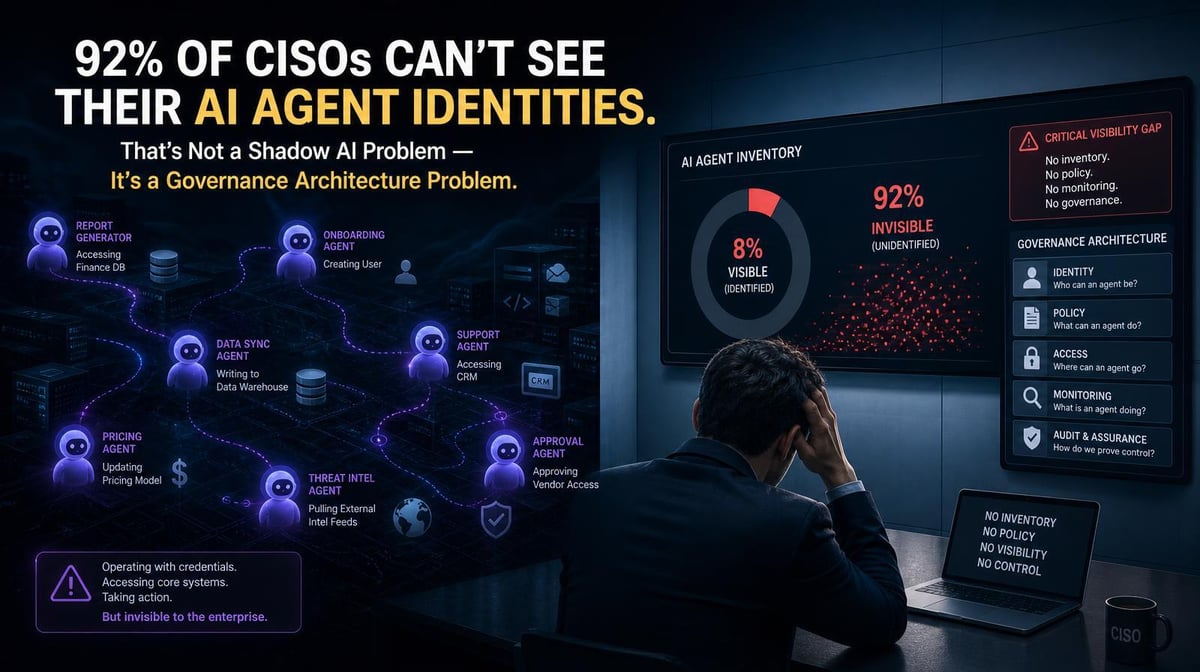

Shadow AI is a tool problem: employees using AI tools that IT hasn’t approved. The AI agent identity gap is an architecture problem: agents operating with credentials, accessing core business systems, and taking actions while the organization has no inventory, policy, or monitoring for them.
Key Takeaways
- The 2026 CISO AI Risk Report found 92% of large-enterprise security leaders surveyed lack full visibility into AI agent identities operating in their environments. 86% don’t enforce access policies for AI identities. 71% report AI systems have access to core business platforms, including ERP, CRM, and financial systems, while only 16% govern that access effectively.
- Cloud Security Alliance research found that non-human identities — including AI agents, service accounts, API keys, and OAuth tokens — outnumber human identities by an average of 45 to 1, with ratios reaching 144 to 1 in cloud-native environments. Identity management infrastructure built for human accounts was not designed for this scale.
- CISA and five partner agencies issued joint guidance on agentic AI adoption in May 2026. Separate CSA research found 82% of organizations had discovered previously unknown AI agents, and 65% reported an AI agent-related incident in the previous 12 months.
Why AI Agent Identities Are Different From Shadow AI
Shadow AI is a people and process problem: employees use tools that aren’t approved because the approval process is slow, the approved alternatives are inadequate, or the policy isn’t enforced. AI governance typically starts with discovery, policy, and enforcement: find the tools, set the rules, and enforce them.
AI agent identities create an additional problem. Agents are automated systems with credentials, access permissions, and the ability to take actions at machine speed across the systems they can access.
An agent that inherits excessive permissions from the user that deployed it or continues operating after the use case it was created for has ended can leave credentials and access in place indefinitely. CSA research found that 51% of organizations report no clear ownership of AI identities.
The Governance Architecture CISOs Need
Only 16% of organizations effectively govern AI system access to core business platforms, according to the 2026 CISO AI Risk Report.
Agent governance starts with several practical controls:
- An agent inventory shows which agents are operating in the environment and who is accountable for them.
- Scoped access policies limit permissions to what each agent needs for its approved function.
- Continuous monitoring helps security teams detect changes in identity, privilege, and behavior.
- Decommissioning processes revoke credentials when an agent’s use case ends rather than leaving them active indefinitely.
That approach aligns with the May 2026 joint guidance from CISA, NSA, and international cybersecurity partners, which recommends strong identity management, limited privileges, continuous monitoring, and maintaining a trusted registry for agentic AI systems.
The starting point is discovery. You can’t set policies for agents you haven’t inventoried or revoke credentials for agents you don’t know exist. And that remains a widespread gap. Only 21% of organizations maintain a real-time registry or inventory of their agents, according to CSA.
Larridin’s AI Adoption capability surfaces AI tools and agents operating across the enterprise, including sanctioned and unsanctioned use. That gives CISOs an inventory and usage context they can use as the starting point for broader identity and access governance.
Frequently Asked Questions
What is an AI agent identity?
An AI agent identity is the credential or set of credentials an autonomous AI system uses to authenticate itself to other systems and take actions. It can include API keys, OAuth tokens, service account credentials, or other access mechanisms.
Unlike human identities, AI agent identities may lack a clear owner and may not go through the same provisioning, review, and decommissioning processes as employee accounts.
What does governing AI system access to core business platforms actually require?
It starts with an inventory of which agents exist and what they can access, followed by scoped permissions, continuous monitoring, and a process for revoking credentials when an agent is no longer needed.
Larridin addresses the discovery prerequisite by helping organizations identify AI tools and agents in use. Identity and access management systems remain responsible for provisioning, enforcing, and revoking credentials and permissions.
How is the AI agent identity problem different from the service account problem that CISOs already manage?
The governance principles are similar, but AI agents can be more dynamic. They can interact with multiple systems, interpret instructions, and take a series of actions during a single task.
That makes clear ownership, tightly scoped permissions, monitoring, and lifecycle management especially important as agent deployments scale.
What regulatory requirements apply to AI agent identity governance?
There’s no single regulation that creates a universal AI agent identity standard. Security guidance is becoming more specific, however.
In May 2026, CISA and its partners recommended strong identity management, limited privileges, continuous monitoring, and clear oversight for agentic AI systems. Organizations should also assess the privacy, cybersecurity, and AI regulations that apply to their specific systems and use cases.
Build the Agent Discovery Layer That Makes Governance Possible
Larridin helps CISOs discover sanctioned and unsanctioned AI tools and agents across the enterprise, providing the inventory and usage context needed to begin governing AI agent identities.
Book a discovery call to see your enterprise AI inventory.