

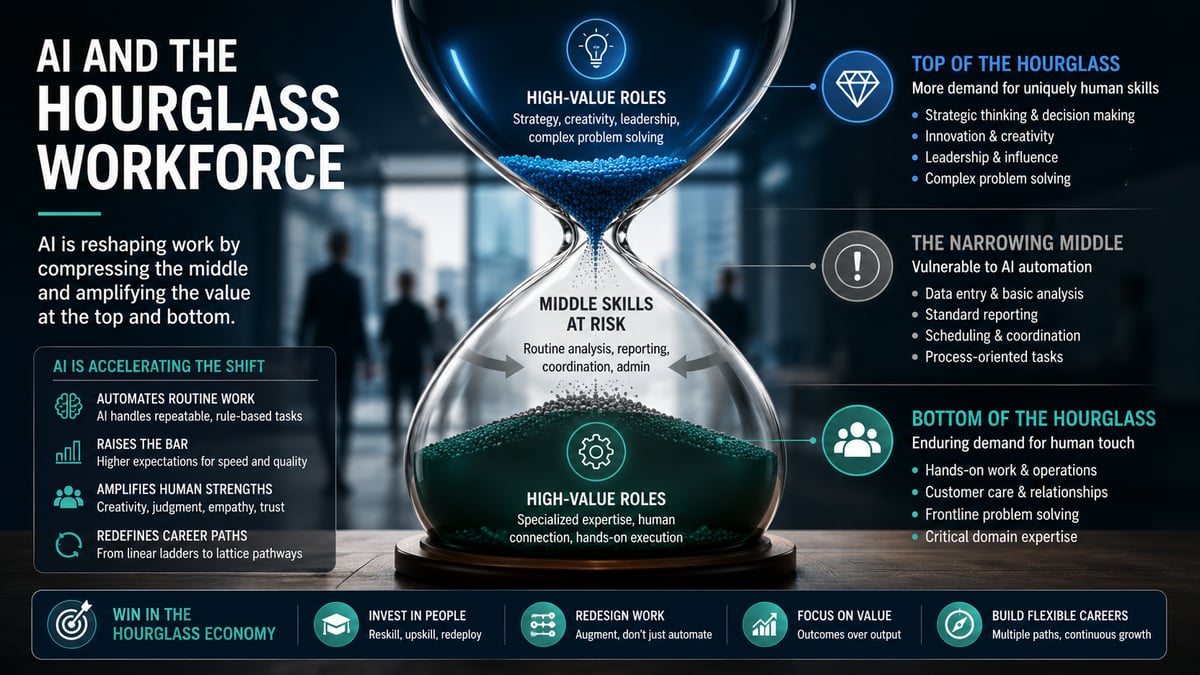

The middle tier of the knowledge workforce is the layer between frontline execution and senior leadership. It’s the part of the org chart most exposed to AI. PwC is calling the result an hourglass, and most organizations still aren’t measuring it.
Key Takeaways
- PwC’s 2026 AI Business Predictions describes an emerging hourglass workforce, with more talent concentrated at junior and senior levels and a smaller mid-tier as agents take on midlevel work.
- BCG’s April 2026 analysis found 43% of U.S. jobs exceed a 40% automation threshold, where role and organization redesign becomes a stronger business case than tool deployment.
- WEF projects 170 million new roles and 92 million displaced jobs by 2030, which makes workforce redesign and upskilling a planning issue now, not later.
What the Hourglass Model Actually Means
PwC’s hourglass framing describes what can happen when AI agents take on work that midlevel knowledge workers have traditionally owned: coordination, analysis, summarization, reporting, routing, and the many decisions that sit between senior strategy and frontline execution. As that layer becomes more automated, organizations face a structural question a tool deployment plan can’t answer: what do midlevel employees do now, and how does the company create a path from junior to senior roles when the midlevel training ground changes?
BCG’s analysis puts numbers on the scale of this transition. It found that 43% of U.S. jobs exceed the 40% automation threshold where role and organizational redesign becomes a stronger business case. That doesn’t mean those jobs disappear. It means the work inside them changes enough that the org chart, career path, and skills strategy need to change with it.
That connects workforce structure directly to the AI skills gap: leaders need to know which people, roles, and tasks are changing, not just which tools are available.
3 Structural Shifts Already Happening
1. Midlevel Coordination Work Moving to Agents
Scheduling, routing, status reporting, cross-functional coordination, and data summarization are all categories of midlevel work where autonomous agents are already being deployed. Gartner’s projection that 40% of enterprise applications will include task-specific agents by the end of 2026 reflects the same shift. The governance infrastructure required to manage those agents is covered in our post on AI agent governance in the enterprise.
2. Performance Gaps Widening Between AI-Fluent and Non-Fluent Employees
As midlevel work becomes agentic, the performance premium grows for employees who can direct and orchestrate AI effectively. They take on higher-complexity work while agents handle the routine layer. Employees who don’t develop AI proficiency may find fewer career development opportunities as the work that used to build those skills shifts to agents.
3. Career Path Compression
When the midlevel work that traditionally trained junior employees for senior roles is handled by agents, the organization needs new mechanisms for developing that capability. This is what makes the hourglass model disruptive rather than merely structurally interesting: the pipeline that produces senior talent depends on midlevel experience, and that experience is changing.
What Measuring This Actually Requires
Organizations that are ahead of the hourglass transition are measuring two things most still track only at the surface level.
1. Task Distribution by Role
Which tasks in each role are being done by AI, which are still being done by humans, and how is that ratio changing quarter over quarter? Our Workflow Intelligence platform captures this at the workflow level continuously, so leaders can see where roles are actually changing instead of relying on assumptions from job descriptions.
2. Proficiency Distribution by Level
Are junior employees developing AI fluency fast enough to reach senior-level capability as the midlevel training path compresses? AI Fluency measurement gives leaders that data at the individual, team, and function level, making it possible to see where capability investment needs to accelerate.
The Redesign Condition Most Organizations Are Ignoring
WEF’s 170 million new roles projection can make AI sound like a simple job-creation story. It isn’t. The same report projects 92 million displaced jobs and says nearly 40% of skills required on the job will change by 2030. That’s a workforce redesign problem, not a hiring forecast.
PwC and BCG point to the same practical requirement: companies need to redesign work, career paths, and capability building as agents spread. Layering AI onto old structures may create productivity bumps, but it won’t show leaders whether the midlevel path is still developing future senior talent.
Frequently Asked Questions
What’s the hourglass workforce, and what causes it?
The hourglass workforce is a structural shift in which human talent becomes more concentrated at junior execution and senior strategy levels while the middle tier shrinks. PwC ties it to agents taking on more midlevel coordination, analysis, and reporting work. Midlevel employees do not disappear overnight; the work that develops them starts to move.
How do we know if AI is already changing our workforce structure?
Track task distribution at the role level: which tasks are shifting to AI, which remain human, and how that ratio changes over time. Organizations that can’t answer this at the team level don’t yet have the measurement infrastructure to see the structural shift as it happens.
What should CHROs do to prepare for the hourglass transition?
Build AI fluency measurement into workforce planning. Identify which roles are most exposed to task automation. Create accelerated development paths for junior employees who need to build senior-level capability as the midlevel training ground changes. Our CHRO guide to AI monitoring covers this strategic planning dimension in more detail.
Will AI eliminate middle management?
Not directly and not immediately. But it’s automating a significant portion of the work middle management has traditionally owned. The question is whether organizations redesign those roles proactively, creating new forms of human value at the midlevel, or react after the structural shift is already visible in performance and retention data.
See Where AI Is Already Reshaping Your Workforce
Larridin’s AI Fluency and Workflow Intelligence capabilities identify where AI is already changing task distribution, which roles are most affected, and where capability investment creates the most strategic leverage.
Book a discovery call to see your workforce structure data.