

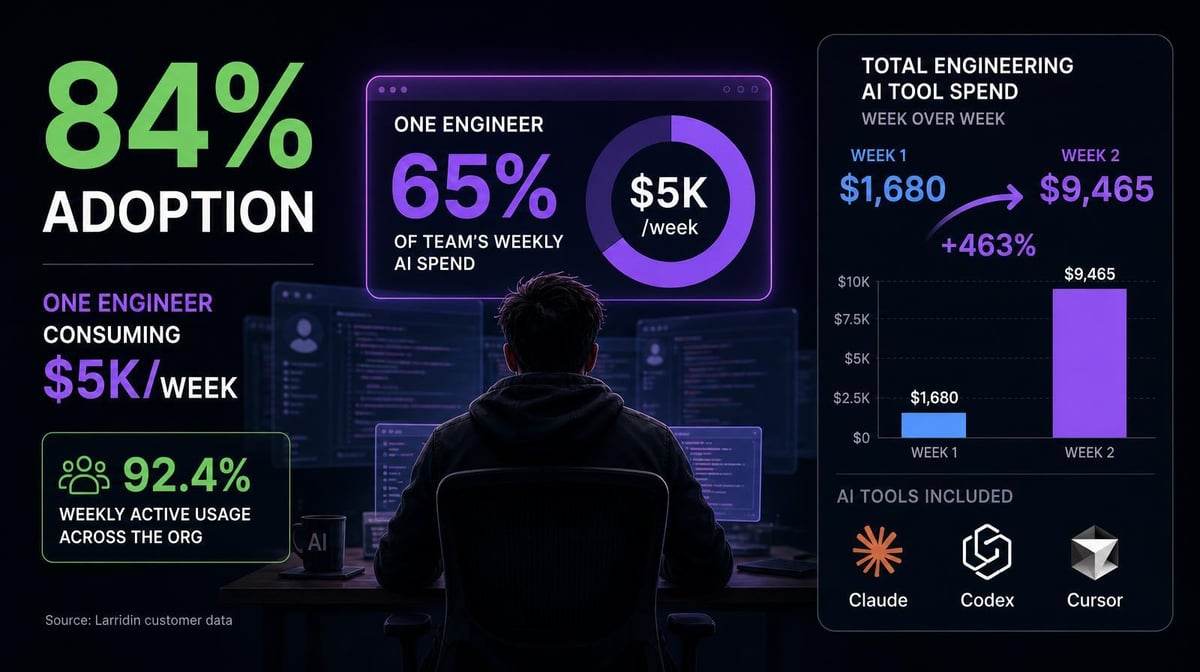

In one Larridin customer environment, broad AI adoption masked a highly concentrated spending pattern. That’s a reason to investigate. It’s not proof that anyone is wasting money. The important question is what the spending produced.
Key Takeaways
- High per-engineer AI spend can reflect productive work, experimentation, or inefficient usage. Spend concentration alone can’t tell leaders which one they’re seeing.
- Compare high spend with delivery, quality, rework, and the purpose of the work before setting limits or reducing access.
- Look at the pattern over time. One expensive week may reflect a temporary project or experiment; repeated high spend without proportionate value calls for a different response.
Spend Concentration Is a Signal, Not a Verdict
Larridin’s customer data shows why adoption and cost need to be measured separately.
Across 12 weeks, the engineering organization spent $79.8K on Claude, Codex, and Cursor. In one week, one engineer generated roughly 65% of the total. The following week, that engineer’s spend fell by half while another engineer’s spending rose more than 6x.
The 92.4% weekly active usage rate couldn’t show any of that.
A leader looking only at adoption would see broad participation. A leader looking only at the total invoice would see the cost. Neither number explains who drove the spending or whether it was worthwhile. That requires attribution plus outcome data.
3 Questions to Ask About a High-Spending Engineer
1. What Did the Spending Produce?
Start with the output that resulted from the spending. Did the engineer ship useful work? Did delivery improve? Did the code hold up after it was merged? Or did the additional AI activity lead to extensive rewriting, high code turnover, or other downstream work?
High spending alongside strong, durable output can be a productive pattern. High spending with little usable output is a different signal.
The point is to determine whether the organization is getting enough value from it.
2. Why Was the Spending High?
The same dollar amount can come from very different work. An engineer may be testing a new agentic workflow, working through a complex project, using a more expensive model, or simply using AI more intensively than teammates.
Some of that spending may be intentional experimentation. If so, leaders should know the objective, owner, budget, and time frame before deciding whether the cost was justified.
Unexpected high spending deserves investigation, but the amount alone doesn’t explain the cause.
3. Is the Pattern Temporary or Recurring?
One week of concentrated spending doesn’t establish a trend. Look at the engineer’s usage and cost over time. A temporary spike tied to a defined project requires a different response from repeated high spending that consistently produces weak results.
That trend also helps leaders avoid setting a permanent policy in response to a temporary event.
Pair Spend With Delivery and Quality
Per-engineer attribution is much more useful when it’s connected with what the engineer produced.
A useful review can include:
- AI spend and usage
- Delivery or throughput
- Code durability and turnover
- Review and rework
- Incidents or quality problems
- The project or use case behind the activity
Larridin’s Token Spend & Insights consolidates AI spending and attributes costs across teams, agents, projects, workflows, vendors, models, and use cases. The AI Dev Productivity platform adds delivery and quality signals that help leaders evaluate whether concentrated engineering spend is producing durable results.
The goal is to give the manager enough context to decide what the high spend means.
Don’t Turn a Concentration Number Into an Automatic Cap
A uniform spending cap is simple to administer. It can also treat productive and unproductive usage the same way.
If an engineer is using significantly more AI while producing proportionately valuable work, restricting access may reduce useful output. If the same spending repeatedly produces rework or little usable output, intervention makes more sense.
A review trigger gives leaders room to make that distinction.
For example, unusually high spending can trigger a review of the engineer’s usage, project, delivery results, and quality measures before a limit changes.
That keeps the decision focused on the value of the work rather than the size of the bill alone.
Frequently Asked Questions
Should we be concerned if one engineer generates most of our AI spend?
Not based on the percentage alone. High spending can reflect productive work, experimentation, inefficient use, or an activity that needs closer review. Compare the spending with what the engineer produced and why the cost was incurred.
What should we compare with per-engineer AI spend?
Use measures that fit the work, such as delivery, code durability, rework, quality, and business outcomes. The goal is to determine whether higher spending is producing proportionately more value.
Should every engineer have the same AI spending limit?
Not necessarily. Engineers use AI for different tasks and at different levels of intensity. A uniform limit can be simple, but it may restrict productive high-use work or fail to address the reason spending is high.
How long should we measure before deciding whether high spending is a problem?
There isn’t a universal time frame. Look for enough history to distinguish a temporary project or experiment from a recurring pattern. The right window depends on the work and how quickly usage changes.
Does high AI usage mean someone is an AI power user?
Not by itself. High usage shows activity. A useful power-user definition should also consider whether that activity produces strong, durable outcomes.
See What High AI Spend Is Producing
Spend concentration tells leaders where to look. Delivery and quality data help explain what they find.
Larridin connects AI spending with the teams, projects, workflows, and engineering outcomes behind it so leaders can see whether high consumption is generating proportionate value.
Book a discovery call to see what’s driving your highest AI spending.