


Larridin
TL;DR
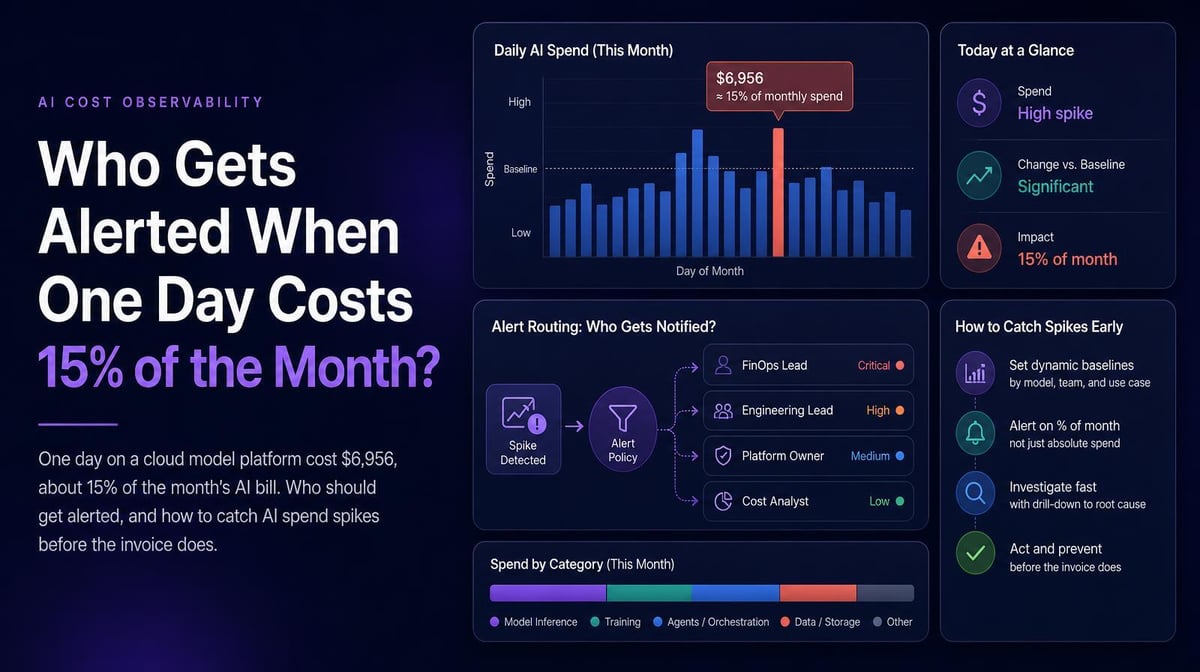
Short answer: Usage-based AI spend can spike in a single day, and monthly or per-seat views won’t show it until you get the invoice. Monitor AI cost daily by source, person, and model; assign an owner; and set an alert threshold for each. In one customer’s instance, a single day of cloud model usage cost about 15% of the month.
Key wins:
- Catch spikes in days, not at month-end.
- Know which source, model, and person drove each spike.
- Give every usage-based line an owner.
Who it’s for: CFOs, CIOs, and FinOps leads responsible for AI budgets.
What’s a Spark Insight? Sparks are short, data-backed findings Larridin surfaces from how AI is actually used across an organization. This post expands on one of them.
Quick Answers
If you’re asking… | The answer |
|---|---|
What is AI spend anomaly detection? | Monitoring AI cost daily or weekly and alerting when a source, model, or person moves outside its normal range. |
Why can’t monthly reporting catch it? | Usage-based spend swings hard within a month. A single day can be a large share of the bill and disappear into a monthly total. |
Where do the spikes come from? | Mostly cloud model platforms and APIs, not seat licenses. In one instance they were about 93% of 30-day AI spend. |
Who should own the alert? | Whoever owns the workload, with finance copied. Seat-license owners usually can’t see API spend at all. |
What We Hear From Leaders
- Our AI budget is the ChatGPT and Cursor renewals.
- Spend is down this month, so we’re fine.
Neither tells you what happened last Tuesday.
What you struggle with | What you need | How Larridin helps |
|---|---|---|
AI cost seen monthly, after the fact | Daily cost by source | AI Spend Intelligence shows spend by day, week and source |
No idea who drove a spike | Per-person and per-team attribution | Spend broken down to individuals and departments |
Model mix shifts unnoticed | Cost by model version | Model-level spend trends |
The Data: One Day, 15% of the Month
In one customer’s instance, AI Spend Intelligence showed $46.3K in AI spend over 30 days:
- GCP Vertex: $37.2K, or 80.4%.
- Cloud model platforms combined (Vertex, AWS Bedrock, Anthropic API): about 93%.
- ChatGPT and Cursor combined: about $1.7K, under 4%.
- One day on Vertex (Nov 9): $6,956, about 15% of the month.
The largest individual spender in the same window came to about $1.1K. The money ran through workloads, not people. Model mix moved too: spend on one model version rose 245% while another fell 53%.
Spikes also hit at the person level. In a different instance, one engineer’s weekly AI spend sat between $1 and $93 for nine weeks, jumped to $5.5K and then $6.3K, and fell back to $2 the following week. A monthly average would have flattened it.
Why Is AI Spend So Spiky?
Usage-based pricing ties cost to tokens, calls, and compute. A batch job, migration, agent left running, or new model rollout can multiply spend overnight. Flat-fee seat licenses don't fluctuate with usage, which is why seat-based budgets can miss these spikes.
The industry is catching up. The FinOps Foundation’s State of FinOps 2026 found 98% of practitioners now manage AI spend. Yet Harness’s State of AI in FinOps 2026 found that just 13% had basic visibility into their AI spend.
What Should an AI Spend Alert Cover?
Four dimensions, each with a normal range:
- Source. Each cloud platform, API, and tool as its own line.
- Day. Daily cost against a trailing average.
- Person and team. Spend by individual and department, including “unassigned.”
- Model. Cost by model version, since a default model change can shift spend quickly.
How to Set up AI Spend Anomaly Detection
- Connect every cost source, including cloud model platforms, not only SaaS tools.
- Set a baseline per source from the last 8–12 weeks.
- Define thresholds, for example any day above 2x the trailing daily average or any person above a weekly cap.
- Assign owners for each source and workload, and copy finance.
- Review spikes weekly: keep the ones that bought real output, fix the rest.
FAQ
What counts as an AI spend anomaly?
Any day, source, person, or model whose cost moves well outside its recent range. Start with 2x the trailing average and tune.
Do seat-based AI tools need anomaly detection?
Less so. Flat-fee seats don’t spike but billed spend and observed usage costs can still differ. Usage-based platforms and APIs are more prone to cost spikes.
Is every spike waste?
No. Some are high-value work. The point is to see them fast enough to decide.
Spark a discussion that moves your AI strategy forward. [Get your first Sparks]
Sources
- State of FinOps 2026 press release, FinOps Foundation / Linux Foundation
- State of AI in FinOps 2026, Harness