


AI transformation is the strategic process of building AI around what makes your organization irreplaceable. Tools, vendors, and consulting partners support that process; they do not substitute for its purpose. See the AI Transformation Guide for the broader framework.
TL;DR / Quick Definition
AI transformation is the multi-year process of making organizational intelligence, including tacit knowledge, domain expertise, decision patterns, and operational wisdom, the foundation of how AI creates value.
The Core-and-Orbit Model starts with that intelligence at the core, surrounds it with enduring execution disciplines, and keeps models, vendors, and implementation choices adaptive. Transformation changes capability and the way work performs; a license rollout alone does not establish it.
Why AI Transformation Matters
Adoption, pilot counts, and impressive demonstrations can grow without a defensible business result. The question is whether the organization is developing a capability suited to its knowledge, workflows, customers, and constraints.
Research discussed in the original transformation guide, including RAND's work on AI project failure, BCG's 2025 AI value-gap analysis, PwC's 2026 CEO Survey, and McKinsey's State of AI research, examines different populations and definitions. Use it as context for the gap between deployment and value, not a single combined failure rate or proof of one guaranteed route to success.
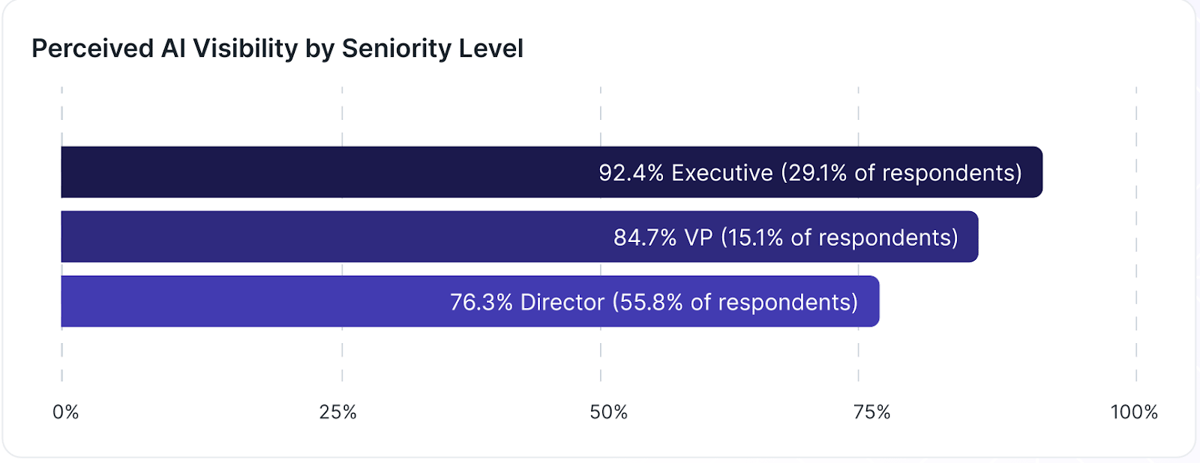
The Larridin State of Enterprise AI 2026 report also examines visibility and differences in confidence across management levels. Leaders need evidence from the work itself, not only a top-level view of tools purchased.
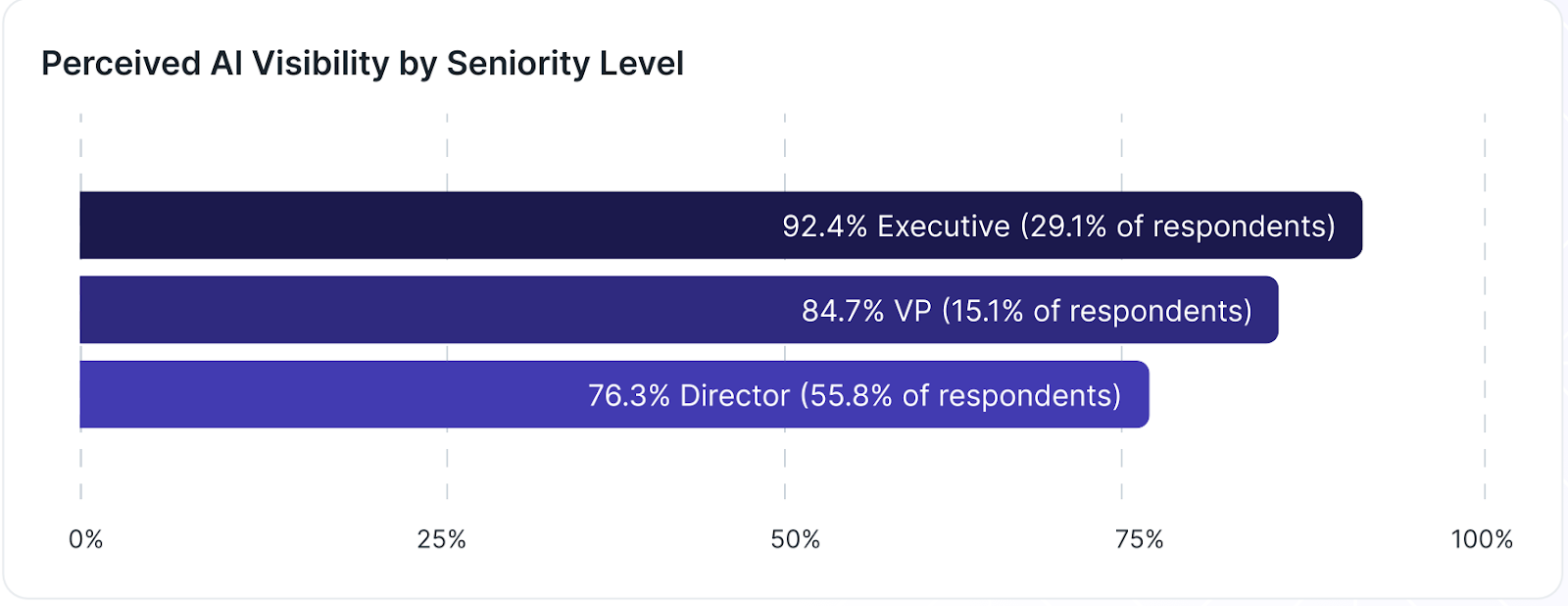
Figure 1. Management-level differences in confidence about AI usage visibility. Source: Larridin State of Enterprise AI 2026 Report.
Buying the same software as competitors may establish access to similar capabilities. A transformation strategy needs an additional answer: what distinctive knowledge and operating judgment will those capabilities amplify, and how will that improvement be verified?
Core Framework: The Core-and-Orbit Model
The Core: Organizational Intelligence
Organizational intelligence includes domain expertise, institutional judgment, operational knowledge, and the reasons behind decisions. Some lives in systems and documents; some remains tacit in people's practices.
Start by identifying which knowledge matters to a business outcome, how it can be made available responsibly, and where human judgment remains necessary. AI cannot amplify context it cannot access or reliably interpret.
The Inner Orbit: Five Strategic Constants
- Adoption depth: Understand how AI becomes part of relevant work across the tool landscape.
- Proficiency development: Build effective task scoping, context grounding, verification, and delegation.
- Governance and visibility: Establish ownership, access, risk assessment, and operational oversight.
- Measurement: Connect practices with accepted outputs, costs, quality, and business outcomes.
- Maturity progression: Develop the capabilities required for repeatable, scalable improvement.
These disciplines reinforce each other. High adoption with weak proficiency can create busy workflows. Strong practice without governance or measurement can remain difficult to scale or defend.
The Outer Orbit: Strategic Variables
Models, vendors, consulting partners, build-versus-buy decisions, and implementation choices belong in the adaptive outer orbit. Review their fit as the evidence, market, regulations, and business needs change.
A partner's proprietary platform can be useful without becoming the center of your strategy. Evaluate its relationship to your organizational knowledge, controls, and intended outcomes rather than allowing the platform to define them.
The 90-Day Transformation Loop
The framework uses repeated cycles: Assess the knowledge and current workflow; Prioritize domains where AI can improve a defined outcome; Execute with appropriate context and controls; Measure the result; and Adapt the outer-orbit choices.
The cycle is a review discipline, not a guaranteed completion timeline. Early cycles may establish visibility and baselines. Later cycles can improve knowledge capture, workflow design, and reuse of validated practices.
Proficiency as a Knowledge-Capture Mechanism
AI proficiency connects what people know with what they can guide AI to do. A practitioner who expresses relevant constraints, examples, checks, and exception rules helps make institutional knowledge usable in a workflow.
Capturing that knowledge does not mean every judgment should be automated. Some tasks require human decision authority, expert review, or a boundary on what an agent can access and change.
Make Transformation Accountable for Operational Performance
The earlier COO strategy guidance remains part of this framework. The core defines what the organization wants to strengthen; operational measurement tests whether that strength changes the work.
Give Deployment, Budget, and Outcomes Named Owners
A practical division is for the CIO to lead technology deployment and governance, the CFO to oversee financial commitments and the investment case, and the COO to coordinate workflow and operational performance. Adapt the roles to the organization and assign business owners to individual workflows.
Name who approves changes, investigates quality issues, accepts risk, and decides whether an initiative should scale. Shared involvement is not a substitute for explicit decision authority.
Measure Four Operational Signals Together
- Workflow cycle time: Include handoffs, review, waiting, and correction through the accepted result.
- Utilization by team and role: Look beneath averages to distinguish access from sustained integration.
- Proficiency distribution: Examine task-appropriate capability and where support is needed.
- Outcome attribution: Connect activity with quality, throughput, error rates, and cost per accepted output, stating the limits of the connection.
Use criteria suited to each workflow. A legal review, support queue, and engineering pipeline require different measures. Account for task mix, staffing, and other process changes before attributing a before-and-after improvement to AI.
Make the Transformation Loop an Outcome Review
Bring operational findings together with access, security, ownership, and financial evidence. Mismatches between adoption and results can reveal questions to investigate, not automatic proof of a governance failure.
At each review, decide what to expand, redesign, support, pause, or stop. Use those decisions to deepen the core capability and adjust tools or partners in the outer orbit.
Apply the Same Transformation Standard to Consulting Partners
The AI in consulting analysis adds a concrete application of the framework. Consulting firms may use AI to research, retrieve institutional knowledge, analyze information, draft deliverables, or coordinate agents. The presence of those tools does not establish that the engagement creates a distinctive capability for the client.
The relevant question is what changes in delivery and what remains with your organization afterward. A faster report can be useful. A validated workflow, accessible knowledge base, evaluation method, and trained internal team may support a more repeatable capability.
Keep the Client's Knowledge at the Core
Ask how the engagement uses your domain expertise, data constraints, customer context, and operating judgment. A generic accelerator should support that knowledge rather than replace it with a template.
Define data access, confidentiality, retention, rights to deliverables, and the ability to maintain or transfer the workflow after the engagement. These requirements belong in the implementation and governance assessment, not only the final handoff.
Evaluate Task Fit, Not the Demonstration
The source discusses research showing that AI-assisted performance can differ between tasks inside and outside a model's capability frontier. The lesson is conditional value, not that AI makes every consultant faster or more accurate.
Test representative tasks and exception cases against the client's acceptance criteria. Check source accuracy, reasoning, confidentiality, review, and downstream use. A polished draft is not necessarily a sound recommendation or a completed business outcome.
Build an Evidence Record for the Engagement
- Baseline: Document comparable delivery time, quality, client effort, and cost before the intervention where possible.
- Utilization: Establish which AI tools and workflows support the engagement, with appropriate disclosure, access, and privacy boundaries.
- Proficiency and verification: Assess how the team grounds, checks, and revises AI-assisted work. Frequency of use is not enough.
- Value: Measure the accepted output and operational or business result, not just billable work completed.
- Full economics: Include advisory fees, model or platform charges, client implementation effort, human review, integration, and ongoing support.
- Capability transfer: Verify that documentation, evaluations, controls, and internal skills support use beyond the engagement.
Agree on definitions with the advisor before delivery. Under hourly billing, reduced production time does not automatically reduce fees or create client savings; the contract and realized benefit matter. Avoid counting the same time saving as both lower cost and additional capacity without a clear method.
Measure With a Client-Owned Framework
Keep enough independent workflow, quality, and financial evidence to evaluate claims instead of relying only on the advisor's reporting. A shared assessment can be constructive: it identifies where the platform helps, where client data or approvals limit results, and what should change in the next cycle.
Apply the same Assess–Prioritize–Execute–Measure–Adapt loop to the relationship. Consulting supports transformation when verified learning and capabilities accumulate in the organization, not merely when more AI-enabled deliverables arrive.
Common Misconceptions
“AI transformation is a technology deployment.” Deployment supplies tools. Transformation connects them with organizational knowledge, changed work, and measured capability.
“It is a project with an end date.” Workflows, models, and business needs evolve. The organization needs a continuing improvement and oversight practice.
“Everyone gets the same tool, so we have a strategy.” Tool access does not explain the distinctive domain or workflow the investment should improve.
“We can skip proficiency.” Effective scoping, grounding, verification, and oversight remain necessary to use capabilities responsibly.
“Transformation belongs only to IT.” Business and operational owners must define accepted outcomes and change the work, while technology and finance supply complementary evidence.
“An AI-enabled consulting engagement is proof of transformation.” Evaluate delivery, value, ownership, and capability transfer. AI use in the engagement is an input, not the conclusion.
Frequently Asked Questions
How is transformation different from adoption?
Adoption establishes use. Transformation develops organizational capability and changes how relevant work performs. It connects unique knowledge with proficiency, governance, measurement, and repeatable improvement.
What is the COO's role?
The COO can anchor the operational assessment: cycle time, quality, workflow integration, and accepted outcomes. Responsibilities should be explicit across the COO, CIO, CFO, and business owners.
How should we evaluate AI-enabled consulting?
Define the engagement baseline, quality criteria, full cost, and intended business outcomes. Review the advisor's use and verification approach and test what reusable capability remains with your organization.
Does faster consulting delivery prove ROI?
No. Consider fees, client effort, output quality, rework, integration, and realized benefit. Reduced elapsed time is not necessarily lower labor cost or cash savings.
How It Connects
AI transformation is the strategic umbrella. Adoption, proficiency, governance, measurement, and maturity provide the execution disciplines.
Larridin's intelligence layer connects AI usage, proficiency, workflows, spending, and outcomes. Workflow Intelligence adds operational context, while AI Impact supports examining business results. Confirm coverage and comparison methods for the environment and engagement being assessed.
See the AI Transformation Guide for the full framework, or learn how Larridin measures AI transformation.
Keep organizational intelligence at the core. Make the outcomes accountable. Use tools and advisors to strengthen the capability your business can sustain.