

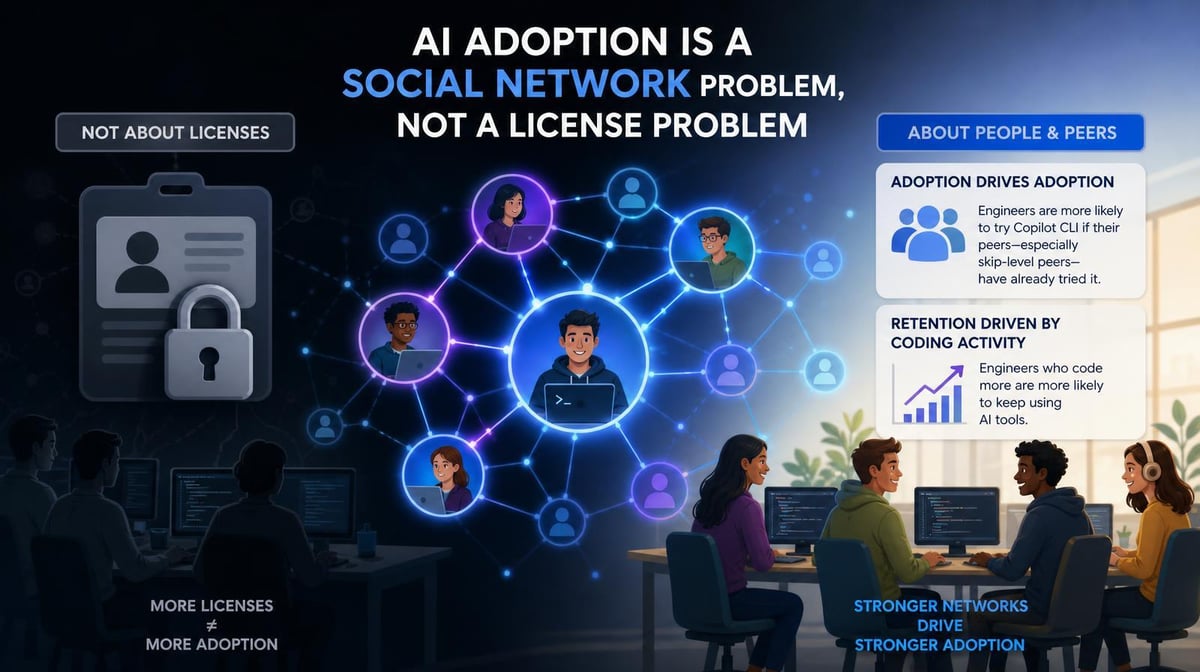

Giving every engineer access to an AI coding tool doesn’t guarantee they’ll use it regularly.
Microsoft’s 2026 study of tens of thousands of engineers found that first use of Copilot CLI was strongly associated with whether the people around an engineer were already using it. The researchers concluded that adoption was “substantially social.”
That doesn’t mean organizations should abandon structured rollouts or mandates. It means rollout plans should account for the influence peers and managers have on whether engineers actually try the tools.
Key Takeaways
- AI coding adoption is influenced by what engineers see happening around them. In Microsoft’s study, skip-level peer usage was the strongest predictor of whether someone tried Copilot CLI.
- Getting engineers to try a tool and getting them to keep using it are different problems. Microsoft found different factors were associated with initial use and retention.
- Rollout teams should measure actual usage patterns, identify where adoption is spreading or stalling, and give successful users opportunities to share how they’re working.
What Microsoft Found About Social Adoption
The Microsoft study separated adoption into two stages: initial use and retention.
For initial use, social exposure stood out. Engineers were more likely to try Copilot CLI when people in their professional network were already using it. When more than 25% of an engineer’s skip-level peers had used Copilot CLI, the engineer had 216% higher odds of trying it than someone with no skip-level peer usage.
The pattern also appeared closer to the engineer. Usage among regular code-review peers was associated with higher odds of first use, and engineers whose direct manager used Copilot CLI had 82% higher odds of trying it.
These are associations, not proof that peer behavior caused adoption. The researchers note that manager usage could also reflect implicit or explicit organizational direction.
The practical lesson is simpler: AI adoption doesn’t happen in isolation. Engineers’ exposure to colleagues and managers using the tool is part of the rollout environment.
Initial Use and Retention Are Different Problems
Trying a tool once isn’t the same as building a habit.
Microsoft defined retention as using Copilot CLI on at least five of the 14 days beginning with an engineer’s first use. The factors associated with trying the tool weren’t always the same as those associated with continuing to use it.
Baseline coding activity was one important signal. Engineers who were already creating two or more pull requests per week had 31% higher odds of retaining Copilot CLI than engineers who created none before the rollout.
Prior use of Copilot in the IDE showed the opposite pattern. Engineers with prior IDE Copilot experience were more likely to try Copilot CLI but somewhat less likely to retain it.
That distinction matters for rollout measurement. A high number of first-time users can make an initial launch look successful even when sustained usage never develops.
4 Ways to Use Social Adoption in Your Rollout
1. Make Useful AI Work Visible
The Microsoft researchers recommend making agentic tool use visible and socially reinforced.
That can be as simple as creating opportunities for engineers to show how they’re using AI in real work: demos, team discussions, examples in documentation, or walkthroughs of useful workflows.
The goal is to make successful use visible enough that other engineers can learn from it.
2. Find the Teams Where Usage Is Already Taking Hold
Organization-wide adoption rates can hide large differences between teams.
Larridin’s AI Adoption dashboard tracks active users, usage, and other adoption signals across teams. That can show where usage is already strong and where access hasn’t translated into regular activity.
Those patterns give rollout leaders a better starting point than assuming every team needs the same intervention.
A team with several active users may benefit from more peer knowledge sharing. A team with little usage may need better training, clearer use cases, or a closer look at whether the tool fits its work.
3. Give Experienced Users Ways to Share What Works
Peer influence becomes more useful when engineers can learn something concrete from it. Teams can create lightweight ways for experienced users to share prompting approaches, useful workflows, task types where AI performs well, and situations where human judgment is especially important.
This doesn’t require turning every strong user into a formal “AI champion.” It means making practical knowledge easier to spread between people who already work together.
Larridin’s AI Proficiency guide distinguishes between simply using AI and developing the skills to use it effectively. That distinction helps rollout teams focus on useful adoption rather than raw activity.
4. Measure Retention, Not Just First Use
A rollout isn’t successful because everyone opened the tool once. Track whether use continues after the launch period. Compare first-time use with weekly or sustained activity and look at the pattern by team.
The Microsoft study is especially useful here because it treats initial use and retention as separate outcomes. Your rollout measurement should do the same.
Larridin’s AI Adoption guide similarly recommends going beyond license counts to understand how deeply AI is being incorporated into work.
What This Research Doesn’t Say About Mandates
The Microsoft study didn’t compare peer-led rollouts with top-down mandates. That means it can’t tell us that mandates fail, that peer programs produce twice the sustained usage, or that organizations should replace structured rollout programs with organic adoption.
The study supports a narrower conclusion: visible use by peers and managers was strongly associated with whether engineers tried Copilot CLI.
A structured rollout can use that insight. Leaders can still set expectations, provide training, and establish approved tools while also making successful use visible and creating opportunities for engineers to learn from one another. Those approaches aren’t mutually exclusive.
Frequently Asked Questions
Did Microsoft find that peer adoption works better than mandates?
No. The study didn’t compare the effectiveness of peer-led adoption with mandates. It found strong associations between social exposure and first use. The researchers also note that some manager effects could reflect organizational direction.
Which coworkers had the strongest relationship with first use?
Skip-level peers had the strongest measured association. When more than 25% of an engineer’s skip-level peers had used Copilot CLI, that engineer had 216% higher odds of trying it compared with engineers who had no skip-level peer usage.
Who was most likely to keep using Copilot CLI?
Retention was more strongly associated with behavior than demographics. Engineers with higher baseline pull-request activity were more likely to keep using the tool, particularly those already creating two or more PRs per week.
Should we identify AI power users before a rollout?
You can identify people already using AI regularly or showing strong engagement, but the Microsoft study doesn’t prove those employees will cause broader adoption. Use them as a source of practical knowledge and then measure whether usage spreads.
How do we know whether our rollout is creating habits?
Measure sustained usage separately from access or first use. Look at activity over time and by team, then pair adoption data with proficiency and impact measures to see whether regular use is producing useful results.
Design for How Adoption Actually Happens
AI coding rollout plans need more than licenses and launch communications. Engineers are also influenced by what they see peers and managers doing with the tools.
Larridin’s AI Adoption platform shows where AI use is growing, where it has stalled, and how usage differs across teams so leaders can target rollout support where it’s needed.
Book a discovery call to see how AI adoption is developing across your organization.