


AI adoption is how deeply and broadly your organization actually uses AI — not just how many licenses you’ve bought.
AI adoption is the process by which an organization moves from experimenting with artificial intelligence tools to embedding them into daily workflows across teams, functions, and business units. It is not a single metric or a binary state. True AI adoption is multi-dimensional—spanning the tools employees use, how deeply they use them, and where across the organization usage is taking hold.
And what is the goal? Employee productivity, where AI is already making a difference (US Federal Reserve Bank of St. Louis). Over time, output per employee is the key driver of profitability, economic growth, and improving living standards worldwide.
Larridin has created an AI Adoption Guide to help you implement AI effectively at your company, helping you to achieve measurable ROI, compounding over time, with your investment (Larridin’s 2026 State of Enterprise AI Report). This blog post provides an introduction to the topic and highlights from the report.
Access Larridin’s AI Adoption Guide.
Why AI Adoption Matters in 2026
AI adoption has shifted from a technology initiative to a strategic imperative. The world’s most valuable companies are no longer asking whether employees should use AI—they are mandating it, incentivizing it, and tying it to performance.
Meta now evaluates every employee on “AI-driven impact” as part of formal performance reviews, with top performers earning bonuses of up to 200%. NVIDIA’s CEO has directed that every task possible should be automated with AI. Zapier achieved 97% company-wide adoption through bottom-up culture-building. Microsoft, Google, and Amazon have all sent the same signal: AI is no longer optional.
Yet despite this urgency, the accountability gap is stark. Only 1 in 5 AI investments delivers measurable ROI (Gartner), and 56% of CEOs report getting “nothing” from their AI adoption efforts (PwC’s 2026 Global CEO Survey). The gap between AI spending and AI outcomes is a measurement problem—and organizations that cannot measure adoption cannot close it.
If your leadership cannot answer key questions, such as: “How deeply has our organization adopted AI. Where are the gaps? How do we know?”—you have a strategic blind spot.
The Larridin AI Tool Classification (Three Axes)
Enterprise AI in 2026 is not one tool. It is an ecosystem of foundation models, AI-first products, AI-augmented features, vertical solutions, and homegrown systems. Making sense of this landscape requires classifying tools along three axes:
- Autonomy Level—Ranges from Agentic (tools that plan, execute, and deliver results independently) through AI-First (products where AI is the entire value proposition, such as ChatGPT or Midjourney) to AI-Augmented at high, medium, and low levels (existing products with varying degrees of AI integration, from Notion AI down to Slack’s AI summaries).
- Modality—What the tool produces and consumes: text, code, image, audio, video, or multimedia. A mature AI portfolio spans multiple modalities, not just chat.
- Scope—Horizontal tools serve any function or industry (ChatGPT, Claude). Vertical tools are domain-specific (Harvey for legal, Rad AI for radiology). Both matter for a complete adoption picture.
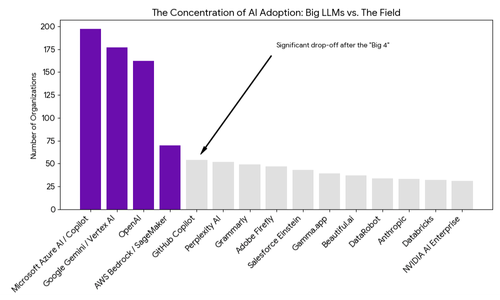
The classification matters because an organization where 80% of employees use only ChatGPT has a fundamentally different—and weaker—adoption profile than one where 60% use a diverse portfolio across autonomy levels, modalities, and scopes.
The Four Layers of Adoption Measurement
Measuring AI adoption effectively requires moving beyond login counts. Larridin’s framework operates across four progressive layers:
- Layer 1: Usage—Are people showing up? DAU/WAU/MAU across all AI tools, activation rates, first-time vs. returning users.
- Layer 2: Depth & Engagement—Is AI becoming a habit? Engagement scores, session patterns, habit formation signals, and where each user falls on the adoption spectrum.
- Layer 3: Breadth—How wide is the tool portfolio? Number of distinct AI tools per person, cross-category usage, tool diversity across autonomy levels and modalities.
- Layer 4: Segmentation—Where is adoption happening and where is it not? Breakdowns by team, hierarchy level, geography, tenure, job function, and business unit.
Each layer adds depth. Usage alone is dangerously incomplete; segmentation transforms adoption data from a dashboard metric into a management tool.
The Adoption Spectrum (User Categories)
Not all usage is equal. Your organization’s employees distribute across a spectrum:
- Non-users—No engagement with AI tools
- Explorers—Tried AI a few times, no habit formed
- Regular users—Use AI multiple times per week for specific tasks
- Power users—Extensive daily AI usage across workflows
- AI-native—AI is the default way they think and work
Understanding this distribution is actionable. If 70% of your organization is stuck at “explorer,” you have a habit formation problem, not a deployment problem. Power users and AI-native employees are your champions—the internal advocates who can accelerate adoption for everyone else.
How AI Adoption Becomes a Sustained Workflow Habit
The adoption spectrum describes where people are today. Rollout design helps explain how they move from exploration to sustained use. Access, first use, retention, and deeper workflow integration are separate stages; a launch that produces many first-time users has not necessarily changed how work gets done.
Engineering provides a useful example, not a universal template for every department. Larridin’s August 27, 2026 guide to AI coding rollout and habit formation summarizes research showing why visible peer use can encourage experimentation while task fit and meaningful work support continued use.
Separate Interest, First Use, and Retention
The guide cites the 2025 Stack Overflow Developer Survey: 84% of respondents were using or planning to use AI tools in development, while 51% of professional developers reported daily use. Those figures come from different respondent groups and must not be subtracted to calculate an adoption drop-off. They illustrate why broad interest and daily workflow integration are different questions.
The same guide reports findings from Microsoft’s 2026 field study of tens of thousands of engineers. Among engineers eligible for Copilot CLI, having more than a quarter of skip-level peers who had used the tool was associated with 216% higher odds of first use than having no such peer use. That is an association in odds, not a percentage-point increase in adoption or evidence that peer exposure caused the behavior.
Retention had a different pattern. The study defined it as use on at least five of the first 14 days; engineers creating two or more pull requests weekly before rollout had 31% higher odds of retention than those creating none. That definition and result belong to the study, not a universal standard for enterprise adoption or proficiency.
1. Seed Credible Use in Relevant Work
Start with people and teams whose recurring tasks are a good match for the tool and who can evaluate its results meaningfully. Choose examples based on useful outcomes, verification, and workflow fit rather than token consumption or enthusiasm alone. A credible initial group should reveal where the tool helps and where it adds friction.
2. Make Successful Peer Practices Visible
Show how coworkers apply AI to specific tasks through short demonstrations, team examples, review discussions, and reusable workflow patterns. In the Microsoft study summarized by the guide, reviewer-peer, skip-level-peer, and direct-manager use were associated with first use. The practical lesson is to make useful behavior observable, not to turn exposure into a guaranteed adoption formula.
3. Build Proficiency Around Real Tasks
Help people learn task scoping, context grounding, steering, and verification. Teach where AI belongs in the workflow and when the review effort outweighs its benefit. Across engineering and other functions, proficiency should be assessed alongside accepted results, not inferred from frequency alone.
Identify teams with effective, repeatable practices and use them to mentor others. Daily use can signal deeper integration, but it does not automatically prove skill or business value. Suitable frequency depends on the role and its work.
4. Track Return Use and Workflow Integration
Follow initial-use cohorts over time. Measure who returns, which tasks recur, how use differs by team and role, and where people stop. Pair those trends with quality, effort, cost, and business outcomes. Adoption measures whether AI is becoming part of work; outcome measurement tests whether that change is worthwhile.
Treat non-retention as a diagnostic signal, not automatically as resistance. Investigate task fit, output quality, verification burden, workflow friction, enablement, and alternative tools. A role with infrequent relevant tasks may not need daily AI use. Repeated access without a useful use case can also become a license-allocation decision.
Expand When the Evidence Supports It
There is no research-backed universal four- or six-week seed phase, or a fixed peer-adoption percentage that guarantees readiness. Look for repeat use, useful workflows, known failure points, examples others can reuse, and demand from teams that have seen credible results. Use those signals to guide expansion rather than an arbitrary calendar or activation target.
The coding research informs this approach, but its numerical findings should not be transferred directly to sales, legal, support, or other functions. Apply the stages to each function’s own task cadence, constraints, and acceptance criteria.
Common Misconceptions
“AI adoption = how many people use ChatGPT (or Copilot).” This is the most widespread misunderstanding. Measuring a single tool gives you a vendor-specific view, not an enterprise view. Your employees are using more AI than any single dashboard reveals—and the tools they use beyond your primary platform may be where the most value is created.
“We bought 10,000 licenses, so we’ve adopted AI.” License counts measure procurement, not adoption. A 10,000-seat Copilot deployment with 15% weekly active usage is not an adoption success—it is a spend optimization problem. Adoption is about active, sustained engagement, not seat allocation.
“We measured adoption last quarter, so we’re covered.” Adoption is a dynamic, evolving metric. Measuring it once or quarterly misses the trajectory entirely. Weekly and monthly trends reveal whether adoption is accelerating, plateauing, or declining—and whether your interventions are working. Treat adoption measurement as continuous infrastructure, not a point-in-time exercise.
"Agentic AI is all that counts." This is untrue, but directionally valuable. Agentic AI can handle entire workflows, and it should be an important part of your AI mix. At the same time, each type of AI has a valuable role in your repertory of solutions. Look at common workflows within each of your teams to see which can be automated entirely with (usually, agentic) AI.
Frequently Asked Questions About Sustained AI Adoption
Is activation enough to demonstrate AI adoption?
No. Activation shows first use. Sustained adoption requires return use and meaningful workflow integration, interpreted for the person’s role. Proficiency and business outcomes need their own evidence.
How long should an initial rollout run before expansion?
There is no universal threshold. Expand when the initial group demonstrates repeat use, credible benefits, understood limitations, and practices other teams can apply. Measure those behaviors rather than assuming a fixed number of weeks establishes readiness.
What if experienced employees try AI and then stop?
Investigate quality, task fit, verification effort, and workflow friction rather than assuming seniority or tenure explains resistance. Relevant enablement or a different tool may help; some roles may not have a strong recurring use case.
Does daily AI use prove ROI?
No. Daily use indicates frequency, not financial return. Connect adoption with proficiency, accepted work, quality, and full costs before claiming value.
How It Connects
AI adoption does not exist in isolation. It is the foundation layer that connects to several related concepts across the AI execution intelligence landscape:
- AI Proficiency measures how skilled your people are at using AI, while adoption measures whether and how much they use it. High adoption with low proficiency means people are using AI badly. You need both.
- Unsanctioned AI (also known as “shadow AI”) is the hidden underside of adoption—employees using unsanctioned AI tools that IT cannot see. You cannot govern what you cannot measure, and adoption measurement is the foundation of shadow AI visibility.
- AI Execution Intelligence is the broader discipline that encompasses adoption, proficiency, and impact measurement. Adoption data feeds into the execution intelligence layer that connects AI usage to business outcomes.
For a comprehensive treatment of adoption strategy, measurement frameworks, and organizational maturity models, see the full AI Adoption Guide.
Larridin is the AI execution intelligence platform that gives enterprises complete visibility into AI adoption, proficiency, and impact across every tool, team, and employee. If your leadership cannot answer “where are we on AI adoption?” with data, Larridin can fix that.