

The definitive guide to understanding, measuring, and accelerating AI adoption across your organization — beyond Copilot dashboards and login counts.
The Age of AI Mandates Is Here
In February 2026, Meta became the first major technology company to formally tie employee performance reviews to AI usage, according to Bloomberg. Under the new policy, “AI-driven impact” is now a core expectation for every employee — from engineers to marketers.
Managers at Meta evaluate workers on how effectively they leverage AI to accelerate development cycles, improve code quality, and deliver business results. High performers can earn bonuses of up to 200%. The message from Janelle Gale, Meta’s Head of People, was direct: “As we move toward an AI-native future, we want to recognize people who are helping us get there faster.”
Meta isn’t alone. At NVIDIA, CEO Jensen Huang responded to reports that some managers were telling employees to use less AI with a single word: “Insane.” In an all-hands meeting following record earnings, as reported by Fortune, Huang told employees he wants “every task that is possible to be automated with artificial intelligence to be automated with artificial intelligence.” He noted that 100% of NVIDIA’s software engineers and chip designers use Cursor, the AI coding assistant, and that employees should persist with AI tools even when they fall short — “use it until it does work, and jump in and help make it better.”
At Zapier, CEO Wade Foster took a different approach to the same destination. Rather than top-down mandates, Foster drove 97% company-wide AI adoption through hackathons, show-and-tells, and a culture of experimentation — proving that creative, bottom-up strategies can be just as effective as executive directives.
These aren’t isolated examples. Microsoft has told employees that AI is “no longer optional,” per an internal memo reported by Business Insider. Google CEO Sundar Pichai told employees at an all-hands meeting that they need to use AI for Google to lead the AI race. Amazon employees have actively requested access to AI coding tools like Cursor.
In many, perhaps most, companies, employees are “bringing their own” AI accounts to work. This is both a positive—employees are upskilling themselves—and a concern, as usage of personal AI accounts is likely to incur exfiltration of employee inputs and company data for model training, or other, perhaps even more severe, problems with AI tools that don’t take good care of data. Managers need to identify “shadow AI” use and evangelize movement to official accounts.
The pattern is unmistakable: the world’s most valuable companies have concluded that AI adoption is a strategic imperative — not a nice-to-have technology initiative, but a core driver of competitive advantage, productivity, and organizational performance. The companies that adopt AI effectively will outperform those that don’t. And the gap between the two is widening.
The question is no longer whether your organization should adopt AI. It’s how deeply is AI adopted today, where are the gaps, and how do you know?
This is where AI adoption measurement comes in, and it’s more complex than most organizations realize.
What AI Adoption Actually Means in the Enterprise
When most people hear “AI adoption,” they think of a single metric: how many employees are using ChatGPT or Microsoft Copilot. This is a dangerously incomplete view.
Enterprise AI adoption in 2026 is not about one tool, or even one tool per user. It’s about an entire ecosystem that spans foundation models, standalone AI products, AI-enhanced features inside existing software, homegrown systems, and increasingly, autonomous AI agents.
Consider what a typical enterprise AI landscape actually looks like today:
- Multiple large language models running simultaneously — employees using ChatGPT for some tasks, Claude for others, Gemini for research, and an internal model fine-tuned on proprietary data
- AI-first products built entirely around AI capabilities — tools such as Cursor for code, ElevenLabs for audio, Midjourney for visual content, and Jasper for marketing copy
- AI-augmented features embedded inside software employees already use — Notion AI for document generation, Slack AI for channel summaries, Adobe Firefly for image editing, Excel Copilot for spreadsheet formulas
- Vertical AI solutions designed for specific industries or functions — Harvey for legal research, Legora for regulatory compliance, Rad AI for radiology
- Homegrown AI systems: internal tools and models built by the organization’s own engineering teams, often using open-source foundations such as Llama or Mistral
This complexity is the fundamental challenge. AI adoption isn’t a single number. It’s a multi-dimensional phenomenon that spans tools, teams, use cases, and levels of maturity. Measuring it requires understanding not just who is using AI, but what they’re using, how deeply they’re using it, and where across the organization adoption is taking hold.
Note: With Gemini built into Google Search, employees are using AI without even trying. Search summaries are produced with Gemini. When employees then click the Dive Deeper in AI Mode button, they slide into doing interactive work, often including the use of company data, without having made a conscious choice to use an LLM for work purposes. If they are using their personal Google account for search, the entire interaction may be exfiltrated back to Google’s servers and used for model training, just as when other LLMs are used from a personal account.
Who Owns AI Adoption
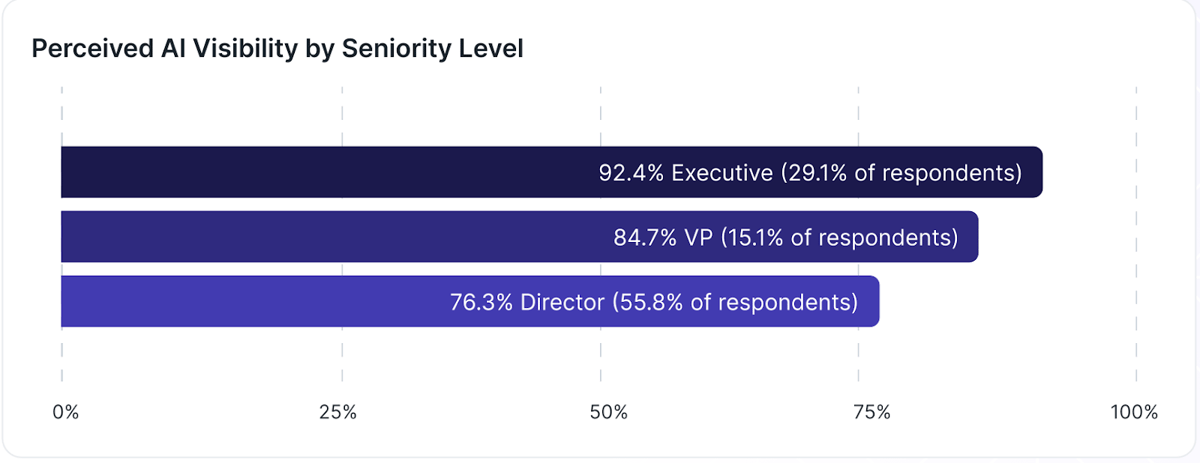
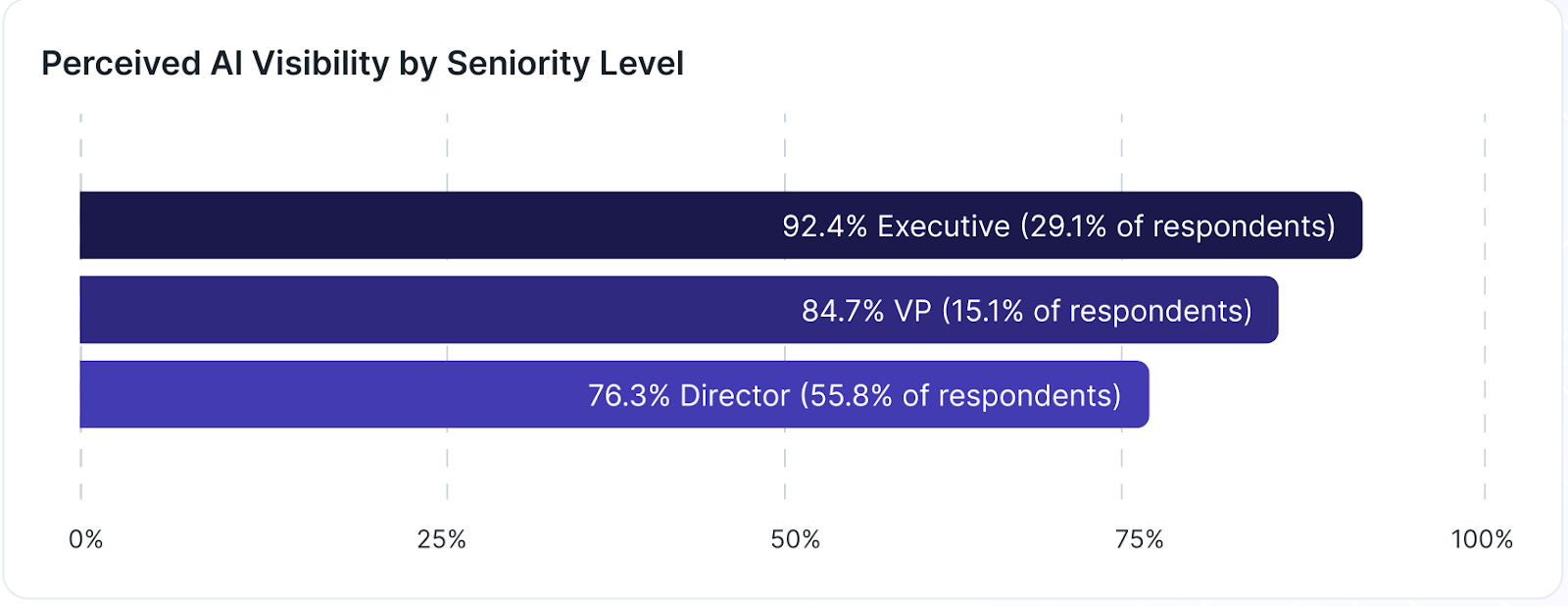
One barrier to AI adoption is lack of shared understanding of the current state of AI usage. In the Larridin report, The State of Enterprise AI 2026, respondents were asked whether they had visibility to AI use in their organization.
Confidence in AI visibility varied by reporting level, as shown in the figure:
- 92.4% of Executive respondents (29.1% of total) believed they have visibility.
- 84.7% of VP respondents (15.1% of total) believed they have visibility.
- 76.3% of Director respondents (55.8% of total) believed they have visibility.
The closer to the action managers are, the less confidence they have in AI visibility within their organization. It’s not just that management disagrees as to what’s happening; they even disagree as to whether they know what’s happening.
The Larridin AI Tool Classification
To make sense of this complexity, it helps to classify AI tools along multiple dimensions. At Larridin, we categorize every AI tool in an enterprise along three axes: autonomy level, modality, and scope.
By Autonomy Level
The autonomy level describes the level of AI technology used by a tool. The most impressive results tend to involve at least some use of the highest levels of AI technology. The levels, from the top down:
- Agentic—Tools that can work independently to solve problems end-to-end, with minimal human intervention. These are AI systems you can hand a task to, and they’ll plan, execute, and deliver a result autonomously. This category is new, having emerged at the beginning of 2025, but growing rapidly — think AI coding agents that can take a specification and ship working code, or research agents that can independently gather, synthesize, and present findings.
- AI-First—Products where AI is the core product and primary value proposition. The entire experience is built around interacting with AI. This includes large language models such as OpenAI’s ChatGPT, Anthropic’s Claude, and Google Gemini, but also specialized AI-first tools like ElevenLabs (audio generation), Midjourney (image generation), and Runway (video generation). Without AI, the product doesn’t exist.
- AI-Augmented (High, Medium, or Low level of integration)—Products that were not originally AI tools but have now integrated AI. If the use of AI is central, as in Notion AI, this is integration at a High level. If the use of AI is important, but complementary, AI integration is Medium. And if AI is used on a spot basis, such as Slack or email summaries, AI integration is considered Low.
By Modality
For AI tools, modality refers to the type of information processed; including:
- Text — writing, summarization, analysis, chat
- Code — code generation, review, debugging, refactoring
- Image — generation, editing, enhancement
- Audio — transcription, generation, voice cloning, music
- Video — generation, editing, enhancement
- Multimedia — tools that work across multiple modalities
By Scope
As with other software, AI tools can be described by how extensively they can be used in your organization:
- Horizontal — General-purpose tools that serve any function or industry. ChatGPT, Claude, and Gemini are the quintessential horizontal AI tools. Anyone, in any role, in any industry, can use them.
- Vertical — Domain-specific tools built for particular industries or functions. Harvey is built for legal professionals. Rad AI serves radiologists. These tools embed deep domain expertise and are often integrated into industry-specific workflows.
Classification by autonomy level, modality, and scope matters because it changes how you think about AI adoption. An organization where 80% of employees use ChatGPT, but nothing else, has a very different AI adoption profile than one where 60% of employees use a diverse portfolio of AI-first, AI-augmented, and vertical tools across their daily workflows. The second organization is almost certainly extracting more value — even though its adoption rate for any single tool is lower.
Why AI Adoption Matters Now
The case for measuring AI adoption has never been stronger, nor more urgent. Three converging forces are making adoption the defining metric for enterprise AI strategy.
1. The Productivity Imperative
Leaders across industries have reached the same conclusion: AI adoption drives productivity, and productivity drives competitive advantage.
Jensen Huang’s vision for NVIDIA is a company of 50,000 human employees (about 50% more than the company has today) working alongside 100 million AI assistants. Meta’s performance review policy is built on the premise that employees who effectively leverage AI will deliver meaningfully better results. Zapier’s 97% AI adoption rate has allowed a relatively small company to operate with the output of a much larger one.
The data supports this conviction. Organizations that redesign work processes with AI are twice as likely to exceed revenue goals, according to Gartner’s 2025 survey of 1,973 managers. The question isn’t whether AI-proficient organizations outperform — it’s by how much, and how quickly the gap widens.
2. The Accountability Gap
Enterprises are pouring unprecedented resources into AI. Global generative AI spending is projected to reach $2.5 billion in 2026, according to Gartner (a 4x increase over 2025). Most large enterprises have deployed multiple AI tools, funded AI training programs, and stood up AI centers of excellence.
Yet establishing ROI has become the top barrier holding back further AI adoption, according to Gartner. A staggering 95% of generative AI pilots fail to move beyond the experimental phase, according to MIT’s GenAI Divide report. And 56% of CEOs surveyed by PwC’s 2026 Global CEO Survey report getting “nothing” from their AI adoption efforts.
Boards and CFOs are starting to ask hard questions: Where is the return on our AI investment? Who is actually using these tools? Is this working? Without adoption data, CIOs have no credible answer.
3. The Risk Dimension
Adoption isn’t just about productivity — it’s about visibility and governance. Shadow AI — the use of unauthorized AI tools by employees — is a growing concern for enterprises. Employees are signing up for AI tools with personal emails, pasting proprietary data into public models, and using AI services that haven’t been vetted by IT or legal.
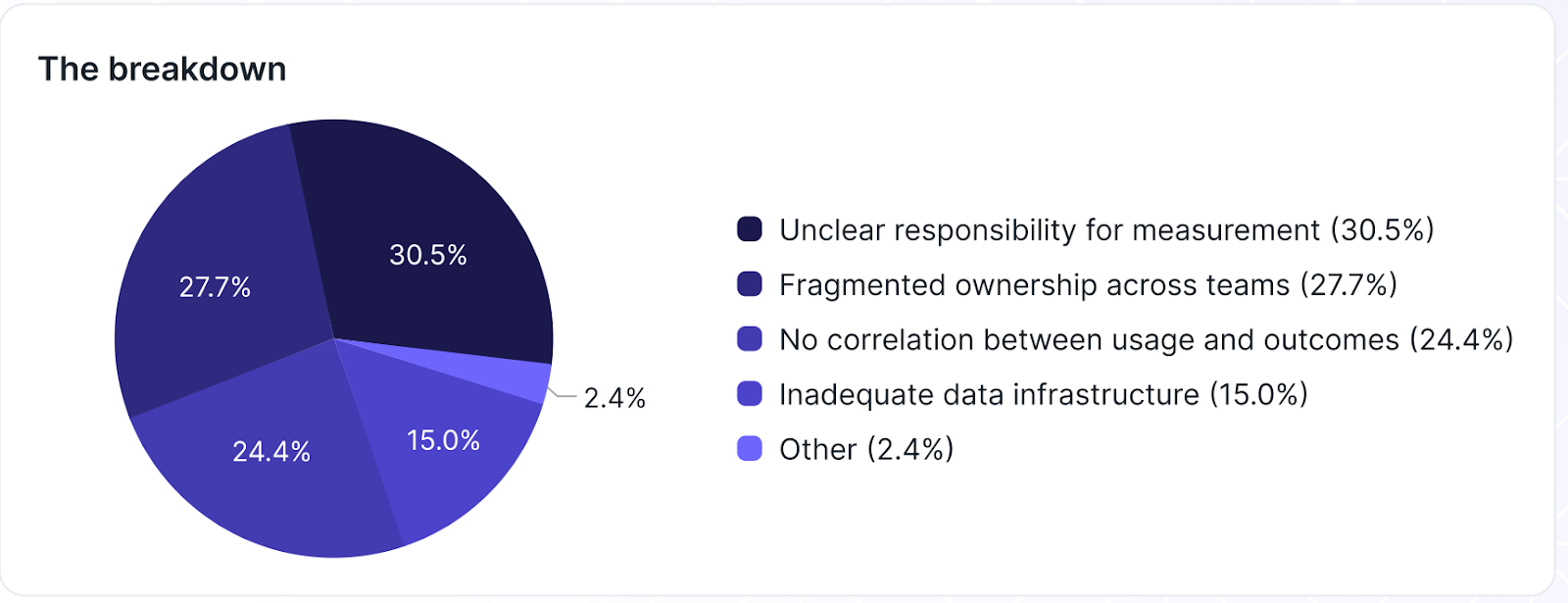
The reasons for not measuring vary across companies. In Larridin’s State of Enterprise AI 2026 report, respondents were asked about barriers to AI measurement, as shown in the figure:
- Unclear responsibility for measurement: 30.5% of respondents
- Fragmented ownership across teams: 27.7% of respondents
- No correlation between usage and outcomes: 24.4% of respondents
- Inadequate data infrastructure: 15.0% of respondents
- Other: 2.4% of respondents
You cannot govern what you cannot see. And you cannot see what you don’t measure. AI adoption measurement is the foundation of AI governance: it tells you which tools are in use, who is using them, and whether they’ve been sanctioned by the organization.
How to Measure AI Adoption: The Four Layers
Effectively measuring AI adoption requires moving beyond simple login counts. True adoption measurement operates across four layers, each providing a progressively deeper view of how AI is embedding into your organization.
Layer 1: Usage — Are People Showing Up?
The foundational layer of adoption measurement is straightforward activity tracking:
- Daily Active Users (DAU), Weekly Active Users (WAU), Monthly Active Users (MAU) — across all AI tools, as well as per tool
- Active user trends — Is usage growing, plateauing, or declining over time?
- First-time vs. returning users — Are new employees onboarding onto AI tools? Are existing users coming back?
- Activation rates — Of the employees who have access to AI tools, what percentage have actually used them?
Usage metrics answer the most basic question: Are people using AI at all? But they tell you almost nothing about whether that usage is meaningful.
Layer 2: Depth & Engagement — Is It Becoming a Habit?
This is where adoption measurement gets interesting. Usage tells you that someone logged in. Depth tells you whether AI is becoming part of how they work.
- Engagement scores: Composite metrics that capture frequency, consistency, and intensity of AI usage over time
- Habit formation signals: Is usage sustained over weeks and months, or does it spike after a training session and then drop off?
- Session patterns: Is AI being used sporadically (once a week for a specific task) or is it embedded into daily workflows?
- The adoption spectrum: Where does each user fall on the continuum from occasional user, to power user, to AI native?
The adoption spectrum is critical. Not all usage is equal. An employee who asks ChatGPT one question per week is fundamentally different from one who uses AI across multiple workflows every day. The goal is to understand the distribution of your organization across this spectrum:
- Non-user: Hasn’t engaged with AI tools at all
- Explorer: Has tried AI tools a few times, haven’t formed a habit
- Regular user: Uses AI tools multiple times per week for specific tasks
- Power users: Consistently uses AI extensively, across their daily work
- AI-native user: AI is deeply integrated into how they think and work; they default to AI-assisted workflows
Understanding this distribution gives leaders actionable intelligence. If 70% of your organization is stuck in the “explorer” phase, you have a habit formation problem, not a deployment problem. If you have a cluster of power users in one department but non-users in another, you have a targeted enablement opportunity.
This layer also surfaces your champions, the power users and AI-native employees who can serve as internal advocates, mentors, and proof points. And it identifies employees who are falling behind: not to punish them, but to understand what barriers are preventing adoption and how to remove them.
Layer 3: Breadth — How Wide Is the Tool Portfolio?
As employees mature in their AI usage, their tool portfolio naturally expands. A beginner might use only ChatGPT. A power user might use ChatGPT for brainstorming, Claude for analysis, Cursor for coding or Lovable for vibe coding, Midjourney for visuals, and Notion AI for documentation — all in a single week, or even a single day.
Breadth metrics capture this expansion:
- Number of distinct AI tools used per person, weekly and monthly
- Cross-category usage: Using AI only for text/chat vs. using AI across some or all of coding, textual content creation, image creation, audio creation, design, and data analysis
- Tool portfolio diversity: Across autonomy levels (agentic, AI-first, AI-augmented), modalities (text and other media types), and vertical vs. horizontal tools
Breadth matters because it signals depth of integration. An organization where employees use 5-7 AI tools across different categories has embedded AI much more deeply into its workflows than one where everyone uses a single chatbot. Breadth is a leading indicator of organizational AI maturity.
Layer 4: Segmentation — Where Is Adoption Happening (and Where Isn’t It)?
The most actionable adoption data isn’t a company-wide average — it’s the breakdown across organizational dimensions:
- By team and department. Engineering vs. sales vs. marketing vs. HR vs. finance vs. operations. Which teams are leading? Which are lagging?
- By hierarchy level. Leadership vs. middle management vs. individual contributors. Are executives walking the talk? Are managers enabling or blocking adoption?
- By location and geography. Are certain offices, regions, or countries ahead or behind? This is especially critical for global enterprises.
- By tenure. Are new hires (who may be digital natives) adopting faster than long-tenured employees? Or are experienced employees, who understand the business deeply, finding more valuable use cases?
- By job type and function. Developers vs. designers vs. analysts vs. account managers vs. recruiters. How does adoption vary by the nature of the work?
- By business unit. In large enterprises, different business units may have vastly different AI maturity levels.
Segmentation transforms adoption data from a dashboard metric into a management tool. Instead of knowing that “65% of our company uses AI,” you know that “Engineering in London is AI-native, Sales in New York is experimenting, Marketing is lagging, and middle management across the board is the bottleneck.” That’s actionable. You can allocate training resources, adjust incentives, and target enablement programs where they’ll have the most impact.
The Challenges of Measuring Enterprise AI Adoption
If measuring AI adoption sounds straightforward in theory, it’s extraordinarily difficult in practice. The CIOs we speak with consistently describe the same set of challenges: fragmented, tool-specific dashboards and the lack of a single pane of glass; difficult board-level reporting; an expanding tool and usage landscape; and inconsistent definitions.
Fragmented Native Dashboards
Every AI tool comes with its own analytics. Microsoft Copilot has a usage dashboard, as does Google Gemini. ChatGPT Enterprise has usage reports. Cursor shows activity data. And that’s just the beginning; Notion AI, Slack AI, Adobe Firefly, and dozens of other tools each surface their own metrics in their own formats with their own definitions.
The result is a CIO with 15 different dashboards, each telling a partial story in a different language. Copilot might report “monthly active users.” ChatGPT might report “messages sent.” Notion might report “AI features used.” These metrics aren’t comparable, can’t be aggregated, and don’t tell a coherent story.
No Single Pane of Glass
In most companies, there is no native way to answer the question: “What does AI adoption look like across our entire enterprise?”
No tool vendor has an incentive to show you this. Microsoft wants you to see Copilot adoption. Google wants you to see Gemini adoption. OpenAI wants you to see ChatGPT adoption. Each vendor shows you a flattering view of their own product, not the full picture.
This means CIOs are left stitching together screenshots, exporting CSVs, and building makeshift spreadsheets to try to construct a company-wide view. It’s manual, error-prone, and always out of date by the time it’s all pulled together.
Board-Level Reporting Is Nearly Impossible
When the board asks, “How is our AI transformation progressing?,” few CIOs have a credible, data-backed answer.
They might have anecdotes: “The engineering team loves Copilot.” They might have vendor-provided statistics: “We have 5,000 Copilot licenses active.” But this doesn’t answer the broad question about AI transformation. These CIOs can’t produce a unified view of adoption across all AI tools, segmented by department, trending over time, benchmarked against industry peers.
This is a governance failure that has real consequences. Without clear adoption data, boards can’t make informed decisions about AI investment, CIOs can’t justify budget renewals, and organizations can’t course-correct when adoption stalls.
The Landscape Keeps Expanding
AI isn’t contained in a single application anymore. It’s in the browser (ChatGPT, Claude, Perplexity), on the desktop (Cursor, Windsurf), embedded in enterprise software (Microsoft 365, Google Workspace, Salesforce), in specialized tools (Harvey, ElevenLabs), and in homegrown systems built on open-source models.
New AI tools and features launch weekly. Employees discover and adopt them on their own. The landscape is a moving target — which means any static inventory of “our AI tools” is out of date almost immediately.
Inconsistent Definitions
What counts as “active use” in one tool is completely different from another. Is opening Copilot and dismissing a suggestion “active use”? Is asking ChatGPT one question per month enough to count as an “active user”? Is using Notion AI’s auto-summary feature — which may fire automatically — a signal of adoption?
Without consistent, cross-tool definitions of what constitutes meaningful engagement, adoption metrics are unreliable and incomparable. You can’t benchmark, you can’t detect trends, and you can’t make apples-to-apples comparisons across your AI portfolio.
And the Survey Says…
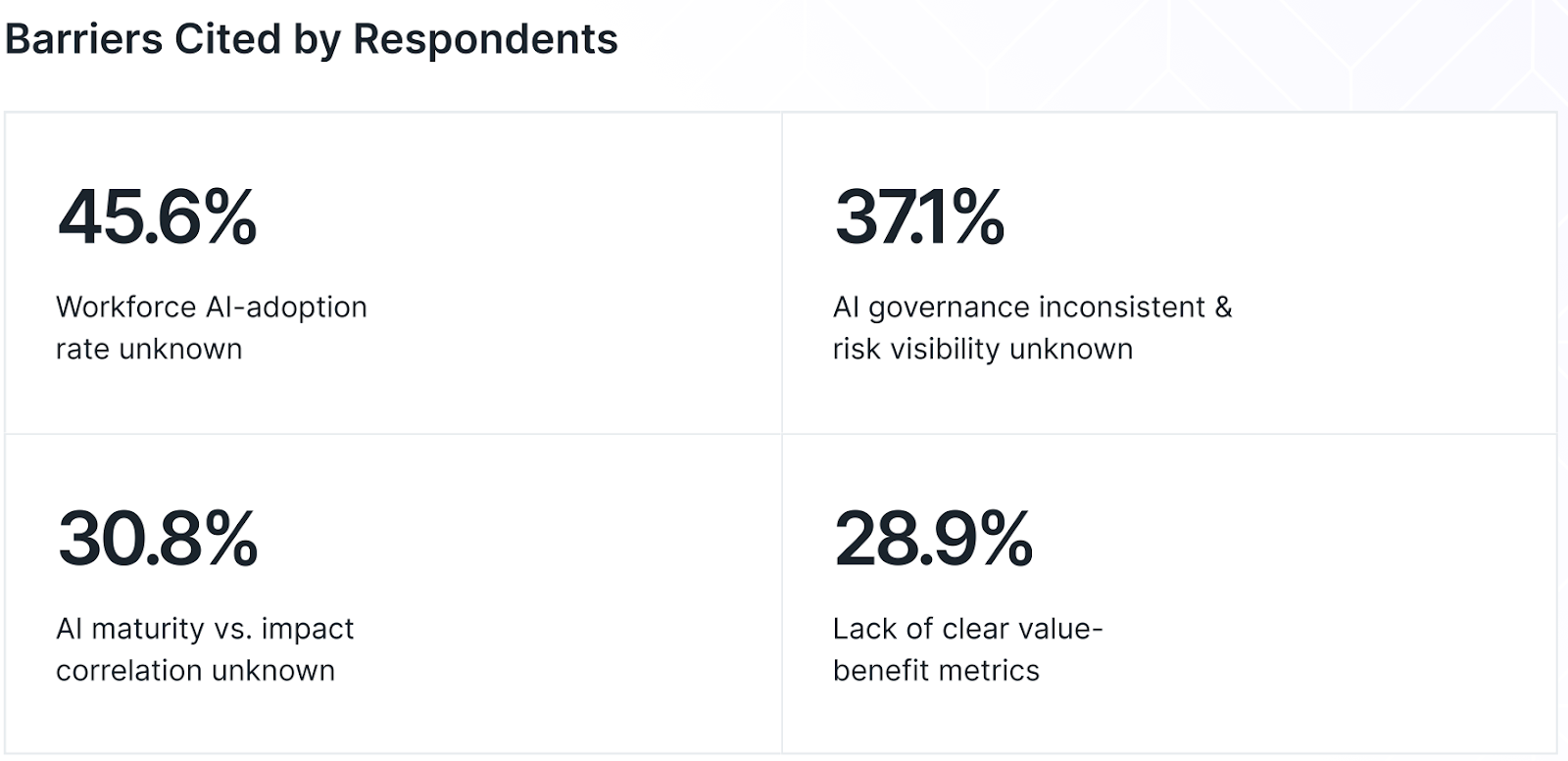
The Larridin report, The State of Enterprise AI 2026, asked respondents about the barriers they faced in AI adoption. Their answers, as shown in the figure:
- Workforce AI-adoption rate unknown (45.6% of total)
- AI governance inconsistent & risk visibility (37.1% of total)
- AI maturity vs. impact correlation unknown (30.8% of total)
- Lack of clear value-benefit metrics (28.9% of total)
The issues vary between informational (not knowing the adoption rate or the extent of impact) and governance-oriented (inconsistent government, lack of established measurement metrics.)
Where AI Adoption Is Happening Today
We’ve discussed AI adoption challenges. Where is adoption happening today?
Larridin’s AI Hiring Pulse – February 2026 tracked 428 companies across 43,422 job postings to measure which functions are hiring for AI. The gradient is steep:
|
Function |
Companies Hiring for AI |
% of Tracked Companies |
|---|---|---|
|
Product |
81 |
18.9% |
|
Customer Success |
61 |
14.3% |
|
Engineering & IT |
54 |
12.6% |
|
Data & Analytics |
49 |
11.4% |
|
HR & People |
47 |
11.0% |
|
Marketing |
31 |
7.2% |
|
Sales |
31 |
7.2% |
|
Operations |
30 |
7.0% |
|
Legal & Compliance |
24 |
5.6% |
|
Finance |
20 |
4.7% |
The gap between top and bottom is 4x. Same organizations, same leadership, same budgets – radically different adoption intensity.
Three forces explain the ordering:
- Digital-native workflows – engineering and product work where AI slots in naturally.
- Measurable outputs – when impact is easy to quantify, investment follows.
- Tool ecosystem maturity – engineering has Copilot, Cursor, and dozens of alternatives; legal and finance have fewer proven options.
McKinsey’s 2025 State of AI report confirms: 88% of organizations use AI in at least one function, but fewer than 40% have scaled beyond pilot. The curve is not a deployment problem. It is a depth problem.
Building an AI Adoption Measurement Program
Given these challenges, how should an enterprise approach AI adoption measurement? Here’s a practical framework.
Step 1: Discover Your AI Landscape
Before you can measure adoption, you need to know what’s out there. This means creating a comprehensive inventory of every AI tool in use across the organization — sanctioned and unsanctioned.
This is harder than it sounds. Shadow AI means that employees are using tools IT doesn’t know about. Browser-based AI tools don’t show up in traditional software asset management systems. And AI features embedded in existing software may fly under the radar entirely.
Effective discovery requires a combination of approaches:
- Network-level monitoring for AI-related traffic
- Browser and endpoint-level visibility into AI tool access
- Employee surveys and self-reporting
- Integration with identity and access management systems
- API-level monitoring for AI tool authentication
The goal is a living, continuously updated map of your organization’s AI ecosystem.
Step 2: Classify and Prioritize
Once you have visibility into the landscape, classify each tool using a consistent framework (autonomy level, modality, scope). Not all AI tools warrant the same level of measurement attention. Focus your deepest measurement efforts on:
- Tools with the highest usage and business impact potential
- Tools that handle sensitive data or raise governance concerns
- Tools that represent significant financial investment (enterprise licenses)
- Emerging tools that are growing rapidly across the organization
Step 3: Establish Consistent Metrics
Define a consistent set of metrics that apply across all AI tools, regardless of vendor. This creates the common language needed for cross-tool comparison and company-wide aggregation:
- Standardized definitions of active usage (daily, weekly, monthly)
- Consistent engagement scoring methodology
- Uniform segmentation dimensions (department, level, location, tenure)
- Benchmarkable adoption spectrum categories
Step 4: Instrument and Integrate
Deploy the instrumentation needed to collect adoption data at the required granularity. This may include:
- Browser-level monitoring for web-based AI tools
- Desktop-level monitoring for native applications
- API integrations with enterprise AI platforms (Microsoft 365 admin, Google Workspace admin, OpenAI Enterprise)
- HRIS integration for organizational segmentation (department, level, location, tenure, job type)
- Identity provider integration for user mapping
Step 5: Report, Benchmark, and Act
With data flowing, build the reporting layers that different stakeholders need:
- Board and executive level: High-level adoption trends, ROI indicators, benchmark comparisons, risk summary
- CIO and IT leadership: Tool-by-tool adoption, spend efficiency, governance compliance, shadow AI visibility
- Department leaders: Team-level adoption, champion identification, enablement gaps, peer benchmarks
- AI program managers: Detailed engagement analytics, training effectiveness, adoption campaign results
The key principle: adoption data is only valuable if it drives action. Every metric should connect to a decision — where to invest, where to train, where to intervene, when to celebrate.
What Good Looks Like: The AI Adoption Maturity Spectrum
Organizations don’t go from zero to AI-native overnight. AI adoption follows a maturity curve, and understanding where your organization sits, and what the next stage looks like, is essential for setting realistic goals and allocating resources effectively.
Stage 1: AI Curious. A small number of employees are experimenting with AI, mostly on their own. There’s no formal AI strategy or tool deployment. Usage is sporadic and untracked. Shadow AI risk is high, because there’s no visibility or governance.
Stage 2: AI Exploring. The organization has deployed one or two enterprise AI tools, typically Copilot or ChatGPT Enterprise. Usage is growing, but unevenly distributed, often concentrated in technical teams. Basic adoption metrics are tracked via vendor dashboards. Leadership is interested in, but not yet committed to, a measurement program.
Stage 3: AI Scaling. Multiple AI tools are deployed across the organization. Adoption is expanding beyond technical teams into business functions, and a formal AI adoption measurement program is likely to be in place. Champions and power users are identified and leveraged; training and enablement programs are active. Board-level reporting on AI adoption exists, but is still maturing.
Stage 4: AI Embedded. AI tools are part of daily workflows for the majority of employees. Adoption is measured across all four layers: usage, depth, breadth, and segmentation. AI governance policies are enforced based on adoption data, and spend optimization is driven by usage analytics. The organization benchmarks its adoption against industry peers.
Stage 5: AI-Native. AI is the default way of working; employees reach for AI tools instinctively. The organization operates with a diverse portfolio of agentic, AI-first, and AI-augmented tools. Adoption data informs strategic decisions about workforce planning, technology investment, and competitive positioning, and AI proficiency is part of performance evaluation and career development. The organization is a talent magnet for AI-skilled professionals.
Most enterprises in 2026 are somewhere between Stage 2 and Stage 3. The organizations that build strong adoption measurement foundations now will be the ones that reach Stage 4 and 5 fastest — and capture the competitive advantage that comes with these higher levels.
Common Mistakes in AI Adoption Measurement
As enterprises build their adoption measurement programs, several common pitfalls emerge.
Measuring a Single Tool Instead of the Ecosystem
The most common mistake is equating AI adoption with Copilot adoption (or ChatGPT adoption, or any other single tool). This gives you a vendor-specific view, not an enterprise view. Your employees are using more AI than any single dashboard shows.
Counting Licenses Instead of Usage
Many organizations track how many AI licenses they’ve purchased, not how many are actively used. A 10,000-seat Copilot deployment with 15% weekly active usage is not an adoption success story; it’s a spend optimization problem.
Ignoring Depth and Quality
Knowing that 5,000 employees “used AI this month” tells you very little. Did they ask one question, or did they integrate AI into daily workflows? Did they use a basic feature once, or are they power users? Without depth metrics, usage numbers are misleading.
Treating Adoption as a One-Time Measurement
Adoption is a dynamic, evolving metric. Measuring it one time, or even quarterly, misses the trajectory of adoption. Weekly and monthly trends reveal whether adoption is accelerating, plateauing, or declining, allowing for timely intervention.
Failing to Segment
Company-wide averages hide enormous variance. If your average adoption rate is 60%, that might mean engineering is at 95% and finance is at 20%. Without segmentation, you can’t identify where enablement efforts are needed most.
The Road Ahead: AI Adoption as Strategic Infrastructure
AI adoption measurement is not a reporting exercise. It’s strategic infrastructure — the data layer that connects AI investment to business outcomes.
As organizations like Meta tie AI usage to performance reviews, as Jensen Huang demands 100% AI automation of every possible task, and as boards scrutinize the return on hundreds of billions of dollars in AI investment, the ability to accurately measure, benchmark, and optimize AI adoption becomes a core enterprise capability.
The organizations that build this capability now — that understand their AI landscape, measure adoption across all four layers, segment with precision, and act on insights — will be the ones that realize the full promise of AI transformation.
The ones that don’t will be guessing. And in a market moving this fast, guessing isn’t a strategy.
FAQs: AI Adoption Guide
Q: What does AI adoption actually mean in the enterprise?
When most people think of AI adoption, they picture employees logging into ChatGPT. In reality, enterprise AI adoption in 2026 encompasses an entire ecosystem: foundation models, AI-first products, AI-augmented features embedded in existing software, vertical AI solutions, homegrown systems, and increasingly, autonomous AI agents. A single organization might have employees using ChatGPT for brainstorming, Claude for analysis, Cursor for coding, Midjourney for visuals, and Notion AI for documentation, all in the same week, even the same day. AI adoption isn't a single number; it's a multi-dimensional phenomenon spanning tools, teams, use cases, and levels of maturity.
Q: Why is measuring AI adoption so urgent right now?
Three forces are converging. First, the productivity imperative: companies such as such Meta, NVIDIA, and Zapier have concluded that employees who effectively leverage AI deliver meaningfully better results, and they're tying performance reviews and bonuses to AI usage. Second, there's an accountability gap. Global generative AI spending is projected to reach $2.5 billion in 2026, yet 56% of CEOs surveyed by PwC report getting "nothing" from their AI efforts. Boards are asking hard questions that CIOs can't answer without adoption data. Third, there's the risk dimension: shadow AI, where employees use unauthorized tools with personal accounts, creates serious data exfiltration and governance concerns. Also, there is often solid productivity happening within this unauthorized use, but the organization can't see it or scale it. As the Larridin report, The State of Enterprise AI 2026, found, 45.6% of respondents said their workforce AI adoption rate was simply unknown.
Q: How should organizations measure AI adoption across the enterprise?
Effective measurement operates across four layers:
-
Usage metrics (DAU, WAU, MAU) tell you whether people are showing up.
-
Depth and engagement metrics reveal whether AI is becoming a habit or just a one-time experiment. This is where the adoption spectrum matters, from non-users and explorers through regular users, power users, and AI-native employees.
-
Breadth metrics capture how wide the tool portfolio is, since an employee using five to seven AI tools across different categories signals much deeper integration than one using a single chatbot.
-
Segmentation breaks adoption down by department, hierarchy level, geography, tenure, and job function, turning a dashboard metric into a management tool.
Larridin's AI Tool Classification framework further helps organizations classify tools by autonomy level, modality, and scope for a complete picture.
Q: What are the most common mistakes in AI adoption measurement?
Five pitfalls come up repeatedly:
-
Measuring a single tool instead of the ecosystem; equating AI adoption with Copilot usage gives you a vendor-specific view, not an enterprise view.
-
Counting licenses instead of usage: a 10,000-seat deployment with 15% weekly active usage is a spend optimization problem, not a success story.
-
Ignoring depth and quality, since knowing that 5,000 employees "used AI this month" tells you almost nothing without understanding engagement intensity.
-
Treating adoption as a one-time measurement rather than tracking weekly and monthly trends.
-
Failing to segment; company-wide averages hide enormous variance, where engineering might be at 95% and finance at 20%.
Q: Where is AI adoption concentrated today, and what does maturity look such as such?
Adoption is steepest in digitally native functions. Larridin's AI Hiring Pulse tracked 428 companies and found that Product (18.9%) and Customer Success (14.3%) functions lead in AI-related hiring, while Finance (4.7%) and Legal (5.6%) trail; a 4x gap between top and bottom. The difference comes down to digital-native workflows, measurable outputs, and tool ecosystem maturity.
Most enterprises sit between Stage 2 (AI Exploring) and Stage 3 (AI Scaling) on the AI adoption maturity spectrum, having deployed a few enterprise tools but not yet achieving broad, deep integration. The organizations building strong adoption measurement foundations now: discovering their full AI landscape, establishing consistent metrics, and acting on segmented insights; will be the ones that reach the AI Embedded and AI-Native stages fastest.
Related Resources
- AI Maturity Measurement
- AI Proficiency Maturity Model
- Assessing Workforce AI Proficiency & Readiness
- The AI Adoption Workbook
- What Is the AI Adoption Workbook?
- State of Enterprise AI in 2025
- CIO Playbook
- AI Tracker: Procter & Gamble
- AI Tracker: JPMorgan
- AI Tracker: Gartner
- AI Adoption KPIS every CIO should track in 2026
- Why AI Adoption Measurement Fails: 7 Mistakes Enterprises Make in 2026
- AI Adoption FAQ & Guide
All Guides and Workbooks
#1 Measuring AI Adoption (this Guide)
Larridin is the AI execution intelligence platform that gives enterprise organizations complete visibility into AI adoption, opportunities, and impact across every team, function, and location.
If you’d like to learn more about how to accelerate your AI transformation with Larridin, sign up for our newsletter or book a demo.