


AI can help engineering teams produce more code. But does that code hold up after it ships?
Tests, reviews, and deployment metrics catch important quality problems. Code turnover adds another view: how much recently merged code is reverted, deleted, or substantially rewritten within a defined period. That gives engineering leaders a way to see when faster output is also creating more rework.
Key Takeaways
- Code turnover measures whether recently merged code survives. Tracking it separately for AI-assisted and human-written code helps teams see whether one source is creating more rework.
- Higher AI code share and higher turnover at the same time are a reason to investigate, not proof that AI caused the increase.
- Turnover is most useful alongside delivery and production-quality metrics. A team can ship quickly and avoid production failures while still rewriting a large amount of recently merged code.
Code Churn and Code Turnover Aren’t the Same Thing
The terms are easy to blur, but the distinction matters.
Code churn measures modification activity across the codebase. That can include healthy work such as refactoring, feature changes, and routine maintenance.
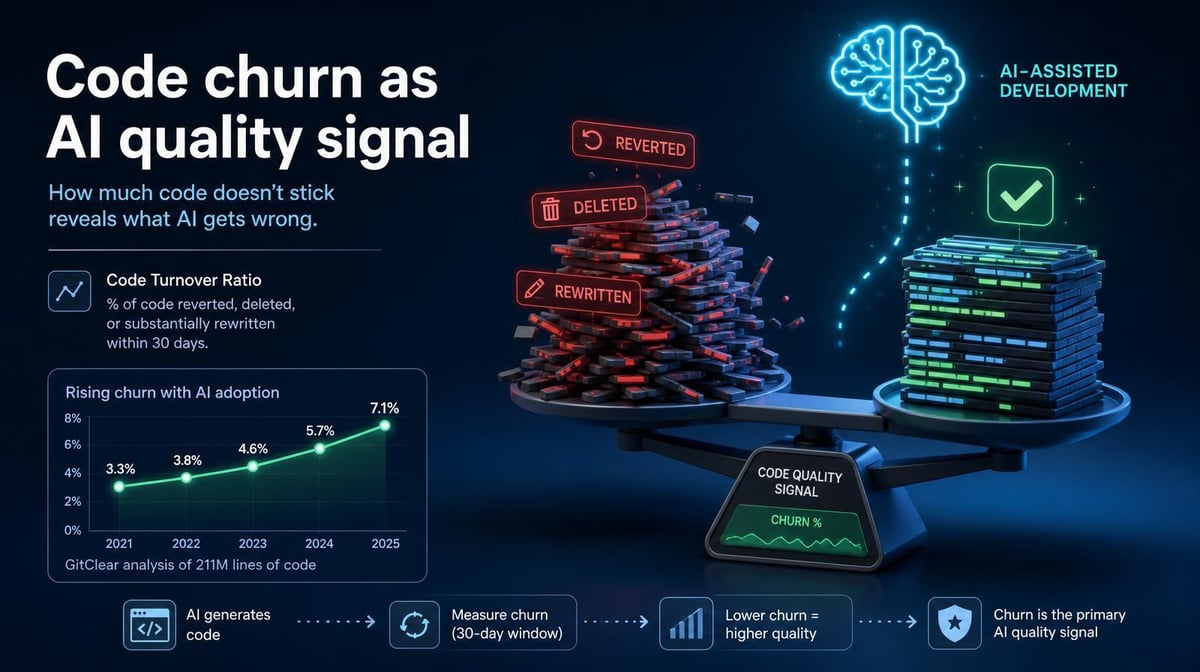
Code turnover is narrower. It measures the percentage of merged code that is reverted, deleted, or substantially rewritten within a defined window, typically 30 or 90 days.
That makes turnover more useful for answering a specific AI quality question: is recently shipped code durable, or does the team have to redo it soon afterward?
The distinction also helps put external research in context.
GitClear analyzed 211 million changed lines of code from 2020 through 2024 and found an increase in short-term churn along with other maintainability concerns as AI coding assistants became more widely used.
That research points to a broader quality trend. Turnover lets an organization test what is happening in its own codebase.
Why Turnover Adds Context to Delivery Metrics
A pull request can pass review, merge successfully, deploy without incident, and still get substantially rewritten two weeks later. That rework may never appear in a production failure metric.
Larridin’s Developer Productivity Benchmarks 2026 treat code turnover as a quality measure alongside AI adoption, AI code share, velocity, and ROI. That combination matters because higher throughput alone doesn’t show whether the new output is durable.
In one Larridin customer environment, AI code share reached 56% while 30-day code turnover rose 64.7%. PR cycle time also increased during the same period.
Those measures moved together. They don’t establish that rising AI code share caused the additional turnover. The pattern tells leaders where to investigate.
3 Turnover Patterns Worth Watching
1. AI and Human Code Both Have Low Turnover
If recently merged AI-assisted and human-written code both remain relatively stable, the team has little evidence of a durability problem.
Continue watching the trend as AI code share changes. A stable quality pattern at 20% AI code share may look different after AI contributes half of the code entering the codebase.
The baseline gives the team something concrete to compare against as usage grows.
2. AI-Assisted Code Turns Over More Than Human Code
A gap between AI-assisted and human-written code can point to a problem specific to how AI is being used.
Look for where the difference is concentrated. It may appear in particular repositories, task types, teams, or workflows.
Then investigate what’s happening before changing AI access across the organization. The issue may be weak codebase context, prompting practices, review standards, or the types of work being handed to AI.
The goal is to identify the source of the rework rather than assume every AI-assisted change carries the same risk.
3. Overall Turnover Rises as AI Code Share Grows
This pattern deserves attention even when the data doesn’t show that AI caused the increase.
In Larridin’s customer example, AI code share, code turnover, and PR cycle time all rose during the same period. That could reflect AI-assisted code, but it could also reflect changes in project complexity, team composition, requirements, release pressure, or review practices.
Segmenting the data helps narrow the possibilities.
Compare AI-assisted and human-written code, then look by team, repository, use case, and time period. If the turnover increase is concentrated in AI-assisted work, leaders have a more specific quality problem to investigate.
Measure Turnover With the Metrics Around It
Turnover shouldn’t become the only quality score.
Pair it with measures that show what happened before and after the code was merged:
- AI code share
- Delivery or throughput
- Review and rework
- Change failure rate
- Incidents
- Revert rate
Each answers a different question.
AI code share shows how much AI contributes. Delivery metrics show how quickly work moves. Change failure rate and incidents capture production problems. Turnover catches code that gets quietly rewritten before it necessarily causes a failure.
Reading those signals together helps leaders distinguish productive acceleration from higher output that creates more downstream work.
What to Do When Turnover Rises
Start by finding where the change is concentrated.
If AI-assisted turnover rises while human-written turnover stays stable, inspect the AI workflows creating the most rework. Look at task type, prompting or context, review practices, and the tools being used.
If turnover rises across both AI-assisted and human-written code, the problem may be broader than AI. Project complexity, changing requirements, team changes, or review pressure may be contributing.
Then adjust the process that matches the problem.
That could mean improving codebase context for AI tools, strengthening review for specific types of AI-assisted work, changing which tasks use AI, or addressing a broader engineering-quality issue.
The metric points leaders toward the investigation. It doesn’t diagnose the cause by itself.
Frequently Asked Questions
What’s the difference between code churn and code turnover?
Code churn measures overall modification activity, including normal refactoring and feature changes. Code turnover focuses on recently merged code that is reverted, deleted, or substantially rewritten within a defined window. Turnover is more directly focused on code durability and rework.
What’s a healthy code turnover rate?
Start with your own baseline and compare AI-assisted and human-written code over consistent time windows. Larridin’s benchmarks provide external ranges for context, but team, codebase, and workload differences can affect what healthy turnover looks like.
Does rising turnover mean AI is creating technical debt?
Not automatically. Rising turnover alongside rising AI code share is a pattern to investigate. Segment the data by code source and other factors before concluding that AI caused the increase.
What’s the difference between code turnover and revert rate?
Revert rate tracks code or changes that are explicitly rolled back. Turnover is broader and can also include deletion and substantial rewriting. A team can therefore have a low revert rate while still rewriting a meaningful amount of recently merged code.
Should we reduce AI usage when turnover rises?
Not based on the overall turnover number alone. First determine whether the increase is concentrated in AI-assisted code and where the rework is happening. A targeted workflow or review change may be more appropriate than reducing AI use across the team.
Track Whether the Code Actually Sticks
Higher AI-assisted output is useful when the resulting code remains durable.
Larridin’s AI Dev Productivity platform connects AI code share with delivery and quality signals, including code durability, so engineering leaders can see whether greater AI use is producing work that holds up over time.
Book a discovery call to measure the quality and durability of AI-assisted code across your engineering organization.