

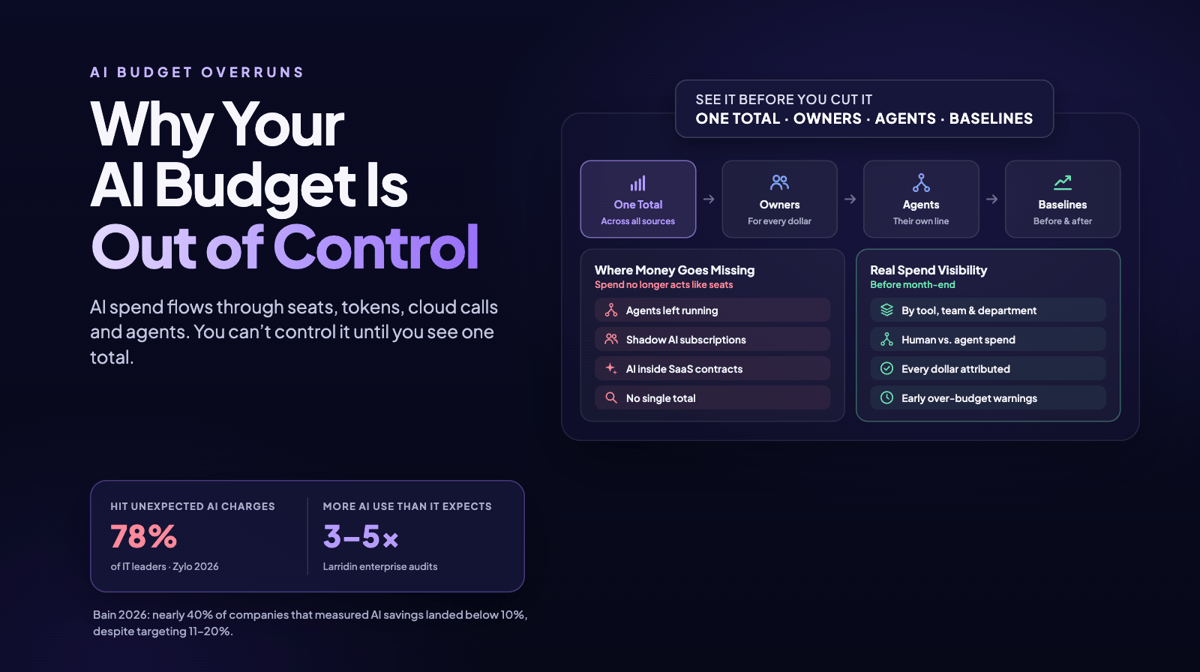

AI budget overruns are harder to catch because AI no longer behaves like fixed software spend. Costs move through seats, tokens, APIs, cloud calls, and agents. The budget problem is not just rising consumption: it is consumption without clear ownership, execution boundaries, or evidence of useful outcomes.
Key Takeaways
- Consolidate direct AI charges with infrastructure, orchestration, operations, labor, and quality costs.
- Assign spending to teams, agents, workflows, and accountable owners before trying to govern it.
- Agent architectures can increase both unit costs and cost variability. Measure successful outcomes, human intervention, and expensive outliers.
- CTOs and CFOs need a shared view of costs, forecasts, controls, and outcomes to decide what to expand, investigate, or reduce.
- Forecast fixed commitments and variable consumption separately, with scenarios for workload growth, credits, model mix, and pricing.
- A longer-term investment case needs checkpoints and evidence of progress. It does not remove budget accountability or determine accounting classification.
Why the Traditional Software Budget Breaks
Seat-based budgets assume relatively predictable subscription costs. AI adds variable consumption that depends on workload volume, model selection, context, retries, tool calls, and agent execution.
- Software subscriptions and AI add-ons.
- Token and API charges.
- Cloud model usage and supporting infrastructure.
- Agents that execute multiple steps without a person initiating each one.
A subscription inventory cannot explain all those costs. A model invoice cannot show everything required to run the workflow. A total token count cannot establish whether the result was useful.
Token Spend & Insights addresses the need to consolidate spending and connect it to its sources. Reconcile operational consumption with billed costs, documenting credits, discounts, bundled allowances, and missing data.
Where the Money Goes Missing
Agents Running Without Oversight
Repeated model calls, chained workflows, and retries can accumulate charges beyond the initial request. An orphaned agent continues operating without a current accountable owner.
Record the agent’s purpose, owner, billing source, permissions, execution boundaries, and stop conditions. A spending alert provides warning; it does not necessarily enforce a limit.
Shadow AI Subscriptions
Team purchases can sit in corporate-card statements and expense accounts outside central procurement. Connect available discovery data with financial records to identify shadow AI costs.
No discovery method should be assumed to capture every tool or device. Make coverage gaps explicit.
Embedded AI in Existing SaaS
Review whether AI features are included, separately licensed, or billed by consumption. Existing contracts can create new AI cost exposure without a standalone purchase.
No Reconciled Total
Model-provider telemetry, cloud invoices, subscription records, and internal allocations may report overlapping amounts. Align periods and currencies, avoid double counting, and retain an explicit category for unknown ownership or estimated attribution.
The Model Invoice Is Not the Full Cost
The CTO and CFO cost-governance framework expands the budget view into four areas:
- Direct AI spend: Models, API consumption, subscriptions, and licenses.
- Data and infrastructure: Relevant storage, embeddings, retrieval systems, caching, compute, and data transfer.
- Orchestration and operations: Workflow execution, monitoring, security, integration, and maintenance.
- Labor and quality: Implementation, human review, corrections, failure recovery, and rework.
Define which costs belong in the assessment and how shared resources are allocated. Keep invoice charges distinct from estimated labor or overhead so finance can understand the calculation.
A low token bill can coexist with substantial review or recovery effort. Optimizing only the visible provider charge can miss the larger source of waste.
Why One Agent Interaction Can Hide Many Costs
A linear workflow may retrieve information and return one response. An orchestrated agent can plan, retrieve, call tools, invoke subagents, validate results, and repeat steps before finishing. Each stage can add model or infrastructure consumption.
The agentic cost analysis published August 27, 2026 reports an EY illustrative customer-service comparison of $0.04 per interaction for a simpler workflow and $1.20 for an orchestrated version. That is the source article’s reported 30-fold example, not a universal multiplier or a forecast for your organization.
The practical lesson is architectural: “one interaction” is not a consistent unit of work across systems. Compare your own workflows using equivalent acceptance and quality criteria rather than applying the headline multiplier to the budget.
Measure Cost per Successful Workflow
Define the intended result: a resolved support case, accepted engineering change, verified analysis, or completed transaction. Include the relevant costs of producing that result, including failed attempts and recovery within the assessment period.
A completed execution that fails the quality threshold should not count as a successful outcome. Specify the numerator, denominator, and reporting period so comparisons remain meaningful.
Track Success and Human Intervention
Measure completions, failures, restarts, and human interventions. Planned human oversight may be part of the workflow; unplanned correction is a different signal. Account for both rather than treating autonomy as an automatic advantage.
An inexpensive agent that repeatedly transfers work to people can be poor value once the entire process is assessed.
Inspect the Distribution, Not Just the Average
Similar tasks can follow different execution paths. Track average cost alongside the range, expensive outliers, retry frequency, and workload context. Investigate whether growing context, repeated tool calls, or unsuccessful loops explain cost spikes.
A seemingly reasonable average can hide a small set of runs that drives the budget risk. Higher token consumption should not be presumed to improve quality.
Compare Cost With Value
A more expensive agent may justify its cost through better outcomes or reduced overall effort. Evaluate quality, cycle time, rework, and cost per accepted result together. Separate cash savings from released capacity and additional output.
What Real Spend Visibility Includes
- Costs by team, tool, model, agent, workflow, and use case where attribution supports it.
- Separate views of human-driven and agent-driven spending.
- Fixed commitments, variable consumption, and relevant supporting costs.
- Current trends, projected spending, and budget-risk signals.
- Accountable owners and documented unknown or estimated allocations.
- Delivery, quality, and business outcomes associated with the spending.
The AI measurement framework considers utilization, proficiency, and value together. These dimensions organize evidence; they do not substitute for a financial ROI calculation.
Give the CTO and CFO the Same Picture
Engineering understands architecture, tool execution, and changes in consumption. Finance understands invoices, commitments, allocation, and budget exposure. Cost governance requires those views to meet.
Agree on four questions for every material cost area:
- Who owns it?
- Which budget, execution limit, or approval rule applies?
- What triggers investigation or escalation?
- Who decides whether spending continues, expands, or is reduced?
Use common definitions and a shared attribution record. Finance should not have to infer workflow ownership from an invoice, and engineering should not have to infer financial exposure from a token counter.
Add Forecasting and Actionable Controls
Establish a usage baseline, separate predictable subscriptions from variable execution, and update forecasts as workload mix or pricing changes. Credits and allowances can temporarily reduce bills without reducing consumption.
Send budget-risk alerts to the accountable owner and define the response. Where the execution system supports them, apply appropriate retry limits, approval gates, spending caps, or termination conditions. Verify enforcement rather than assuming every warning can stop consumption.
Higher spending is not itself a governance failure. Unexpected growth without ownership, explanation, or an outcome review is the concern.
Forecast the Overrun Before the Invoice Arrives
A budget sets the spending plan. A forecast estimates where actual spending is headed. Your budget can stay fixed while the forecast changes because a team introduces an agent, switches models, adds a workflow, or exhausts a provider credit.
The enterprise AI spend forecasting guide extends spend visibility into an early-warning process. Build the forecast from the bill and the behavior behind it, not a seat-count spreadsheet alone.
Reconcile Billed Spend With Observed Usage
Keep invoice charges alongside available token, model, request, and agent usage. Credits, discounts, bundled allowances, and pricing terms can reduce the current bill without reducing consumption. Record when those terms expire so temporary discounts do not become permanent planning assumptions.
Keep each provider’s cost logic intact rather than applying one blended token rate to every workload. Separate committed subscriptions from variable consumption and supporting costs. Document missing data and estimates instead of presenting an incomplete total as exact.
Model the Drivers, Not Just the Team Average
Segment variable costs by team, model, agent, workflow, project, or use case where attribution supports it. A few high-consumption users or workflows can drive the bill while an organization-wide average conceals the concentration.
Use a baseline that represents normal activity for the workload. There is no universal history requirement: a new deployment may need a rolling baseline, while an established workflow needs enough history to capture ordinary variation. Flag unusually expensive runs rather than treating them as typical behavior.
Model Mix Can Break a Budget Even When Prompt Volume Looks Stable
Larridin’s September 11, 2026 analysis of CTO Ameya Kanitkar’s investment and spending arguments summarizes his Forbes Technology Council data across Larridin enterprise customers. In that reported dataset, Claude Sonnet accounts for 70% of API prompts but 51% of API spend. Claude Opus accounts for 27% of prompts but 48% of spend, with each Opus prompt reported to cost three to four times more. These are figures from the source’s customer dataset, not universal model prices or a forecast for your organization.
The budget implication is direct: prompt volume and spending are not interchangeable. A shift toward a more expensive model can change the bill without a matching increase in requests. Forecast model mix alongside workload volume, and evaluate whether the higher-cost model improves quality or cost per accepted result enough to justify the difference.
The same September 11 analysis reports that, over a 10-week period in the underlying customer dataset, active Claude users increased 41% and sessions increased 76%. Those figures describe changing consumption, not demonstrated business value. They show why a static annual assumption can become stale quickly. The source does not specify the observation dates or sample size; treat the figures as an attributed example of volatility, not a planning benchmark.
Costs also arrive through cloud model providers, AI subscriptions, browser plugins, desktop agents, custom connectors, and API gateways, each with its own reporting. Reconcile those sources before attributing variance to adoption alone. Ask whether workload growth, model selection, execution behavior, or billing terms changed, then connect the answer to an accountable owner.
Show Scenarios and Their Budget Exposure
Build a base case from current usage and known commitments, then model plausible changes in adoption, agent execution, model mix, workload volume, credits, and prices. Show which assumptions move the forecast above the budget and which owner must respond.
For multi-year planning, include more than one pricing path. Higher prices, relatively stable prices, and lower unit costs can each produce different exposure. Lower unit prices also do not guarantee lower total spending if consumption grows faster.
Reforecast When Behavior Changes
Compare forecast with actuals as new data arrives. Investigate meaningful variance and revise assumptions when workflows, models, or billing terms change. Define review and escalation thresholds with finance and engineering rather than waiting for the next annual planning cycle.
A forecast provides warning; it does not stop execution. Connect budget-risk signals with the ownership, approval gates, and enforceable limits described above. Decide whether increased consumption is expected, valuable, and affordable before the period closes.
A Longer Return Horizon Is Not Permission to Overrun
The CapEx versus OpEx investment-framing guide adds an important distinction to budget control. Monthly variance tells you whether spending exceeded the plan. A longer-term investment review asks whether that spending is building a capability whose outcomes justify its cost.
Use both views. Cutting every rising AI bill can interrupt a useful investment before teams develop proficiency. Excusing every overrun as an investment can preserve waste indefinitely. A credible business case defines the expected return, measurement horizon, checkpoints, quality standards, and conditions for changing or stopping the rollout.
Separate the Investment Argument From the Spending Evidence
The analysis of Kanitkar’s two statements distinguishes his Business Insider case for evaluating AI as a longer-term capital investment from his Forbes description of token spend as a “variable operating expense.” The first concerns the horizon for judging returns. The second concerns the behavior of consumption costs.
Those arguments can inform the same budget conversation, but they do not establish the same conclusion. The reported model-mix and usage-growth data explains why AI costs are difficult to track and forecast. It does not prove that those costs qualify for capitalization, or that rising consumption is producing a return.
For finance and IT leaders, the response is to maintain both disciplines: govern variable spending now and test the longer-term capability case at agreed checkpoints. Neither an accounting label nor an investment narrative explains who is spending, what changed, or whether the work was worth its full cost.
Track the Capability Trajectory Alongside Cost
Follow comparable workflows over time. Measure adoption, proficiency, cycle time, output quality, human intervention, and cost per successful outcome. In engineering, examine delivery and code quality alongside AI usage and spend. Keep released capacity distinct from cash savings and revenue that has been realized.
Initial costs can precede measurable gains while teams learn tools, redesign workflows, and add review or governance. That possible J-curve is a planning assumption to test, not a guaranteed return. At each checkpoint, ask whether the expected improvement is appearing and whether its economics support further spending.
Keep Strategic Framing Separate From Accounting Treatment
A CapEx-style investment conversation does not mean all AI expenditure qualifies for capitalization. Accounting classification depends on the specific expenditure and applicable rules. Finance should assess that treatment separately; the strategic case still needs ownership, a budget, a forecast, and evidence of value.
If results underperform, revisit tool fit, adoption, proficiency, workflow design, quality, and cost assumptions. Adjust the deployment, rationalize spending, or reconsider the investment. A longer horizon earns credibility through measurable progress, not through relabeling the bill.
What Finance and IT Leaders Should Do Now
- Establish the total cost scope: Reconcile direct charges and document infrastructure, operations, labor, and quality costs.
- Assign owners and use cases: Investigate unknown costs and orphaned agents before allocating them arbitrarily.
- Separate human and agent spending: Preserve their different execution and forecasting patterns.
- Set controls and escalation rules: Distinguish warnings from enforced limits and name the decision owner.
- Measure successful outcomes: Track quality, intervention, rework, cost variation, and cost per accepted result.
- Build comparison evidence: Establish baselines and comparable workloads. The CFO guide to AI monitoring develops the assessment approach.
- Reforecast from observed behavior: Compare billed costs and consumption, model concentrated workloads separately, and show the assumptions behind budget-risk scenarios.
- Define a return horizon: Review cost alongside capability and outcomes at agreed checkpoints, with criteria for continuing, changing, or stopping the investment.
- Optimize before cutting indiscriminately: Investigate retries, abandoned execution, duplicated capabilities, and correction-heavy workflows, then scale what the evidence supports.
A before-and-after improvement is not automatically caused by AI. Account for task complexity, staffing, and process changes, and disclose uncertainty in the investment case.
Frequently Asked Questions
What is the difference between tracking and governing AI costs?
Tracking records spending. Governance defines ownership, rules, escalation, and decisions. Cost and outcome evidence make those decisions informed.
Do agents always cost 30 times more?
No. The linked article reports an illustrative EY comparison of different customer-service architectures. Measure your own workflows; do not treat that example as a universal budget multiplier.
Which costs are easiest to overlook?
Costs outside the model invoice, including retrieval infrastructure, orchestration, security, integration, human review, maintenance, and failure recovery. The relevant mix depends on the workload.
Is average cost per agent run sufficient?
No. Pair the average with cost variation, expensive outliers, success rates, quality, and intervention effort so failed or costly runs do not disappear inside a blended figure.
Is high AI spending necessarily a problem?
No. It can be justified by valuable outcomes. Evaluate the full workflow economics rather than reducing spending solely because its absolute amount is high.
Where should governance start?
Identify tools and workloads, reconcile cost sources, attach owners and use cases, and establish a baseline. Add forecasts, controls, and outcome review from that shared starting point.
How is an AI spend forecast different from a budget?
The budget is the approved spending plan. The forecast estimates where spending is headed based on commitments, usage, and pricing. Update the forecast as behavior changes and use the variance to trigger an accountable decision before an overrun occurs.
How should we handle credits and discounts?
Track billed costs alongside underlying consumption and record the applicable terms and expiration dates. Model what happens when credits or discounts end. A temporarily lower invoice does not necessarily mean a lower ongoing cost trajectory.
Should AI be evaluated as CapEx rather than OpEx?
A longer-term investment framing can help assess capability development and return over time, alongside monthly budget control. It does not determine accounting treatment. Whether a particular cost qualifies for capitalization requires a separate assessment under applicable accounting rules.
Can prompt volume explain an AI budget overrun?
Not by itself. The model mix, context, retries, tool calls, and billing terms can change the cost of each request. Compare usage and billed spend by model and workflow, then assess quality and cost per successful outcome before deciding whether higher spending is justified.
Who should own AI forecasting?
Assign a clear forecast owner in finance or FinOps, with engineering and workload owners supplying context on agents, model changes, and planned usage. Shared attribution data lets both sides explain variance and agree on the response.
Control the Budget by Governing the Work
Larridin connects AI spend with adoption, proficiency, and business outcomes across tools and teams. Its spend intelligence supports attribution across human and agent work so technology and finance leaders can evaluate costs together.
Establish ownership. Make execution costs visible. Measure successful work and its full economics. That is the foundation for removing waste while preserving AI investments whose value withstands scrutiny.
Book a discovery call to discuss AI spend governance.
Related Resources
- Larridin’s CTO Says AI Spend Should Be CapEx. Here’s What His Own Numbers Show.
- Your AI Spend Forecast Is Probably Wrong. Here’s How to Build a Better One.
- AI Costs as CapEx, Not OpEx: The Framing Shift That Changes the Budget Conversation
- AI Cost Governance: What CTOs and CFOs Need to See
- Agentic AI Costs and Workflow Economics
- What Is Shadow AI?
- AI Token Spend and Insights