

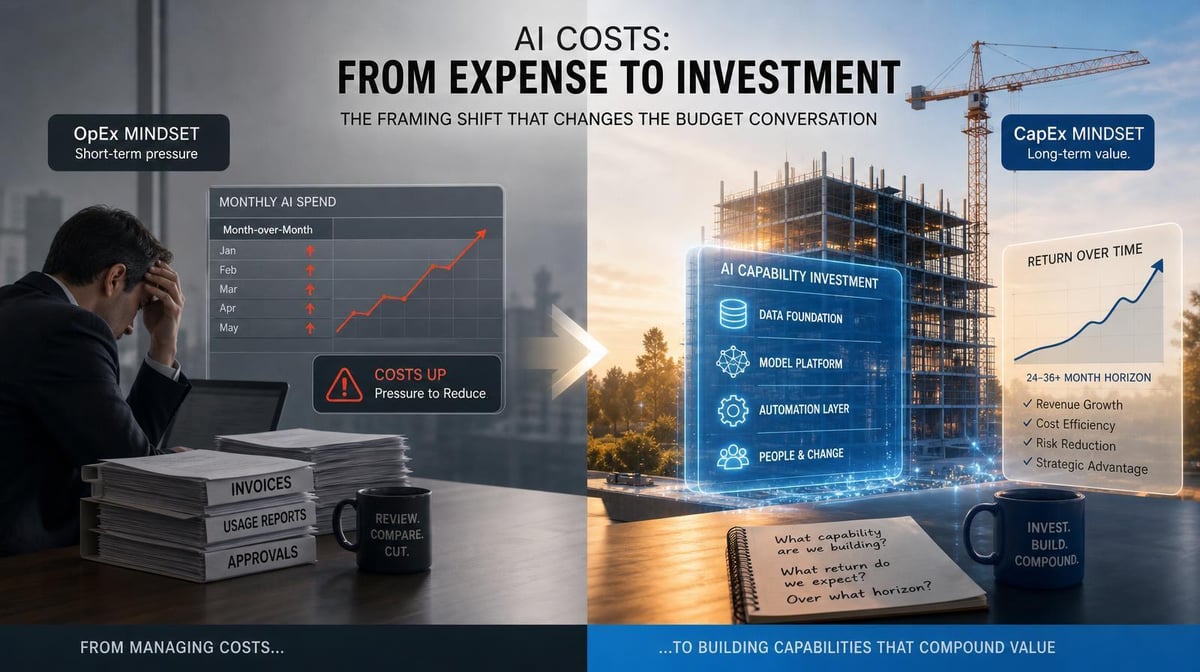

Most enterprise AI spending is treated as an operating expense: a monthly line item that finance reviews against budget and compares with the previous month. That framing creates constant pressure to reduce AI costs. A longer-term investment framing asks a different question: what capability are we building, and what return do we expect over what horizon?
Key Takeaways
- Larridin CTO Ameya Kanitkar told Business Insider that AI costs should be treated as capital expenditures rather than operating expenses, and organizations shouldn’t expect gains immediately.
- OpenAI CFO Sarah Friar’s Useful Intelligence per Dollar scorecard asks whether each AI dollar produces more value as usage grows. That reinforces the need to evaluate AI against the value it creates over time, not cost alone.
- A CapEx-style investment case needs a defined return horizon and evidence that the capability is improving. Monthly spend can show what AI costs. It can’t show whether productivity, proficiency, quality, or value is improving alongside it.
Why the Framing Matters for the CFO Conversation
An OpEx framing asks a familiar CFO question: Is this month’s AI spend within budget, and why did it change? The CapEx framing asks a different question: Is this AI investment building the capability the business expected, and is it on track to produce the projected return? Those conversations require different evidence.
If AI costs rise over six months, a monthly operating-cost view focuses on the increase. That can create pressure to cut spending before leaders know whether the additional investment is producing better results.
A CapEx view evaluates cost against outcome. Instead of asking only whether AI spend increased, leaders ask whether the underlying capability and business value are improving alongside the investment.
What Makes the CapEx Framing Defensible
Long-Term Data Showing the Capability Trajectory
A CapEx framing needs evidence that the organization is building something more valuable over time.
Monthly cost data shows expenditure. Quarterly productivity trajectory data shows whether the investment is producing measurable change. Is AI proficiency across the engineering organization improving? Is code quality holding as AI code share increases? Is delivery velocity per dollar of AI spend trending in the right direction?
Tracking those measures over multiple quarters turns the CapEx framing into an evidence-based investment case.
Larridin’s AI Impact connects AI spend with adoption, proficiency, and outcomes so CTOs and CFOs can see whether increased investment is accompanied by measurable improvement.
A Return Horizon With Defined Measurement Criteria
A longer return horizon should still come with clear expectations. Before committing more budget, finance and technology leaders can agree on what improvement should look like and when they expect to see evidence of it.
For example, a CFO and CTO might evaluate the investment over several quarters using measures such as onboarding time, delivery speed, quality, AI proficiency, and cost per successful outcome. At each review, the question becomes whether those measures are moving in the expected direction, not simply whether the monthly AI bill increased.
Larridin’s Developer Productivity Benchmarks 2026 can provide additional context when engineering outcomes are part of that business case.
J-Curve Communication at Deployment
The CapEx framing also helps explain the period when AI costs begin before the full productivity return appears.
Teams need time to adopt new tools, develop proficiency, redesign workflows, and absorb new review or governance work. During that period, costs can rise while measurable gains are still developing. That pattern can look like a failed investment if it’s only viewed as a monthly operating expense. A longer-term investment framing doesn’t guarantee a return, but it gives leaders a defined period to measure whether the deployment is moving toward it.
Our guide to the AI coding tool J-curve explains how to set checkpoints without either cutting an investment too early or excusing weak results indefinitely.
How OpenAI’s Scorecard Fits the CapEx Conversation
OpenAI CFO Sarah Friar’s Useful Intelligence per Dollar scorecard approaches the problem from a different direction but reinforces the longer-term measurement logic.
One of its four questions asks: Does each AI dollar produce more value as usage grows?
OpenAI recommends following the same workflow over time and tracking successful work, cost, cost per successful task, and quality.
That’s useful evidence for a CapEx-style investment conversation because it asks whether AI economics improve as usage grows.
For a CFO, that shifts the discussion from “What did AI cost this month?” toward “Is each dollar producing more useful work over time?”
Frequently Asked Questions
Does treating AI as CapEx have accounting implications?
Potentially, but the strategic framing and accounting classification are separate questions. Whether a specific AI expenditure qualifies for capital treatment depends on the expenditure and the accounting rules that apply. The framing is about evaluating AI with a return horizon and measurable capability goals rather than judging it only by monthly cost.
How do we present the CapEx framing to a CFO who is used to OpEx AI reporting?
Start with a business case that defines the expected return, the measurement period, and the criteria leaders will use to judge progress. Then report AI cost alongside those outcomes so the CFO can see whether the investment is on track rather than reviewing spend in isolation.
What’s the practical difference between CapEx and OpEx AI evaluation in a budget review?
An OpEx-style review focuses heavily on current spending and budget variance. A CapEx-style investment review adds the capability and return: what is the organization building with that spending, and is it progressing toward the expected outcome?
What happens if AI investment underperforms against the business case?
Revisit the assumptions behind the investment. Look at whether the problem is tool fit, adoption, proficiency, workflow design, or another constraint. If the expected return isn’t developing, leaders can change the rollout, rationalize spending, or reconsider the investment.
Build the Data Record That Makes the CapEx Framing Work
A longer return horizon is only credible if leaders can show what is happening during it.
Larridin connects AI spend with adoption, proficiency, productivity, and outcomes over time, giving CTOs and CFOs the evidence they need to evaluate AI as an investment rather than a monthly bill alone.
Book a discovery call to build your AI investment case around measurable return.