

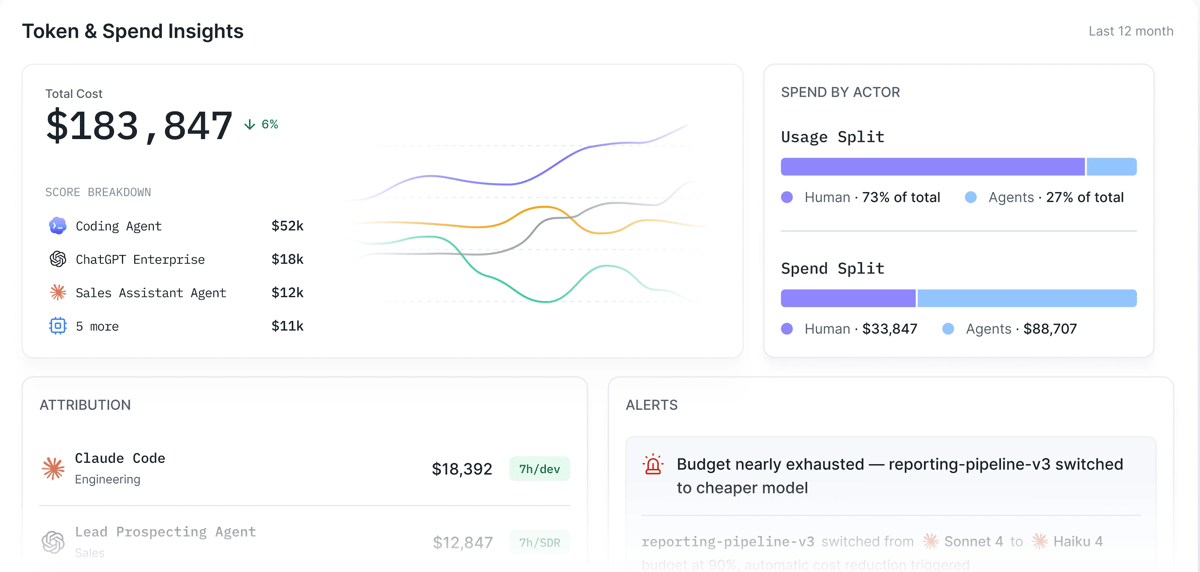

Tracking, allocating, and budgeting enterprise AI spend requires more than a provider invoice. Finance and IT need to understand what was billed, which usage generated it, who owns the workload, and what the organization received in return.
Larridin introduced Token Spend & Insights to connect that financial picture with teams, agents, projects, and use cases. The product brings cost sources together and adds attribution, forecasts, and budget-risk signals that support accountable decisions.
Those same capabilities also support board reporting. Leadership needs a concise explanation of spending, ownership, budget exposure, and accepted outcomes, with the evidence and limitations behind the numbers.
What We Built
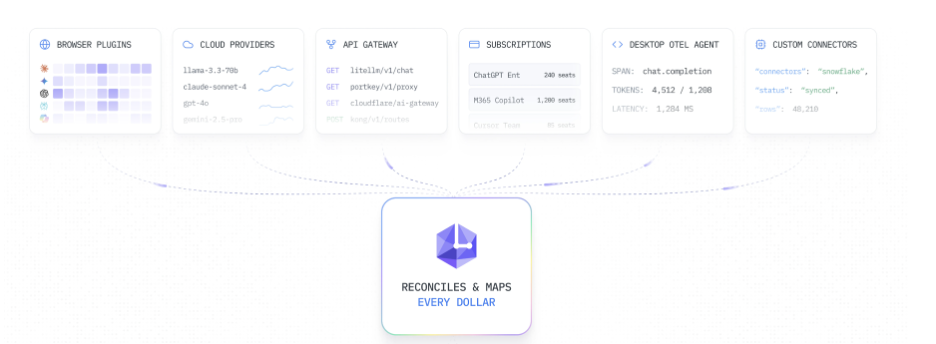
AI Spend Sources Consolidated
Token Spend & Insights ingests spend and usage from sources such as Bedrock, GCP, OpenAI, Codex, Cursor, Claude, LLM gateways, employee-built agents, desktop applications such as Cowork, and invoice data in CSV files.
Consolidation gives finance and technology leaders a shared starting point. Confirm the connectors, source coverage, supported fields, and billing periods for your deployment. Keep missing sources visible rather than presenting a partial record as complete.
Observed Token Usage and Billed AI Spend
The product distinguishes consumption from the amount charged after credits, discounts, subsidies, and included allowances. Those views answer different questions:
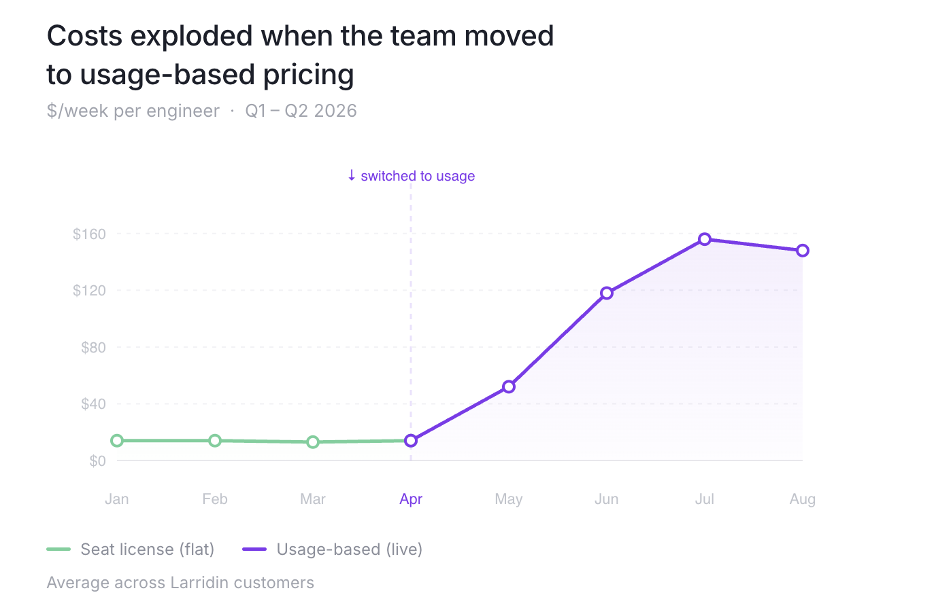
- Observed usage: Token and model activity where available helps explain workload behavior and supports scenarios for different pricing and commercial terms.
- Billed spending: Reconciled charges show the current financial cost and support accounting and budget review.
Usage is not a guaranteed future bill. Prices, model mix, caching, credits, and workload behavior can change. Likewise, a temporarily low invoice does not establish low ongoing consumption.
Model-level attribution can reveal candidates for routing or optimization. Test another model against quality, reliability, latency, privacy, and total cost before assuming a cheaper token rate will preserve the result.
Attribution to the Work Behind the Cost
Connect available tokens and dollars with departments, teams, agents, projects, workflows, and use cases. Attribution helps leaders investigate variance, assign accountability, and evaluate investments beyond an organization-wide total.
Some sources support more detail than others. Preserve shared, estimated, or unattributed amounts and document the allocation method. An unknown owner is a gap to investigate, not a reason to manufacture a precise assignment.
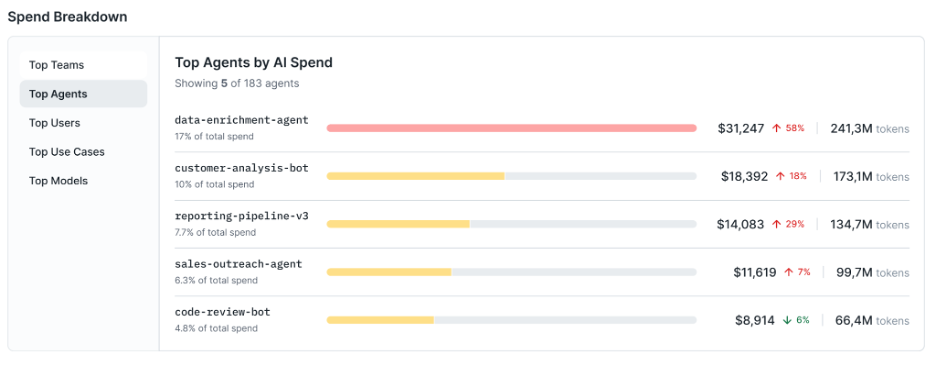
Alerting and Projections
Token Spend & Insights surfaces projected overages, unattributed costs, agents without clear ownership, and dormant seats. These signals help the responsible team investigate before a budget issue becomes larger.
Attach an owner, escalation path, and response to each material signal. A projected-overage alert is not an enforced spending cap. Stopping or limiting execution requires the appropriate control in the provider, gateway, or agent system.
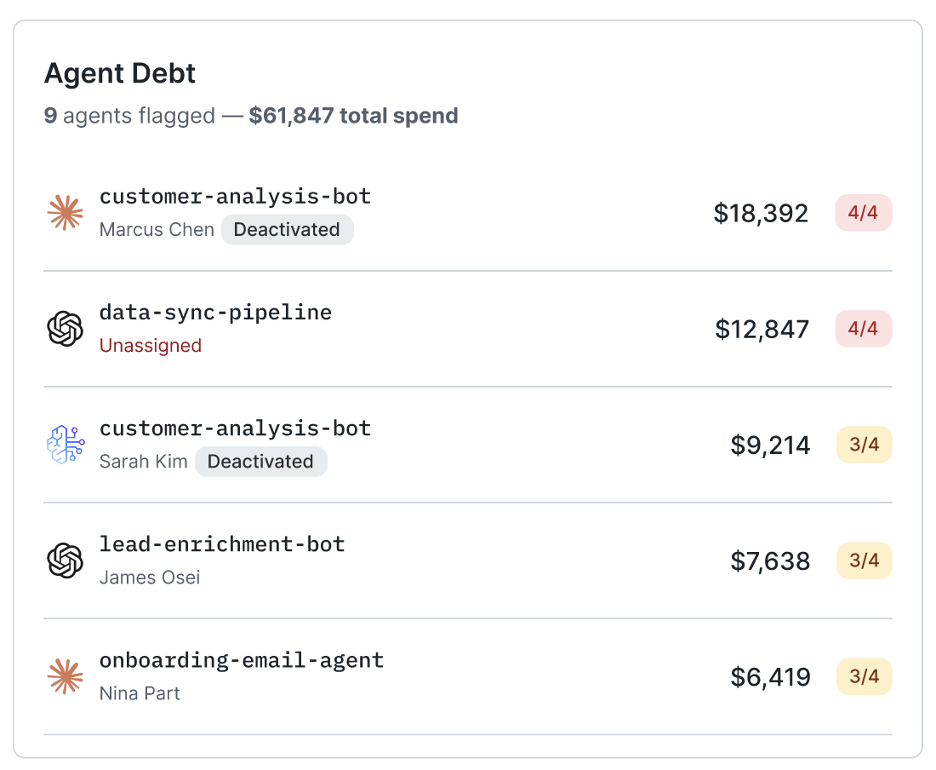
Turn the Product View Into Board-Ready Reporting
The AI token spend board-reporting guide translates these capabilities into four reporting measures. They are a practical management framework, not a universal regulatory reporting requirement.
1. Total AI Spend and Trend
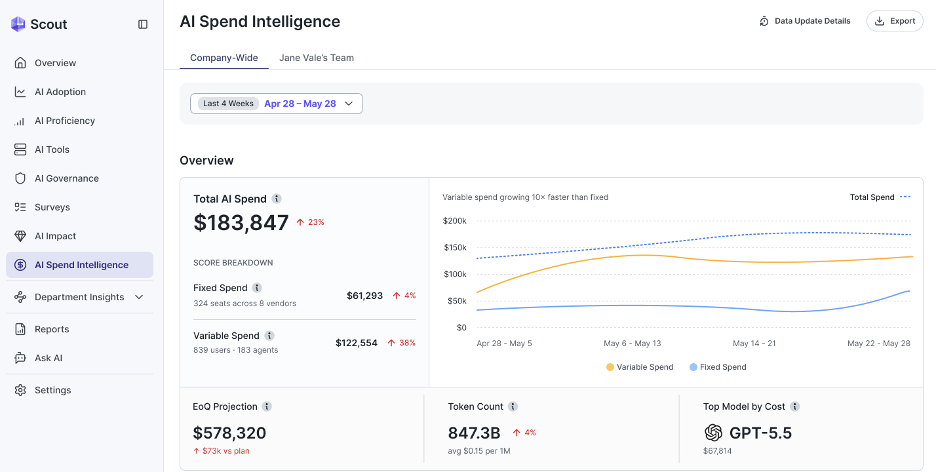
Report the cost for a defined period and show the trend across comparable prior periods. State the sources included, fixed commitments, variable charges, and known omissions. Explain material changes by business unit, team, tool, model, agent, or use case where attribution supports it.
Decide whether the headline includes only direct billed AI charges or broader infrastructure, operations, and labor costs. Keep that scope stable, and show the reconciliation if it changes.
2. Allocation Coverage
Show the share of the defined spend total connected to an accountable owner and the business dimensions required by your reporting policy. Then identify the largest shared or unattributed pools, the reason for the gap, and the remediation owner.
A cost tagged to a department may still lack an agent owner or use case. Define what counts as allocated rather than treating every tag as equivalent. There is no universal healthy threshold; track progress against your own baseline without concealing uncertainty.
3. Projected Spend Versus Budget
Combine actual spending, projected period-end spending, and the approved budget. Explain the assumptions behind the forecast and the workflows or teams driving material variance.
Show anomalies, expiring credits, unused seats, unowned agents, and the action taken. Use scenarios where consumption or pricing is uncertain. A new high-value workflow can justify increased spending, but it needs an explicit decision rather than an unexplained overrun.
4. Cost per Useful Outcome
Choose a unit suited to the use case, such as a resolved customer issue, verified transaction, accepted engineering change, or durable feature. Define success and quality criteria, and distinguish an intermediate artifact from a completed business outcome.
Include relevant failed attempts and recovery in the stated cost scope. Pair unit cost with quality, rework, human review, and delivery. A lower cost can result from easier work or weaker acceptance standards, not improved efficiency.
AI Impact and Developer Productivity provide outcome context alongside spending evidence. Confirm the integration coverage and comparison method for the workflow being reported.
Agree on the Reporting Method Before the Board Meeting
- Consolidate: Reconcile billed spend and available consumption across sources, periods, and currencies.
- Attribute: Map material costs to accountable owners and workloads, retaining unknown or estimated categories.
- Forecast: Add budget assumptions, scenarios, risk signals, and named responses.
- Connect outcomes: Apply consistent acceptance, quality, and cost definitions.
- Decide: State which investments should expand, change, continue, or stop, and who owns the next action.
Finance, engineering, procurement, and business owners should agree on the definitions and evidence limitations. The board summary can be concise, with a supporting record available for questions.
The source guide discusses emerging Tokenomics Foundation work on common cost, telemetry, and value standards. Treat that standards work as context, not an enacted reporting duty or proof that a product complies with a standard. Verify any required specification and implementation separately.
What Comes Next: Connect Spend With Durable Value
Visibility and attribution are the first milestone. The next challenge is connecting the financial record with the accepted work and business outcomes it supports.
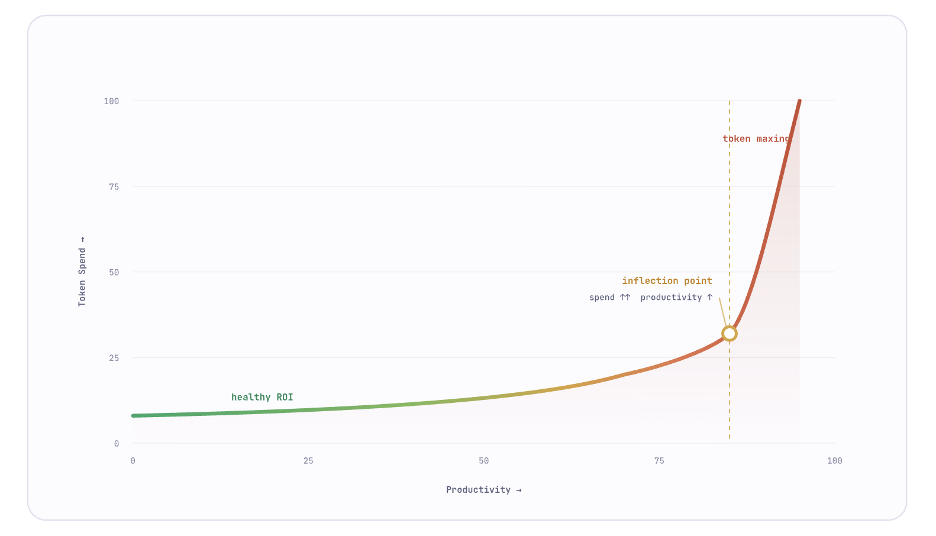
The figure illustrates a diminishing-return question to test in your environment. It should not be read as a universal rule that a particular fraction of AI spending is productive. Measure where incremental usage produces useful outcomes and where it adds repetition, recovery, or review without proportional value.
Connecting systems of record, costs, and workflow results helps leaders scale evidence-backed investments and redesign or reduce weaker ones. A before-and-after difference does not alone establish causation; account for work mix, staffing, and other process changes where practical.
Separate operational gains, released capacity, projected benefits, and realized cash savings. If outcome attribution is incomplete, report the gap and the next measurement step rather than a precise ROI figure the evidence cannot support.
Frequently Asked Questions
Does the board need raw token counts?
Usually not as the headline. Token and model data can explain cost drivers, while spending, allocation coverage, budget exposure, and accepted-outcome economics support investment decisions.
Why show both observed usage and billed spend?
Observed usage explains consumption. Billed spending reflects the charge under current commercial terms. Credits, discounts, and allowances can make them diverge, so reconcile both rather than treating either as a complete financial forecast.
Does an alert stop an agent from spending?
Not automatically. Alerts identify a risk. Enforced budgets, approval gates, or stop conditions must be implemented and tested in the execution system capable of applying them.
How often should AI spending be reviewed?
Monitor material changes operationally and review budgets with owners regularly. Board reporting may be quarterly when conditions are stable, but major unexplained spikes, exposure, or investment decisions can require earlier escalation.
What if we cannot connect spending to outcomes yet?
Start with reconciled spending, ownership, budget trends, and available operational measures. State what remains unknown and assign the work to improve attribution. Honest limits are more useful than unsupported financial precision.
Learn More About Token Spend & Insights
Token Spend & Insights connects the cost record with teams, agents, projects, and workflows so technology and finance leaders can ask better questions about what to fund next.
Explore the product or contact our team to discuss consolidation, attribution, and reporting needs.