
Enterprise AI Measurement Guide
Survey Data
Survey Results
What dimensions does the Survey Results table cover for each engineering survey respondent, and how do the per-respondent scores relate to ORG and TEAM averages?
What it shows
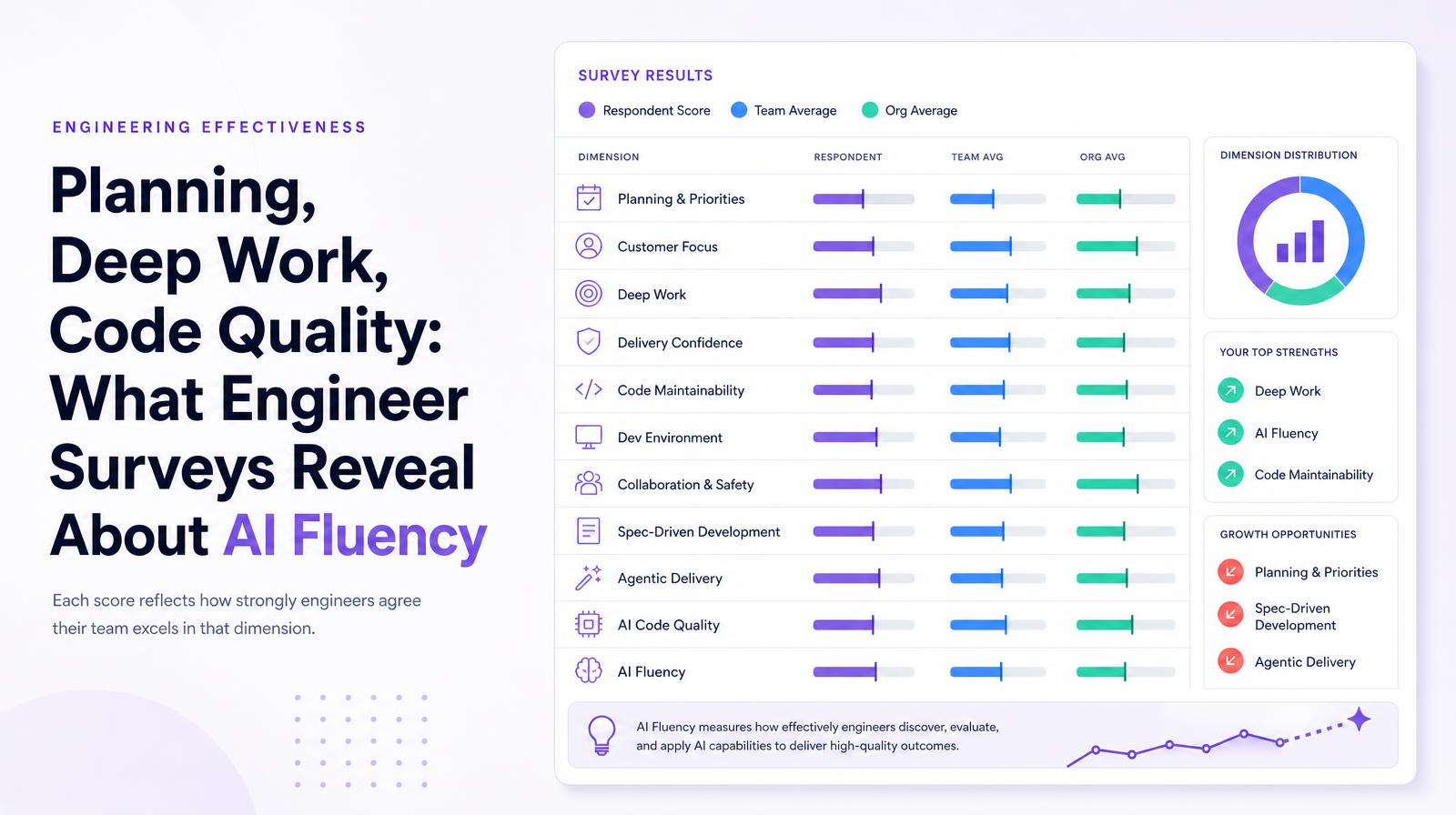
The Survey Results table shows each respondent's score across eleven dimensions of engineering effectiveness, Planning & Priorities, Customer Focus, Deep Work, Delivery Confidence, Code Maintainability, Dev Environment, Collaboration & Safety, Spec-Driven Development, Agentic Delivery, AI Code Quality, and AI Fluency, alongside org and team averages for each dimension. The per-respondent view makes it possible to identify clusters of engineers with consistently high or low scores across multiple dimensions, rather than reading only aggregate team averages.
Why it matters
The eleven dimensions span both the traditional engineering effectiveness questions (planning, delivery confidence, code maintainability) and the AI-specific ones (Agentic Delivery, AI Code Quality, AI Fluency). That combination is intentional: AI fluency doesn't exist independently of engineering fundamentals, and an engineer scoring low on Spec-Driven Development alongside high on Agentic Delivery is a risk profile, agents operating without clear specs produce exactly the kind of output that inflates turnover rates and rubber stamp rates. The survey creates the qualitative context for the quantitative signals elsewhere in the dashboard.
The Larridin angle
Larridin cross-references survey dimensions with observed behavioral metrics, so an engineer who self-reports high AI Fluency can be compared against their actual AI Code Share, Rubber Stamp Rate, and Outcome Success score. That triangulation between self-reported and system-measured data is where the most actionable development insights come from.
Related Survey Data Metrics
Common questions
What dimensions are covered in the Larridin Survey Results?
The survey covers eleven dimensions including Planning & Priorities, Customer Focus, Deep Work, Delivery Confidence, Code Maintainability, Dev Environment, Collaboration & Safety, Spec-Driven Development, Agentic Delivery, AI Code Quality, and AI Fluency.
Why is AI fluency important in engineering surveys?
AI fluency is crucial because it integrates with engineering fundamentals, and discrepancies in dimensions like Spec-Driven Development and Agentic Delivery can indicate potential risks in engineering outputs.
How does Larridin use survey data to provide insights?
Larridin cross-references survey dimensions with behavioral metrics, allowing for a comparison between self-reported data and actual performance, leading to actionable development insights.
What is the significance of identifying clusters of engineers with similar scores?
Identifying clusters helps in understanding patterns of high or low performance across multiple dimensions, which is more informative than just looking at aggregate team averages.