
Enterprise AI Measurement Guide
AI Governance · AI Tool Compliance
Unapproved AI Tools DAU %
What percentage of our engineers' daily AI activity is happening on tools that haven't been approved by IT, and is that share growing or shrinking?
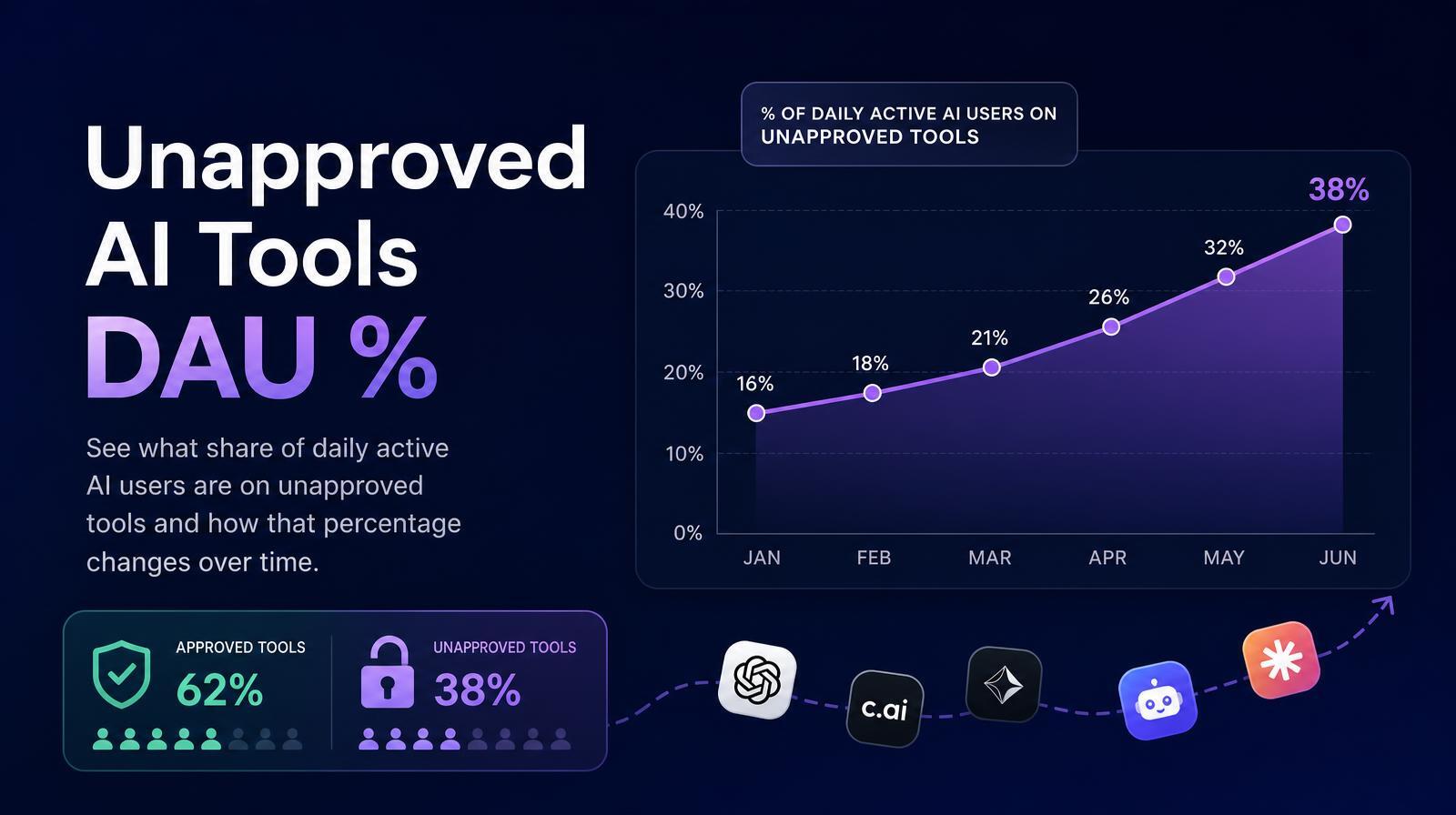
What it shows
Where the Unapproved AI Tools % measures the breadth of the shadow AI portfolio, the Unapproved AI Tools DAU % measures its depth: what share of daily active users are actually using unapproved tools on any given day. A high DAU % on unapproved tools is the governance signal that matters most operationally. It means shadow AI isn't just installed, it's embedded in daily work.
Why it matters
A compliance posture built on blocking tools that nobody actually uses is an easy win that creates false confidence. This metric forces the honest question: of the people who showed up to work today and used an AI tool, how many of them went outside sanctioned channels? If that number is high, the policy isn't working. Either it's too restrictive, causing engineers to route around it, or it's not enforced, meaning it exists on paper only. Both are problems, and they require different responses.
The Larridin angle
Larridin tracks both approved and unapproved tools through the same behavioral telemetry, which means the DAU % is calculated from observed usage, not from self-reporting or license tracking. An engineer using Claude Desktop (flagged unapproved) instead of Claude Browser (flagged approved) shows up accurately in both counts.
Related AI Governance Metrics
Common questions
How does the Unapproved AI Tools DAU % help in understanding AI tool compliance?
The Unapproved AI Tools DAU % provides insight into the extent to which daily active users are engaging with unapproved AI tools, offering a clear picture of compliance beyond just the number of unapproved tools in use.
What implications does a high Unapproved AI Tools DAU % have for our AI governance policy?
A high DAU % indicates that unapproved AI tools are deeply embedded in daily workflows, suggesting that current policies may be too restrictive or inadequately enforced, necessitating a review and potential adjustment of governance strategies.
How does Larridin ensure the accuracy of the Unapproved AI Tools DAU % metric?
Larridin calculates the DAU % from observed user behavior through telemetry, ensuring accuracy by tracking actual usage rather than relying on self-reporting or license tracking.
What should be our next steps if we notice a rising trend in the Unapproved AI Tools DAU %?
If the DAU % trend is rising, it is advisable to compare this change with policy enforcement data and other governance metrics to understand the underlying causes before making any policy adjustments.