

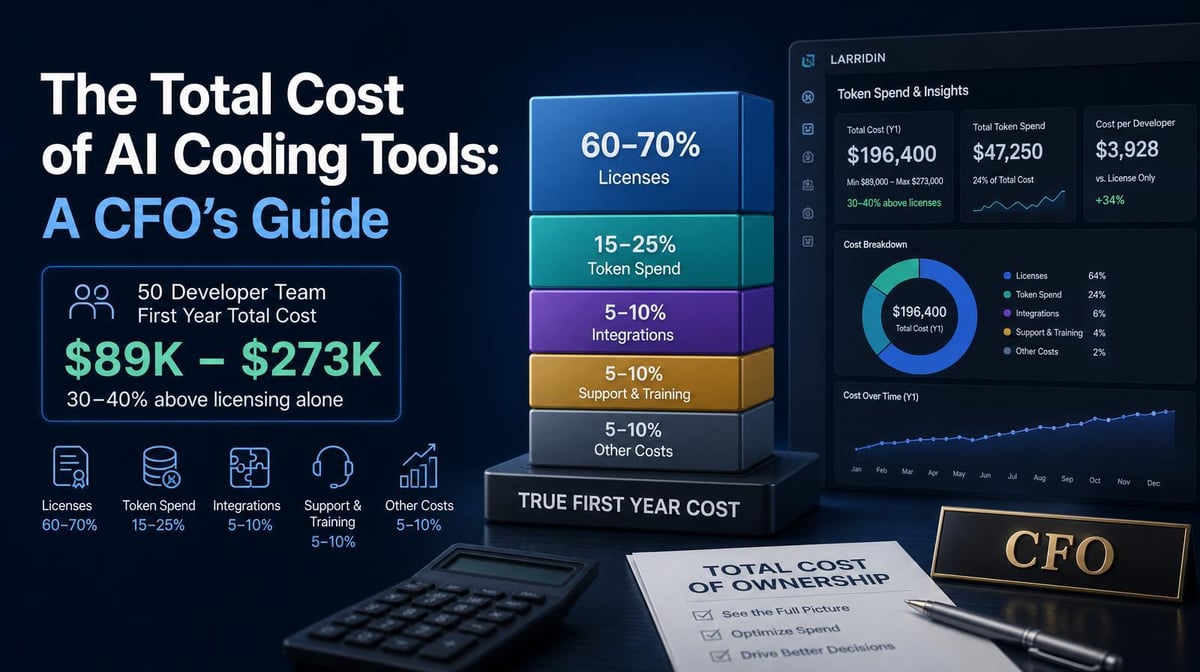

Seat prices are easy to budget. Agent usage, rollout labor, governance, and downstream rework aren’t. A CFO-ready model has to capture the full cost of putting AI coding tools into production and keeping them there.
Key Takeaways
- GitHub Copilot, Cursor, and Claude Code combine seat fees and consumption charges in different ways. The pricing page is an input, not a complete budget.
- The total cost of AI coding tools includes five layers: subscriptions and platform access, usage-based consumption, implementation and integration, enablement and governance, and review and remediation.
- The State of FinOps 2026 found that 98% of FinOps practitioners now manage AI spend, up from 31% two years earlier. AI coding costs need the same ownership, forecasting, and value discipline as other technology spending.
Why Pricing Pages Don’t Produce a Reliable Budget
AI coding pricing now mixes predictable access costs with variable usage.
GitHub prices Copilot Business at $19 per user per month and Copilot Enterprise at $39. Both include monthly GitHub AI Credits, and organizations can allow or cap additional usage after the included pool is exhausted. GitHub moved Copilot to this model in June 2026 because a quick chat question and a multi-hour autonomous coding session no longer represented comparable compute costs.
Cursor’s Teams Standard plan costs $32 per seat per month with annual billing or $40 monthly. Premium provides five times the included usage for $96 per month with annual billing or $120 monthly. Teams may also generate on-demand and separately billed usage.
Claude Enterprise costs $20 per seat per month plus usage at API rates. Anthropic reports that Claude Code averages about $13 per developer per active day and $150 to $250 per developer per month across enterprise deployments, but cost varies widely by model, codebase, and workflow.
Those pricing models aren’t directly comparable, and none captures every labor or operational expense required to deploy the tools safely.
5 Cost Layers CFOs Need to Model
1. Subscriptions and Platform Access
Start with paid seats, plan tiers, and platform licenses the decision actually adds.
Copilot Enterprise requires GitHub Enterprise Cloud. An organization that already uses the platform shouldn’t assign its full cost to Copilot. An organization buying or upgrading it specifically for Copilot Enterprise should include that incremental expense.
Apply the same logic to cloud commitments, security products, and other shared services. The model should capture costs caused by the deployment, not every technology expense engineering already carries.
2. Usage-Based Consumption
Model AI Credits, tokens, on-demand model usage, cloud agents, code reviews, and API charges separately from seats.
Consumption depends on the work. Routine completion, a long-context debugging session, and an autonomous agent can produce very different costs for the same developer.
Use a pilot to establish usage by team, workflow, model, and user type. Larridin’s Token Spend & Insights attributes AI costs across tools, teams, and workflows so finance can see what generated the charge.
3. Implementation and Integration
Include internal labor for identity and access management, security and legal review, procurement, configuration, integrations, logging, policy controls, continuous integration and delivery workflows, and reporting.
Estimate this cost from actual hours and loaded labor rates. A generic implementation percentage or borrowed dollar range may not resemble the organization’s environment.
4. Enablement and Governance
Developers need time to learn approved workflows, validate output, and understand when not to rely on the tool. Managers and platform teams may create documentation, office hours, examples, guardrails, and escalation paths.
Governance adds recurring work, including policy maintenance, access reviews, vendor assessments, audit support, and data-handling controls.
5. Review, Rework, and Remediation
AI-generated code still requires review, testing, and production monitoring. When output fails downstream, senior engineering, security, site reliability, and support teams absorb the cost.
New Relic’s 2026 State of AI Coding report found that 74% of surveyed organizations said at least one-quarter of AI-generated code required significant post-deployment rework, while 86% reported more senior-engineer firefighting.
Those figures shouldn’t become a universal cost assumption. They show why a TCO model needs organization-specific data on review time, rework, incidents, code turnover, and remediation.
Build a 50-Developer Budget Without False Precision
There’s no defensible universal total for a 50-developer deployment. The answer depends on the tool mix, seat tiers, active usage, agent workflows, existing infrastructure, rollout complexity, and quality outcomes.
Build low, expected, and high scenarios:
- Calculate direct access costs from the actual seat and plan mix.
- Estimate variable usage from a representative pilot, segmented by team, workflow, model, and user type.
- Convert implementation, enablement, governance, and administration hours into loaded labor costs.
- Add review, rework, incident, and remediation costs using the organization’s baseline and measured post-adoption results.
- Compare projected spend with actual in-period usage and update the forecast before renewal or budget reviews.
The output should be a range with visible assumptions, not one precise number built from industry averages.
What CFO-Ready Reporting Looks Like
A useful operating view shows seats assigned and actively used, included and additional consumption, projected period-end spend, cost by tool and team, implementation and governance labor, and the operational cost of AI-assisted work.
Managing AI cost is now mainstream FinOps work. The next step is connecting that cost to ownership and value.
Larridin combines cross-tool spend attribution with delivery and quality context. That gives finance and engineering a shared view of what AI coding tools cost, where spending occurs, and what the organization receives in return.
Frequently Asked Questions
What should be included in the total cost of AI coding tools?
Include seats and platform access, usage-based charges, implementation and integration labor, enablement, governance, administration, review, testing, rework, incident response, and remediation. Count only costs caused or increased by the deployment.
What does GitHub Copilot cost for a 50-developer team?
At current seat prices, 50 Copilot Business seats cost $950 per month and 50 Copilot Enterprise seats cost $1,950 per month before additional AI Credits and other incremental costs. The all-in total depends on usage and operational work.
Should GitHub Enterprise Cloud be counted as a Copilot cost?
Only when the Copilot decision creates that expense. An organization that already licenses the platform shouldn’t automatically assign its full cost to Copilot.
How often should finance update the AI coding budget?
Review allocation, usage, and outcomes at least monthly. Use in-period alerts and projected spend to catch unusual consumption before the billing period closes.
Is total cost of ownership the same as ROI?
No. TCO measures the full cost of the deployment. ROI compares that cost with measurable benefits such as faster delivery, avoided outside spend, lower rework, fewer incidents, or capacity redirected to business priorities.
Get the Complete AI Coding Tool Cost Picture
Larridin connects seat and consumption costs with teams, workflows, delivery, and quality outcomes across the AI coding stack. That gives CFOs a budget based on actual usage and operational impact rather than vendor sticker prices.
Book a discovery call to build your AI coding tool cost model.