


A short history of knowing how work actually works, and why we finally have the tools to accelerate and improve it.
There is a question that has haunted organizations for as long as they’ve existed: how does work actually happen here?
Not how the org chart says it happens. Not how the process documentation from years ago describes it. Not how the new VP thinks it happens when she presents to the board. How it actually happens: what people open, what they copy, what they wait for, what they do twice because something upstream broke, and no one told them.
Finding the answer to this question has always been difficult and expensive. So it has, until recently, largely gone unanswered.
Act One: The Archaeologists
The first serious attempt to answer questions about how work happens started in the late 1990s. A Dutch computer scientist named Wil van der Aalst had a simple and radical idea: every time a business process does something, it leaves a trace in the system log. If you collected enough of those traces, you could reconstruct what actually happened: not a model of what was supposed to happen, but an empirical record of what did.
He called this approach process mining. It was, and still is, a genuinely elegant idea.
The problem is execution. Those event logs live inside ERP systems: SAP, Oracle, the giant software monoliths that run operations in most enterprise companies. And extracting the traces left by business processes, and interpreting them, has required consultants. Lots of them.
Companies like Celonis built real businesses on exactly this: send in the consulting team, talk to some managers, pull the logs, run the analysis, interpret the results, produce the process map, and hand it to the client. The whole exercise took months of professional consultants’ time, as well as the client’s time, and the effort was billed accordingly.
Unfortunately, the usefulness of the results has tended to be short-lived. Because the world is changing, sometimes very rapidly indeed, even while the map is being put together.
Process mining, in this version, is archaeology. It’s excellent at telling you how work happened, firmly in the past tense. By the time the deliverable landed, the process had already evolved. The map was as accurate as it was going to get on the day it was drawn up, and increasingly fictional every day after.
The insight, that machine logs can help in mapping processes, was right. The instrumentation was too slow.
Act Two: The Watchers
The second act arrived in the 2010s, as SaaS proliferated and the ERP-centric world fragmented into dozens of overlapping tools. A new generation of process intelligence companies tried to span them.
UiPath and ServiceNow brought automation platforms with process discovery baked in. Task mining specialists such as Mimica built lightweight desktop agents that watch what people actually do and feed it back into process models. The approach was faster and more continuous than the archaeological approach introduced in the 1990s, and for the first time, it didn't require a consulting engagement to get started.
But the mental model underneath is still the same: here are your people, here are the tools they use, here is how work moves through them; now find the points of friction and recommend the automation needed to remove them.
The goal was a leaner process. The output was subtraction. Remove the waste, rationalize the handoffs. These tools ask the right questions for the problems they were designed to solve. But they weren’t designed for the world that was coming.
Act Three: A Different Kind of Question
Then AI happened.
AI's enterprise explosion in this decade didn't just make individual steps faster; it changed what is possible to do in a step at all. With AI, a workflow that once required four manual copy-paste handoffs between three systems doesn't just get trimmed; it potentially collapses into a single prompt, or disappears entirely.
That means the old question, ”Where's the waste?,” is no longer sufficient. The new question is: where can AI change what's possible? That's a bigger question, and it demands a different kind of map.
But here is the part that makes this moment genuinely different from every prior wave, and it isn't about AI capability at all.
For the first time in the history of process intelligence, the workforce itself is changing. Not just the tools. The workers.
Agents are entering the workforce: not as software that humans use, but as participants in workflows. They take handoffs. They produce outputs. They sit inside sequences that cross systems and teams.
And, unlike a human hire, you cannot watch an agent learn on the job and course-correct through observation. You cannot give it three months to absorb context, and you cannot rely on it to flag when something upstream has broken.
You need a workflow map before an agent ever touches production, and you need continuous visibility into what it's doing once it does; because without that, you have no guidance layer, no accountability layer, and no way to know whether the agent is adding value, or generating new failure modes three steps downstream.
Act one and act two were built for a workforce made entirely of humans. Act three must be built differently.
What This Requires
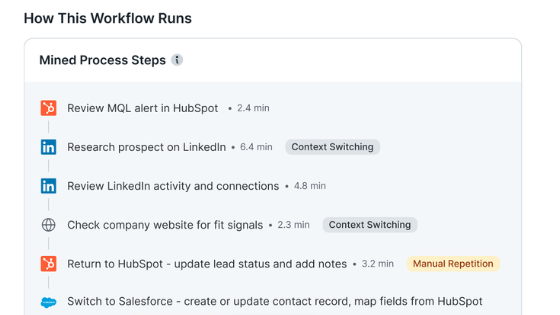
The third act of process intelligence doesn't need an archaeologist or a six-month consulting engagement. It needs something browser-native and continuous, across dozens of tools that no single system of record can see, because that’s how work today is done. It needs to be AI-native, because the point isn't just to map human workflows, but to find where AI can change what those workflows are capable of. And it needs to treat agents as first-class participants, because that is how the workforce is evolving, whether or not the org chart reflects it yet.
The question, "How does work actually happen here?" has always been worth answering. What's different now is that the answer has consequences beyond efficiency. It determines where you point your AI investments, whether your agents succeed or fail, and how you govern a workforce that is no longer entirely human.
That's a lot to ask of a map. Good thing we finally have the instrumentation to draw one.
Workflow Intelligence is now available. If you're preparing for agent deployment, or trying to prove AI ROI before your next budget cycle, get in touch.