

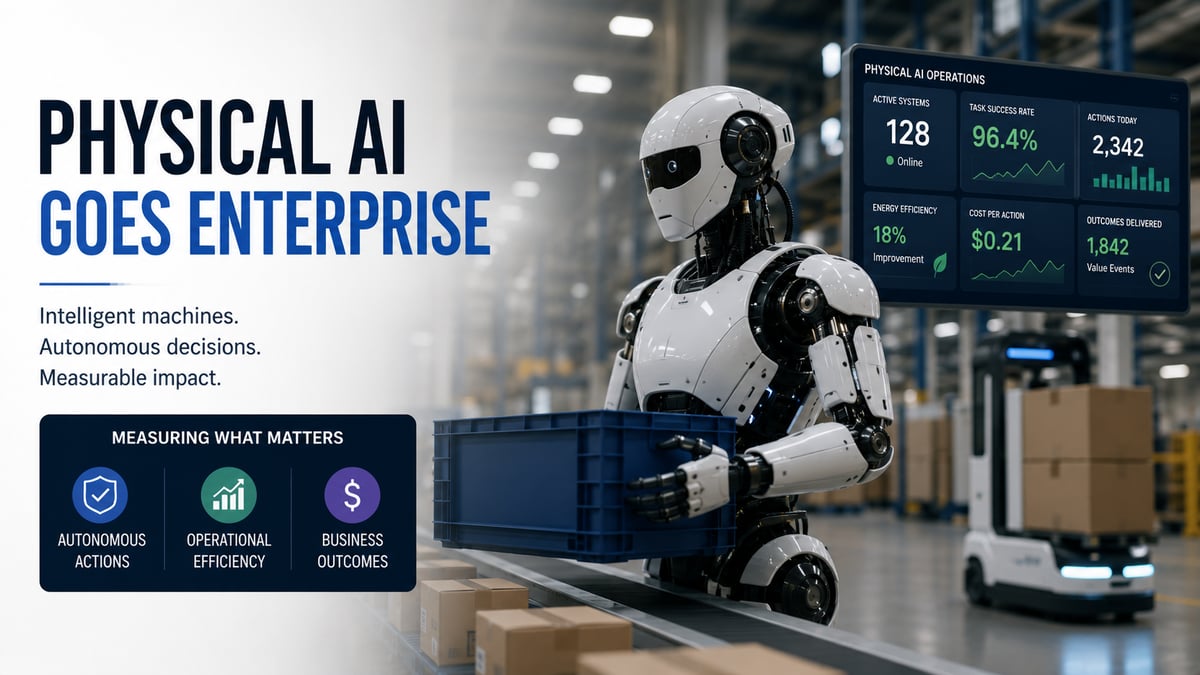

Physical AI is moving from research labs and pilots into manufacturing, logistics, and supply chain operations. CIOs and operations leaders need a clear view of how these systems make decisions, where humans stay involved, and whether they create measurable value.
Key Takeaways
- Physical AI combines AI models with robots, autonomous vehicles, and industrial machines that sense, interpret, and act in the physical world.
- Deloitte found that 58% of companies already use physical AI, with manufacturing, logistics, and defense leading adoption. Maturity ranges from limited use to commercial deployment.
- As physical and agentic AI converge, leaders need to govern both the machine’s actions and the digital workflows that trigger, review, and respond to them.
Key Terms
- Physical AI: AI systems that sense and act in the physical world through robots, autonomous vehicles, and industrial machines.
- Vision-language-action (VLA) model: An AI model that combines visual perception, language understanding, and action planning so a robot can interpret instructions and respond physically.
- Digital twin: A virtual representation of an environment, machine, or process used to simulate scenarios and test changes before deployment.
- Agentic AI: AI that plans and takes multi-step actions toward a goal. In a physical AI operating model, agents may interpret data, coordinate decisions, or initiate workflows.
- Autonomous mobile robot (AMR): A self-navigating robot used in warehouses, factories, and other facilities to move materials or support operations.
Quick Navigation
- What Physical AI Actually Is
- Where Physical AI Is Operating Today
- The Convergence With Agentic AI Is the Real Shift
- What Physical AI Means for Enterprise Measurement
- How Larridin Helps
- Frequently Asked Questions
What Physical AI Actually Is
Physical AI gives AI systems a way to perceive and act in the real world. Instead of producing only text, code, or analysis, these systems use sensors, cameras, robotics hardware, and specialized models to interact with physical environments.
At CES 2026, NVIDIA CEO Jensen Huang said, “The ChatGPT moment for robotics is here.” NVIDIA also released new Cosmos and GR00T models for robot learning, reasoning, and action. Partners including Boston Dynamics and Caterpillar introduced robots and autonomous machines built on NVIDIA technologies.
Traditional industrial robots typically execute predefined tasks in controlled settings. Newer physical AI systems can interpret less-structured inputs, adapt to changing conditions, and learn through demonstrations and simulation. That flexibility expands where robots can operate, but it also makes their behavior harder to govern through fixed rules alone.
Where Physical AI Is Operating Today
Enterprise adoption is real, although “adoption” covers a wide range of maturity. Deloitte surveyed 3,235 senior business and IT leaders and found that 58% of companies already use physical AI.
Commercial examples show how quickly the category is developing:
- Boston Dynamics began producing its enterprise Atlas humanoid in 2026, with deployments scheduled for Hyundai and Google DeepMind.
- Agility Robotics reports that Digit is commercially deployed in manufacturing, distribution, and logistics.
- Caterpillar expanded its NVIDIA partnership to support AI-enhanced machines, autonomous construction fleets, and intelligent manufacturing systems.
Physical AI hasn’t reached the same maturity in every industry or use case. But it has moved far enough into commercial operations that leaders need to evaluate it as an operational investment with real costs, outputs, dependencies, and risks.
The Convergence With Agentic AI Is the Real Shift
The bigger enterprise change is connecting physical systems to AI agents that interpret events, coordinate work, and recommend or initiate a response.
Consider a supply chain disruption. A digital agent may identify an inventory risk, evaluate routing or sourcing options, and trigger an approval workflow. A physical AI system may handle part of the response, such as moving materials, inspecting equipment, or adjusting an automated process. The value comes from how the digital and physical steps work together.
Microsoft has deployed more than 25 AI agents and applications across its supply chain, including demand planning, storage forecasting, and cargo recommendations. It aims to operate more than 100 agents by the end of 2026 while integrating early physical AI capabilities. That doesn’t mean the full supply chain runs without people. It shows how the operating model is moving toward connected simulations, agents, and physical systems.
For leaders, the question is shifting from “Should we deploy physical AI?” to “How will we know what it’s doing, when humans need to intervene, and whether it’s creating value?”
What Physical AI Means for Enterprise Measurement
Traditional equipment monitoring can show whether a machine is running, idle, or failing. Physical AI governance also needs visibility into why an autonomous action occurred, what systems influenced it, and what happened afterward.
Three questions become critical:
- Can we trace the decision? Leaders need an auditable record of the data, model, rules, agent actions, and human approvals behind high-impact decisions.
- What does the action cost? The full cost may include compute, energy, maintenance, downtime, supervision, and exception handling.
- What outcome did it produce? Uptime doesn’t show whether physical AI improved throughput, quality, safety, cycle time, or another business objective.
The consequences are also harder to reverse when AI acts in the physical world. A flawed digital recommendation can often be corrected before execution. A machine action may affect inventory, equipment, employee safety, or customer commitments before a person reviews it.
Measurement is therefore a shared responsibility across AI governance, operations, safety, IT, and finance. No single dashboard will cover the entire system.
How Larridin Helps
Larridin’s role is on the digital side of the operating model. Larridin Workflow Intelligence observes which applications teams use, the order and duration of steps, tool transitions, and friction patterns. Then it maps recurring workflows and compares how they perform with and without AI.
For organizations evaluating physical AI, that visibility can help measure the human and software workflows surrounding a deployment: planning, review, exception handling, approvals, escalation, and follow-up. It can show where AI reduces friction, where it adds overhead, and which surrounding processes need attention.
Larridin doesn’t replace industrial control, robotics telemetry, or safety systems. It strengthens the measurement layer around the digital work that supports physical AI. Combined with operational and machine-level data, this visibility gives leaders a more complete basis for governance and investment decisions.
Book a Discovery Call to discuss how AI measurement and optimization can support your physical AI strategy.
Frequently Asked Questions
What is physical AI?
Physical AI is AI that senses and acts in the physical world through robots, autonomous vehicles, and industrial machines. It uses sensors, cameras, models, and actuators to interpret conditions and complete physical tasks.
How is physical AI different from traditional industrial robots?
Traditional industrial robots usually execute predefined routines in controlled environments. Physical AI systems can interpret less-structured inputs, adapt to changing conditions, and learn or refine tasks through demonstrations, data, and simulation.
What industries are using physical AI today?
Manufacturing, logistics, supply chain operations, construction, and defense are among the leading areas. Commercial deployments include humanoid robots, autonomous heavy equipment, inspection systems, and warehouse robotics.
Why does physical AI require different measurement and governance?
Physical AI connects autonomous digital decisions to real-world actions. Governance must cover decision traceability, system and action costs, human oversight, operational outcomes, and safety. Leaders also need to understand the digital workflows around the machine, including approvals, exceptions, and escalation.
Related Resources
- AI Measurement Frameworks: Building a Repeatable Assessment Process
- Larridin Workflow Intelligence
- State of Enterprise AI 2026 Report
- AI Measurement and Optimization
Deploying physical AI or evaluating it for your operations?
Book a Discovery Call to build a clearer measurement strategy around the digital workflows that support it.