


Your organization has AI pilots underway. Can you measure which ones should scale, and how quickly your teams turn new evidence into better outcomes?
Key Takeaway
AI maturity measurement connects capability assessment with the decisions needed to progress from pilots to performance at scale. Stage models help identify missing capabilities. Improvement-cycle measures show whether the organization detects constraints, acts on them, and carries the learning into its next investment.
The MIT CISR enterprise AI maturity update published August 1, 2025 associates later maturity stages with stronger financial performance and highlights the transition from pilots to scaled ways of working. Treat those findings as research context, not a guarantee that moving to a stage label will produce a particular financial return.
Quick Navigation
- The Four Stages of AI Maturity
- Key Dimensions to Measure
- Building Your Maturity Assessment
- Tracking Progress Over Time
- Measure Maturity Velocity
- Advancing Your AI Maturity
- Build a Compounding Measurement Loop
- From Assessment to Action
- Frequently Asked Questions
- Speeding AI Adoption
Key Terms
- AI Maturity: The capabilities an organization develops to deploy, govern, measure, and improve AI across operations and business strategy.
- Maturity Model: A framework describing capability stages from experimentation to scaled, continuously improved adoption.
- AI Readiness Index: An assessment of capabilities such as strategy, governance, data, and technology.
- Benchmark: A defined reference for comparing capability or performance, with scope and methodology made explicit.
- Use Case: A specific application of AI to a business task or workflow.
- Maturity Velocity: How quickly the organization turns meaningful signals into decisions, interventions, and verified improvement.
- Compounding Advantage: Repeated gains supported by learning, reusable capabilities, and better-informed subsequent investment decisions.
The Four Stages of AI Maturity
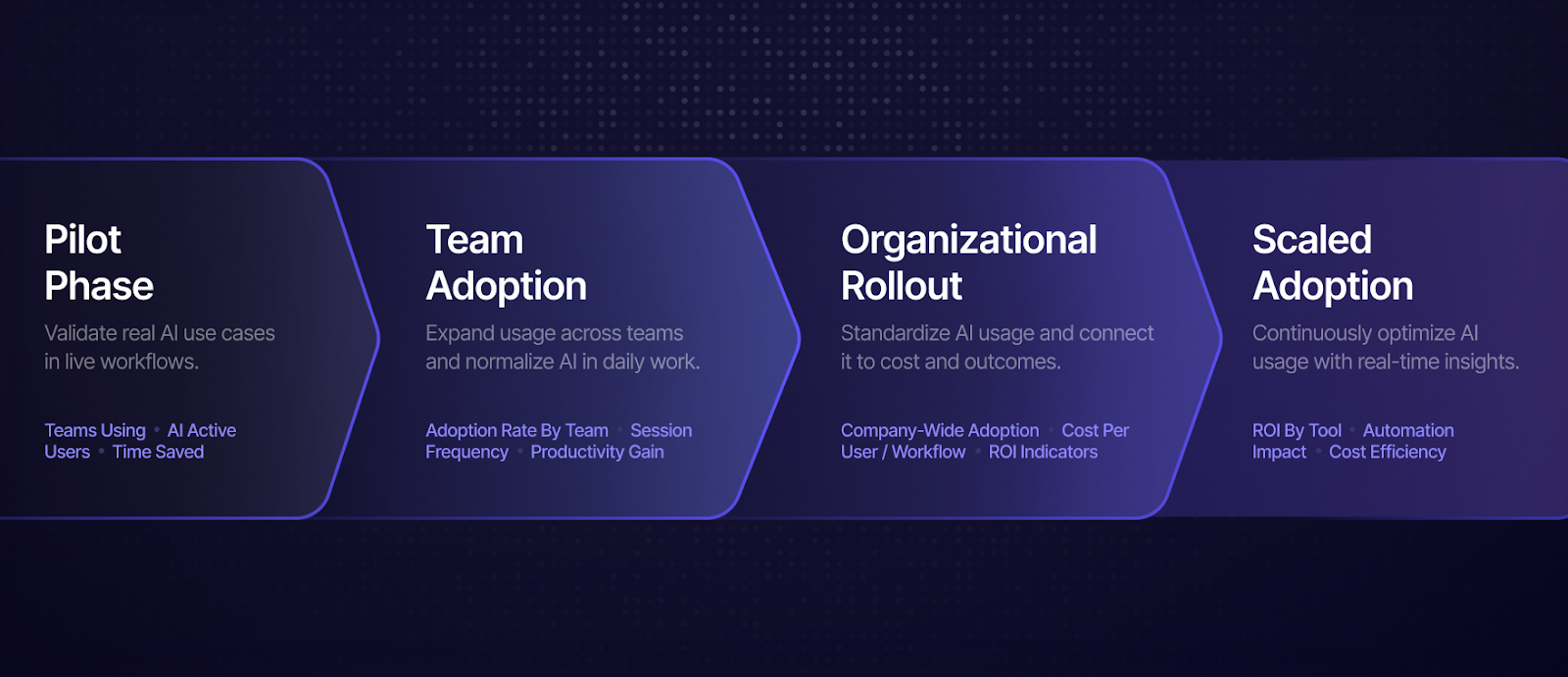
The MIT CISR report organizes enterprise AI development into four stages. Use this structure to assess the capabilities required for scaling:
- Stage 1: Build awareness and foundations. Develop AI literacy, governance policies, and initial experimentation.
- Stage 2: Run pilots and prove value. Track outcomes, build capabilities, and support AI-informed decisions at the frontline.
- Stage 3: Scale AI ways of working. Embed successful practices in workflows and redesign processes around what the evidence supports.
- Stage 4: Continuously optimize. Assess business value systematically and integrate AI improvement with broader transformation.
Different maturity frameworks use different stage definitions. Keep the framework and evidence criteria consistent when comparing assessments. A team may be advanced in one capability and still constrained by another; one enterprise-wide label can hide that variation.
Key Dimensions to Measure
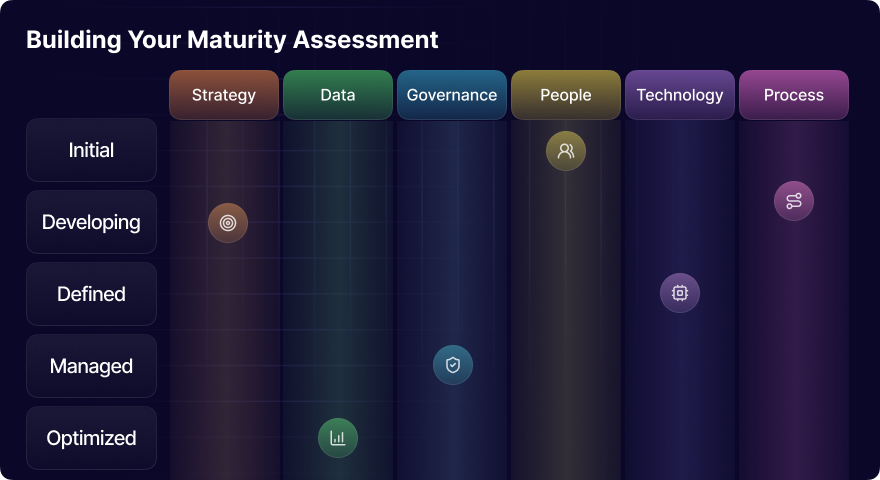
The Gartner AI Maturity Model evaluates readiness across strategy, product, governance, engineering, data, operating models, and culture. These capability dimensions help identify the constraints behind a stalled pilot or uneven adoption.
- Strategy alignment: Connect initiatives with business objectives and a defined investment decision.
- Data and infrastructure: Evaluate access, quality, permissions, and the systems supporting AI work.
- People and capability: Assess literacy, task-specific proficiency, and the support required to change work.
- Governance: Review ownership, human oversight, risk assessment, and tested controls.
- Operational outcomes: Measure cycle time, quality, rework, cost, and other use-case-specific results.
Readiness indicators describe the conditions for improvement. Outcome indicators test whether improvement happened. Training completion, tool access, and the number of pilots should not stand alone as evidence of business value.
Building Your Maturity Assessment
Use an established readiness framework to organize the assessment. The CNA AI Maturity Model offers a detailed capability assessment and roadmap approach. Select the depth appropriate to your mission and use cases rather than attempting every measure at once.
Conduct Self-Assessment, Then Validate It
Compare practices with the chosen model’s indicators. Assess teams and functions separately, and support self-reported answers with usage, workflow, governance, and outcome evidence where available. Record missing or uncertain data rather than treating an unanswered item as a verified capability.
Set Target Maturity Levels
Not every organization needs the highest level in every dimension. Choose target capabilities based on business strategy, risk, resources, and workflow needs. Prioritize the gap whose resolution will make the next meaningful outcome possible.
Create a Phased Roadmap
Break advancement into interventions with named owners, decision deadlines, and acceptance criteria. Structured improvement approaches such as CMMI can inform process discipline, while the AI maturity framework defines the capabilities being assessed.
Use workforce and workflow data to decide where to train, redesign roles, improve access, or change responsibilities. Match the intervention to the constraint rather than assuming every low score requires another tool.
Tracking Progress Over Time
Establish a baseline for adoption, tool usage, data quality, proficiency, governance coverage, and business outcomes. Review capability progress on a regular schedule, while using current operational signals to investigate changes between assessments.
Preserve consistent definitions and reporting periods. When the team, workflow, tool, or expected outcome changes, document the change and establish a relevant new baseline without discarding the history needed to explain progress.
Measure scaled use cases and workflow integration alongside quality, cycle time, rework, and cost. A stronger maturity score should be accompanied by evidence of stronger management capability or performance, not merely additional documentation.
Measure Maturity Velocity, Not Just the Current Stage
The maturity improvement-speed guide adds a complementary question to the stage assessment: how quickly can the organization detect a problem, diagnose it, and improve the next cycle?
A high stage score can coexist with slow responses to a model change, rising agent costs, or an emerging quality issue. Track five indicators:
- Signal latency: Time between a meaningful change and its detection by the responsible team.
- Decision latency: Time from the finding to an agreed response.
- Intervention time: Time required to change training, workflow, governance, or investment.
- Outcome movement: Whether the change improved the intended measure while preserving guardrails.
- Learning transfer: Whether the validated practice helped another relevant team or workflow.
Define the starting and ending events for each timing measure. Faster decisions are useful only if quality and governance remain sound. Do not reward rapid rollout or shorter review time when the intervention leaves risks unresolved.
Use a Repeatable Improvement Cycle
- Detect: Identify a material change in adoption, proficiency, spend, workflow performance, quality, or risk.
- Diagnose: Determine whether the constraint comes from data, tool fit, implementation, capability, governance, or workflow design.
- Decide: Choose whether to scale, redesign, support, consolidate, pause, or stop.
- Intervene: Make the change with an accountable owner and defined success criteria.
- Rebaseline: Test the outcome and use the evidence in the next assessment.
New agents, embedded features, and employee-created workflows can change the risk picture between formal reviews. Maturity includes the ability to discover those changes and update ownership and controls without waiting for the next annual assessment.
Advancing Your AI Maturity
MIT CISR research identifies four challenges in progressing from pilots to scale: aligning investment with goals, architecting modular platforms, creating AI-ready teams, and synchronizing work redesign with AI capabilities.
Translate those challenges into priorities:
- Early stages: Improve data quality and visibility, establish controls, develop literacy, and run bounded pilots with outcome baselines.
- Middle stages: Build reusable assets, targeted proficiency support, governance, and workflow redesign. Test whether pilot gains survive broader deployment.
- Advanced stages: Optimize repeatedly, review investment economics, transfer effective practices, and reassess agent permissions and oversight as capabilities change.
Compare against peers where definitions and workloads are compatible. External benchmarks provide context; they do not replace evidence that a change worked in your environment.
Build a Compounding Measurement Loop
The compounding advantage analysis explains how each assessment can improve the next investment. A one-time gain becomes a reusable capability only when the organization preserves the learning, applies it appropriately, and verifies the result again.
Measure adoption, proficiency, spend, and outcomes. Identify where value is growing or plateauing. Reallocate investment toward evidence-backed opportunities, address the constraints, and measure again against a relevant baseline.
Improve the Evidence Behind Decisions
Move from aggregate adoption totals toward workflow-level explanations of quality, cost, cycle time, and proficiency. Record which finding changed a funding, enablement, or deployment decision and whether the response worked.
Move Capital With the Evidence
Use measurement to support expansion as well as reductions. A promising use case with a solvable constraint may warrant targeted intervention. An initiative with persistent weak outcomes may need redesign or closure. Separate expected benefits from realized results.
Transfer Capabilities, Not Just Tool Access
Document reusable workflow practices, data assets, validation methods, proficiency support, and governance controls. Test their fit when transferring them to another function. Copying the same software does not reproduce the conditions behind a successful deployment.
Research discussed in the source article measures different populations, periods, and performance dimensions. Do not combine those findings into a universal AI leaderboard or assume that maturity alone caused the observed financial differences. Test your own operating improvements with comparable workloads and appropriate evaluation methods.
From Assessment to Action
Bring a stage assessment and an improvement record to each review. Show where capabilities remain uneven, which constraints were addressed, how long the response took, what outcomes changed, and which lessons transferred.
Ask whether your evidence is more specific than in the previous cycle, whether it changed where resources went, whether gains persisted, and whether another relevant workflow benefited. Rising adoption and spending do not answer those questions.
The goal is systematic advancement from pilots to reliable performance at scale. Keep capability development, decision speed, and outcome evidence together rather than making the stage label the objective.
Frequently Asked Questions
What is enterprise AI maturity measurement?
It assesses the capabilities needed to deploy, govern, measure, and improve AI consistently. Stage assessments show current development; maturity velocity shows how effectively new evidence leads to action and stronger outcomes.
Do improvement-speed measures replace maturity stages?
No. Stages identify capability gaps. Signal, decision, and intervention measures show how quickly the organization responds to those gaps. Use both with quality, governance, and business outcome evidence.
How does AI advantage compound?
It can compound when verified learning improves subsequent investments and deployments. Reusable practices, data, governance, and proficiency reduce repeated mistakes and support further gains. More tools or higher usage do not independently establish that effect.
What is a realistic timeline for improvement?
There is no universal timeline. Track your own response cycles and outcomes by workflow. Shorter latency matters when decisions remain sound and interventions produce the intended improvement.
How should baselines change as pilots scale?
Document changes in population, workload, tools, and acceptance criteria. Preserve historical definitions while introducing a baseline suited to the scaled process. Avoid presenting unlike workloads as a direct comparison.
Speeding AI Adoption With an Improvement System
AI dashboards become useful when they inform a specific action. Larridin connects AI Adoption, AI Fluency, AI Impact, and Workflow Intelligence so leaders can examine usage, capability, workflow constraints, and outcomes together.
Schedule a Demo to discuss your maturity assessment and measurement priorities.
Assess the capabilities. Act on the constraint. Verify the outcome. Preserve the learning that makes the next decision better.