

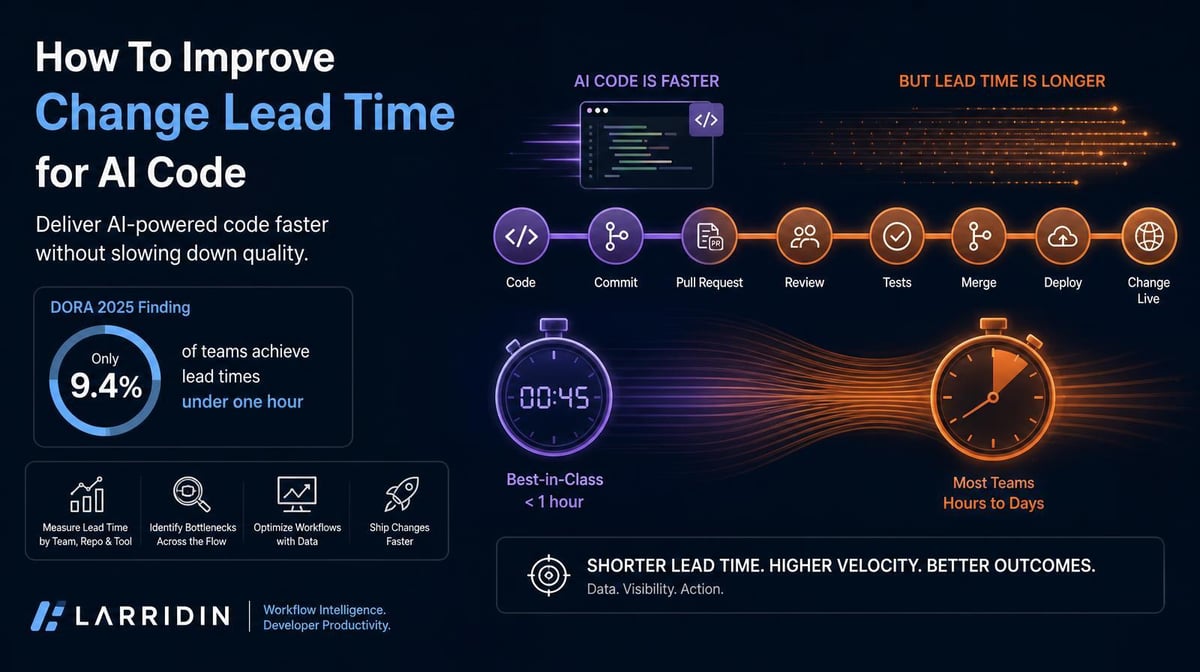

More code is entering the pipeline faster. If review, validation, merge, and deployment don’t keep pace, generation speed won’t translate into shorter change lead time.
Key Takeaways
- DORA’s 2025 State of AI-assisted Software Development report found that only 9.4% of respondents reported change lead times under one hour, while 43.5% reported lead times longer than one week. Faster code generation doesn’t guarantee a shorter path from commit to production.
- Larridin’s 2026 Developer Productivity Benchmarks show shorter pull request (PR) cycle times for AI-assisted work across benchmark tiers. But that metric covers only the period from opening to merging a PR, not the commit-to-production cycle.
- Improving lead time with AI-assisted development often requires addressing review and merge constraints, not further accelerating code generation. Stage-level data shows where the bottleneck actually sits.
Where the Lead Time Problem Actually Is
The assumption that AI coding tools improve lead time seems intuitive: if engineers produce code faster, then the code should reach production faster. But generation is only one stage in the delivery system.
Larridin’s 2026 Developer Productivity Benchmarks show that AI-assisted PRs can move faster through part of that system. Average AI-assisted PR cycle time is 24 to 36 hours compared with 36 to 48 hours for human-only PRs. Elite teams can reduce the times to under eight hours and under 12 hours, respectively.
Larridin defines PR cycle time as PR opened to PR merged. Change lead time extends through production, and even that total can hide the delay.
DORA’s 2025 research helps explain that distinction. AI amplifies the surrounding engineering system: a mature delivery process may convert faster generation into faster delivery, while a constrained process may simply receive more work at the same review, validation, merge, or deployment capacity.
The gap becomes visible when leaders measure each stage. A Larridin customer’s pipeline recorded zero seconds of PR-ready time, one hour, two minutes in review, and 57 minutes to merge. Most measured time accumulated after generation.
Our AI code review bottleneck article covers how to diagnose that downstream pressure without assuming review is the constraint everywhere.
5 Levers for Improving Lead Time in an AI-Assisted Environment
1. Measure Lead Time by Stage, Not in Aggregate
Aggregate lead time tells you that work is slow, but not where or why.
Break the cycle into PR-ready time, reviewer pickup, active review, validation, merge, and deployment, and track each separately. Segment the data by team, repository, code source, PR size, risk level, and tool. This shows where bottlenecks are forming so leaders can target the right intervention. If generation is fast and review is slow, accelerating generation further will only add pressure to the queue.
Larridin’s Workflow Intelligence and AI Dev Productivity platforms provide stage-level workflow, cycle-time, quality, and AI contribution data. That turns a broad lead-time problem into a specific decision about reviewer routing, continuous integration (CI) capacity, branch policy, release coordination, or another constraint.
2. Keep AI-Assisted Changes Small
AI tools can generate large changes faster than engineers can scope them and reviewers can absorb them. That makes small-batch discipline more important, not less.
DORA recommends working in small batches that can be completed in hours or a couple of days. Its guidance specifically warns teams not to use generative AI to create massive pull requests because machine-generated code can impose greater review load per line.
Set expectations for small, independently testable changes, with policies that account for risk. A large documentation update doesn’t carry the same review burden as a change to authentication, data access, or payment logic.
3. Match Review Capacity and Routing to Generation Volume
Review capacity is relatively fixed. AI generation capacity isn’t. If more code enters the queue without corresponding changes to ownership, routing, or reviewer availability, lead time can grow even when active review is efficient.
Before adding reviewers, identify why changes are waiting. Delays may reflect unclear ownership, uneven workload, scarce expertise, oversized PRs, or too many approval paths. Depending on the bottleneck, the right response may be review rotations, clearer assignments, AI-assisted review tooling, or limits on concurrent agent work.
Some review friction is healthy. The goal is to remove avoidable waiting without weakening scrutiny for high-risk changes.
4. Track Whether AI Shortens the Full Commit-to-Production Cycle
PR cycle time is useful, but it doesn’t show the full path to production. Track whether AI-assisted work reduces end-to-end lead time, then read that result alongside deployment frequency, change failure rate, code turnover, and rework.
Faster delivery isn’t an improvement if weaker review shifts the cost into incidents or rework. Compare results by team, repository, and tool to see whether AI is shortening the cycle or simply moving the bottleneck downstream. Larridin’s AI Dev Productivity platform provides that view, and our DORA metrics article explains why speed and stability need to be read together.
5. Identify Team-Specific Bottlenecks Before Applying Organization-Wide Solutions
Lead time problems are rarely uniform. One team may be waiting on review, while another is losing time to testing or release approvals.
Use consistent stage definitions across the organization, but diagnose the problem at the team level. Larridin’s benchmark guidance recommends comparing teams internally first because those differences are more actionable than external benchmarks alone.
Organization-wide fixes waste time and money when they target the wrong constraint. Team-level data shows where changes to policy, tooling, capacity, or enablement are most likely to improve lead time.
Frequently Asked Questions
Why can lead time increase even when AI coding tools generate code faster?
AI can accelerate code creation without expanding review, validation, merge, or deployment capacity. More work entering a constrained stage can create a queue. Stage-level measurement shows whether that is happening and where.
What lead time should an engineering team target?
There’s no universal target for the full commit-to-production cycle. For PR cycle time specifically, Larridin’s benchmarks place AI-assisted work at 24 to 36 hours for the industry average, 12 to 18 hours for the top quartile, and under eight hours for elite teams. Use those figures as external context, then set targets from your own architecture, risk, and baseline.
How does AI-generated PR size affect lead time?
Larger changes require more context, testing, and reviewer attention. They may also wait longer because reviewers need more uninterrupted time or specialized expertise. DORA recommends small, independently testable batches to shorten feedback loops and reduce instability as AI accelerates development.
Which DORA metrics matter most for tracking lead time improvement?
Lead time for changes is the primary metric, but it should be read with deployment frequency and change failure rate. Engineering teams using AI coding tools should also track stage-level wait times, code turnover, rework, and AI code share so faster delivery doesn’t hide declining quality. Larridin’s DORA metrics guide covers the full framework.
See Where Lead Time Is Accumulating in Your Pipeline
Larridin’s Workflow Intelligence and AI Dev Productivity platforms show where time accumulates across the delivery cycle, so engineering leaders can see whether AI is shortening the path to production or moving the constraint downstream.
Book a discovery call to see your pipeline lead-time picture.