

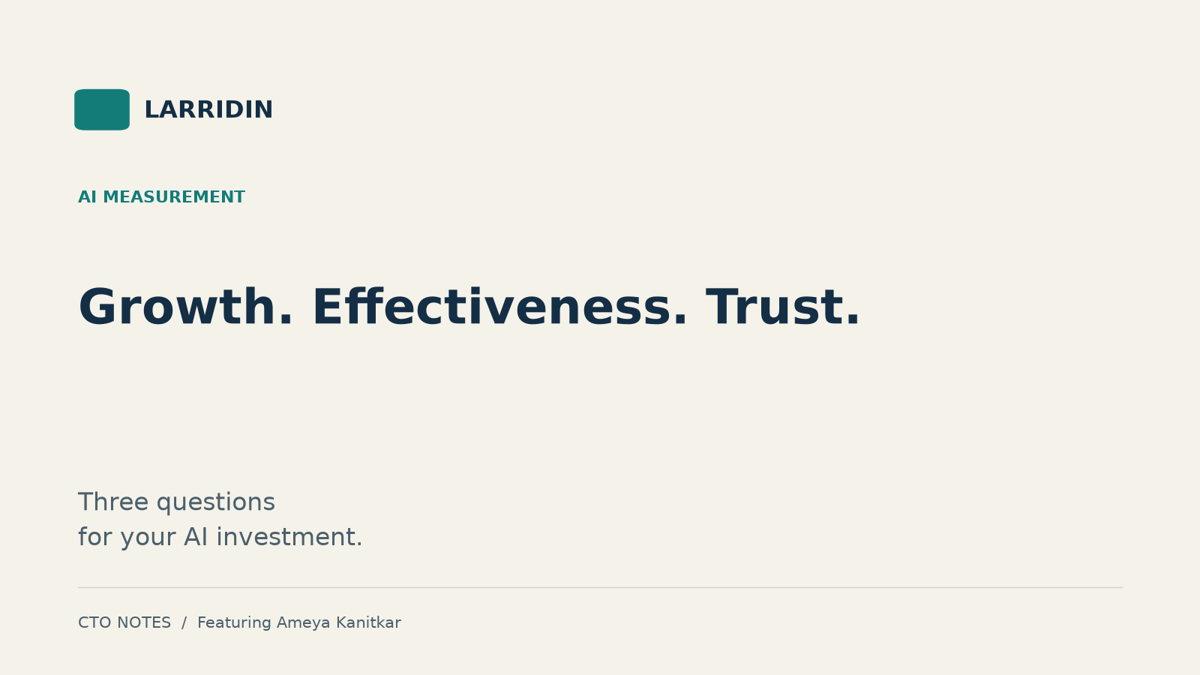

Our CTO, Ameya Kanitkar, thinks most companies track too many AI metrics. A conversation with SurveyMonkey's Meenal Iyer gave him a much simpler way to look at it.
He explained his thinking on LinkedIn:
Ameya Kanitkar, co-founder and CTO of Larridin, on LinkedIn:
Most companies have too many metrics for AI.
Adoption.
Usage.
Tokens.
Cost.
Time saved.
Models deployed.
Agents launched.I was talking recently with SurveyMonkey's SVP of AI & Data Meenal Iyer, and she gave me a much simpler way to think about it.
She calls it the GET framework:
Growth.
Efficiency.
Trust.Growth is straightforward: for the money we are putting into AI, are we creating measurable business growth?
More revenue.
Higher conversion.
Better retention.
New products or capabilities.Efficiency is broader than cost cutting.
Are people getting more done?
Are processes getting faster?
Are we increasing output without increasing resources at the same rate?And then there is Trust.
This one is easy to underestimate.The AI system has to operate securely. The data and context feeding it have to be trustworthy. Hallucinations need to be controlled. The system needs the right guardrails, evaluation, and context engineering around it.
What I like about GET is that it forces AI programs back to business fundamentals.You can have incredible adoption and still fail the Growth test.
You can reduce costs and still fail the Trust test.
You can build something technically impressive that creates neither Growth nor Efficiency.As AI budgets get larger, I suspect the companies that do this well will stop asking, “How much AI are we using?”
They’ll ask three much harder questions:
Is it growing the business?
Is it making us more efficient?
Can we trust it?
Everything else is a supporting metric.
Why This Matters if You Own an AI Budget
Adoption, usage, tokens, cost, time saved, models deployed, and agents launched are easy to count. But none of those metrics alone tells you whether AI is paying off. As budgets grow, the question from the board moves from "are we using AI?" to "what are we getting for it?"
GET gives you three buckets to answer that with.
Ameya used “Efficiency” for E in his original post. Meenal’s own explanation calls it “Effectiveness,” encompassing speed, productivity, organizational capacity, and changes in how work operates. We use her term below.
G is for Growth
For the money going into AI, is the business growing in ways you can measure? Think more revenue, higher conversion, better retention, or new products and capabilities you couldn't offer before.
E is for Effectiveness
This one is broader than cost cutting. Are people getting more done? Are processes getting faster? Is output rising without resources rising at the same rate?
T is for Trust
Ameya calls this the easy one to underestimate. The system has to run securely, the data and context feeding it have to be trustworthy, and hallucinations have to be under control. That takes guardrails, evaluation, and context engineering.
Meenal's story shows why it matters. She shared on the AI Impact podcast with Ameya that when SurveyMonkey first put AI on top of its curated data, accuracy was 14%. After nine months of context engineering, it reached 98%. The difference came from giving the AI what it was missing: a semantic layer, the business logic, and clear definitions of what each question was really asking.
Why 3 Questions Beat a Dozen Dashboards
GET forces AI programs back to business fundamentals. Ameya's examples make the point:
- You can have incredible AI adoption and still fail the Growth test
- You can cut costs and still fail the Trust test
- You can build something technically impressive that delivers neither Growth nor Effectiveness
Meenal also offers practical advice on the podcast. Stop handing teams AI and telling them to go figure it out. Give them a budget, set clear expectations, and ask them to show what their token spend produced. And when AI frees up capacity, talk openly about how people's responsibilities should change.
Closing Thought
Ameya expects the companies that get this right to stop asking how much AI they're using. They'll ask three harder questions instead: Is it growing the business? Is it making us more efficient? Can we trust it?
Here's an easy way to try it. Take your current AI dashboard and sort every metric under G, E, or T. Anything that doesn't fit anywhere is a supporting metric at best.
Ameya shares this kind of practical, numbers-first stuff on LinkedIn pretty regularly. If you want more of it in your feed, follow Ameya Kanitkar on LinkedIn. He's co-founder and CTO of Larridin. You can also hear the full conversation with Meenal on the AI Impact podcast.
Related Reading
On larridin.com:
- How to Measure AI Coding Tool ROI for Engineering Leaders: netting recovered developer time against rework and full usage-based spend.
- GitHub Copilot vs. Claude Code vs. Cursor: Total Cost Comparison: why AI coding tools should be compared on total deployment cost, not seat price.