

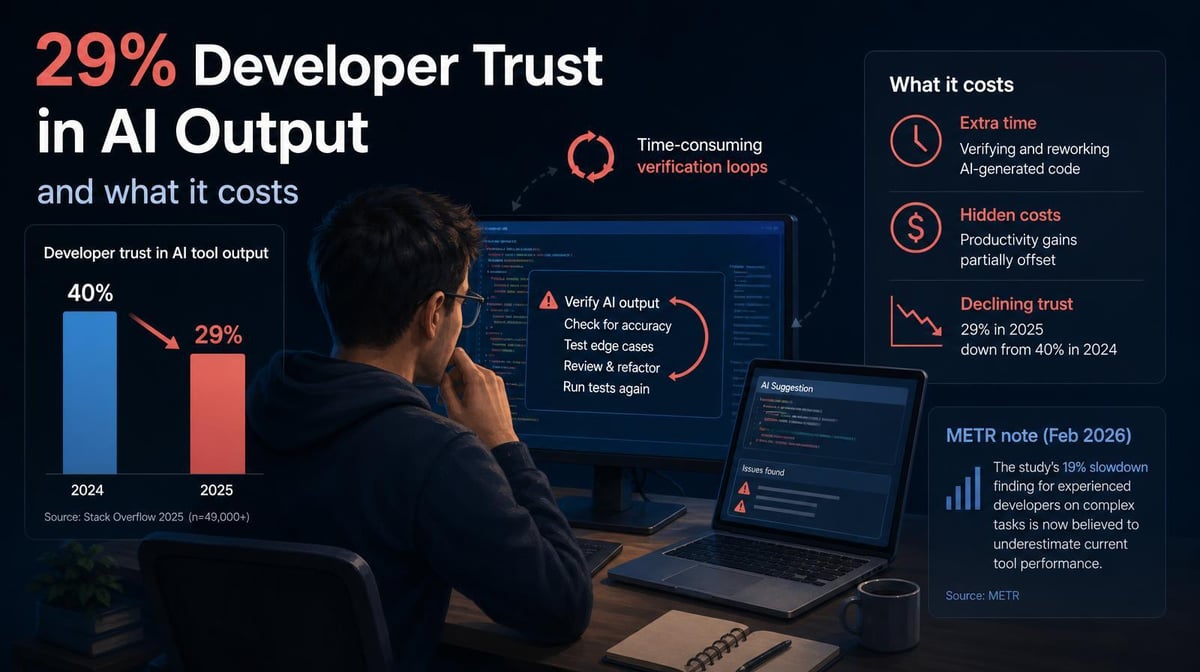

Low trust in AI output isn’t automatically a problem. If AI-generated code often needs correction or deeper security review, skepticism can protect quality. The problem is applying the same level of scrutiny to every task without knowing whether it matches the actual risk.
Key Takeaways
- Developer skepticism can protect quality when it catches bad output, but applying the same level of scrutiny to every AI suggestion can create unnecessary review work.
- AI code review should be risk-based. Security-sensitive code and core business logic need stronger verification than lower-risk work such as boilerplate or documentation.
- Acceptance rate alone can’t show whether developer skepticism is helping. Pair it with post-acceptance edit rate and code turnover to see whether accepted AI code actually holds up. Larridin’s benchmarks use the metrics together rather than treating acceptance as a quality score.
Why Low Trust Isn’t Automatically Bad
The Stack Overflow 2025 Developer Survey found that more developers distrust AI output accuracy than trust it. It also found that 66% were frustrated by AI solutions that are “almost right, but not quite,” while 45% said debugging AI-generated code can take more time than writing the code themselves.
That doesn’t mean developers should distrust every suggestion. It means trust should depend on what the AI is doing and what happens to the output afterward.
Security is a good example. Veracode tested more than 150 large language models across coding tasks and found that 45% of generations contained a known security flaw when the models received no security guidance. The result does not mean 45% of every organization’s AI-generated code is vulnerable. It does show why security-sensitive work deserves stronger controls than lower-risk boilerplate or documentation.
For engineering leaders, the key is whether developers’ level of scrutiny matches the quality and risk of the work.
3 Signals That Show Whether Skepticism Is Calibrated
1. AI Suggestion Acceptance Rate
Acceptance rate shows how often developers accept AI suggestions. Larridin’s Developer Productivity Benchmarks place the healthy range at 25–45%, but the number isn’t a quality score by itself.
A high rate can mean the tool is producing useful suggestions. It can also mean developers are accepting output too quickly. A low rate can reflect poor tool fit, or it can mean developers are being selective and accepting only high-value suggestions.
That’s why acceptance rate needs downstream context. Larridin recommends reading acceptance rate alongside post-acceptance edits and code turnover rather than setting a standalone target.
2. Post-Acceptance Edit Rate
Acceptance only captures the moment a developer takes a suggestion. Post-acceptance edit rate shows what happens next.
If developers frequently accept AI output and then substantially rewrite it, the acceptance rate overstates how useful the suggestion was. The AI may have provided a starting point, but the developer still had to do significant work to make it usable.
This signal helps separate “accepted because it was good” from “accepted because it was faster than starting from zero.”
3. Code Turnover
Code turnover looks further downstream. It measures how much recently merged code is reverted, deleted, or substantially rewritten within a defined period.
If AI-assisted code has high turnover, skepticism at review time may not be catching the problems that matter. If acceptance is relatively high but turnover stays low, developers may be judging AI output effectively.
The point isn’t to optimize any one of these metrics. A team can have a low acceptance rate and still get strong value from the suggestions it keeps. Another can have a high acceptance rate and low turnover. The useful signal is how the measures move together and whether the resulting code remains durable. That keeps teams focused on outcomes rather than acceptance volume.
What Miscalibrated Skepticism Looks Like
Overcautious teams apply the same review intensity to every AI suggestion. A simple documentation change or routine boilerplate gets treated like authentication logic or a change touching sensitive data. That can reduce the time savings AI was supposed to create.
Undercautious teams have the opposite problem. Developers accept output quickly without enough verification for the risk of the task. The problem may not appear until code review, testing, production, or later rework.
A better approach is risk-based verification. Routine, lower-risk work can follow standard review and automated testing. Security-sensitive code, core business logic, and changes with greater production impact should get deeper review and stronger validation.
Internal data should refine those rules over time. If one type of AI-assisted work consistently has low rework and turnover, teams can review it more efficiently. If another type repeatedly creates problems, that workflow may need stronger controls, better prompting or context, or limits on where AI is used.
Frequently Asked Questions
Is low developer trust a sign that we chose the wrong AI tool?
Not necessarily. Stack Overflow found low trust across the broader developer population, so skepticism isn’t unique to one product. Look at your own acceptance, edit, turnover, rework, and security data before concluding that the tool is the problem.
How do we improve trust calibration across the team?
Use task-specific guidance instead of telling developers to trust AI more or less. Identify where AI-assisted code holds up well and where it creates rework, security issues, or high turnover. Then adjust review requirements to match those patterns.
What is the relationship between developer trust and AI adoption?
Stack Overflow’s survey shows that AI use is widespread even while trust remains low. That means adoption and trust should be measured separately. The survey does not show that greater AI use causes lower trust.
Should we set acceptance rate targets?
Not by themselves. A target can encourage developers to accept more suggestions without improving quality. Pair acceptance rate with post-acceptance edits, code turnover, and other downstream outcomes so the goal is useful AI-assisted work, not a higher acceptance number.
Measure Whether Skepticism Is Helping
Larridin’s AI Dev Productivity platform connects AI usage with delivery and quality signals so engineering leaders can see whether developer skepticism is protecting quality or adding unnecessary friction.
Book a discovery call to measure how AI-assisted code is performing across your engineering organization.