

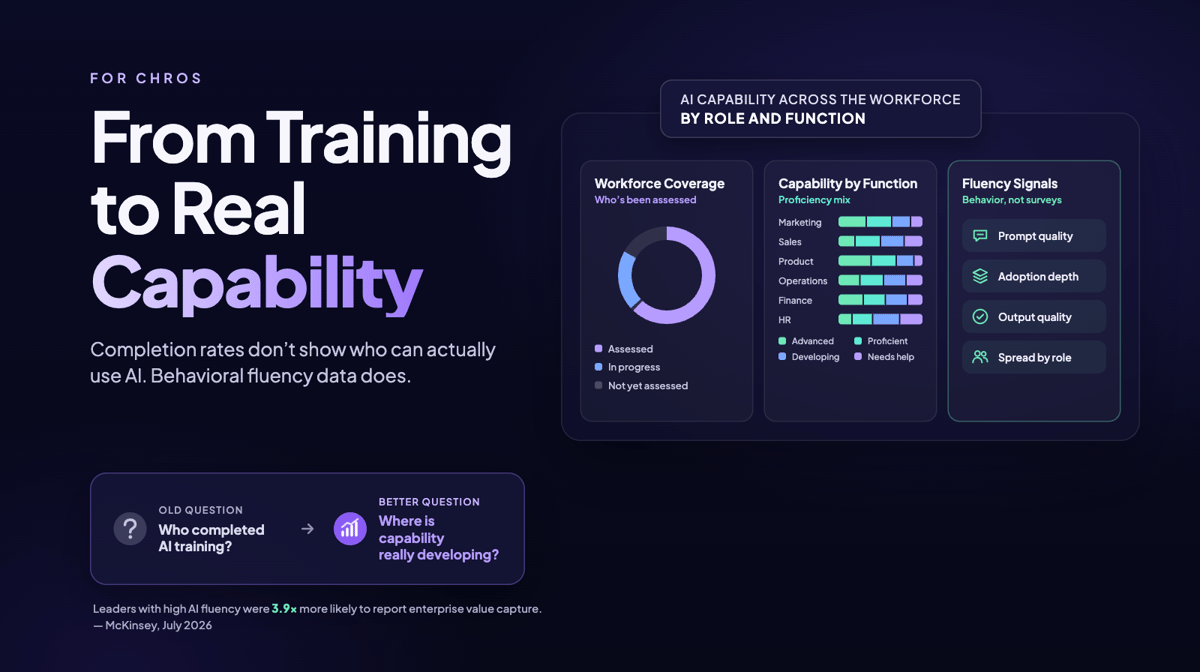

In a recent Larridin demo, the CHRO described the problem she was trying to solve in the first 30 seconds: assess AI competency across the workforce and train people based on their role. That shifts the buying question from “Who completed AI training?” to “Where is AI capability actually developing, and where do people still need help?”
Key Takeaways
- CHROs need workforce AI measurement that goes beyond access and training completion to show how effectively teams are using AI.
- Role and function matter. A useful proficiency view should show where capability is strong, where gaps are concentrated, and where targeted development could have the most impact.
- Training is only one part of the job. CHROs also need data that shows whether AI capability is improving in day-to-day work.
What the CHRO Is Trying to Solve
CHROs measuring AI need answers to two questions about the workforce:
- Assessment: Who has actually developed AI capability, by role and function?
- Targeting: Where should training and development investment go next?
Surveys and completion data don’t provide these answers. Surveys can capture sentiment, confidence level, and perceived skill. Training systems can show who finished a course. Neither shows whether capability is changing in the work itself.
That distinction matters because training alone does not redesign how work gets done. A CIO.com article on the AI skills gap makes the point directly: teaching employees to use AI has limited value if they return to the same slow workflows and approval loops afterward.
What Behavioral AI Fluency Measurement Captures That Surveys Cannot
Prompt Quality Across Actual Usage
Prompt quality is one signal that shows whether employees are moving beyond basic AI use. Are interactions becoming more specific, contextual, and effective, or are employees still relying on generic requests that take multiple rounds to become useful?
Larridin’s AI Fluency capability uses behavioral signals such as prompt quality to measure proficiency without storing prompt content. For the CHRO, the value is seeing where teams are developing stronger AI-working habits and where they need support.
Use-Case and Feature Adoption Depth
AI proficiency also shows up in how broadly employees use AI across their work. Someone using one basic feature for one repetitive task is at a different stage from someone who has integrated AI into several appropriate workflows.
That distinction helps CHROs move away from generic training. If one function has broad adoption but shallow use, it may need workflow-specific enablement. Another team may already have power users whose practices can be shared more widely.
Output Quality and Consistency
High activity doesn’t necessarily mean high proficiency. Useful workforce measurement also needs signals that help show whether AI-assisted work is producing dependable results rather than just more interactions.
This is where behavioral measurement complements adoption data. The CHRO needs enough data to tell whether greater AI use is translating into stronger working capability or simply more tool activity.
Proficiency Distribution by Role and Function
The CHRO’s training investment question becomes actionable when proficiency is broken out by role, team, and function. A broad enterprise average can look healthy while one function has a much larger capability gap than another.
Larridin measures AI fluency across teams and roles and can compare proficiency across functions. That gives CHROs a way to target development based on where the gap actually is rather than distributing the same program to everyone.
Connecting CHRO Data to the McKinsey 3.9x Finding
McKinsey’s July 2026 research found that leaders in the automation horizon were 3.9 times more likely to report enterprise value capture when leadership teams demonstrated high AI fluency than when they demonstrated low AI fluency.
That doesn’t mean fluency alone causes ROI. It does make leadership capability part of the workforce picture. CHROs need enough visibility to understand whether leaders are developing the AI fluency needed to make better decisions about roles, workflows, skills, and where the organization should invest next.
The same logic applies to the broader workforce: measurement should show not just the current proficiency distribution, but whether that distribution is improving over time. If targeted development is working, more people and teams should move toward stronger, more repeatable AI use.
Frequently Asked Questions
How is AI Fluency measurement different from an AI training completion tracker?
Training completion shows who attended or finished a program. AI Fluency measurement looks at whether teams are developing useful AI capability in their actual work. The two can be used together: completion shows the input, while proficiency trends show whether capability is changing.
What role and function breakdown does Larridin support?
Larridin measures AI fluency across teams and roles and can compare proficiency across functions. That lets CHROs see where capability is concentrated and where support may need to be more targeted.
Can workforce AI measurement create employee privacy concerns?
Yes, if measurement is designed like surveillance. Larridin is designed to measure usage and proficiency without storing prompt or work content, while standard manager views use team-level aggregates. That gives CHROs workforce-level signals without turning measurement into content monitoring.
What does McKinsey’s 3.9x finding mean for CHROs?
Leadership AI fluency was associated with a much higher likelihood of reported enterprise value in McKinsey’s automation horizon. For CHROs, the practical implication is to measure and develop AI capability at the leadership level as well as across the broader workforce.
Give the CHRO Better Data for Workforce AI Decisions
Larridin’s AI Fluency capability helps CHROs see how AI proficiency is developing across teams, roles, and functions so training and workforce investments can be targeted where they are most useful.
Book a discovery call to see your workforce AI fluency picture.