

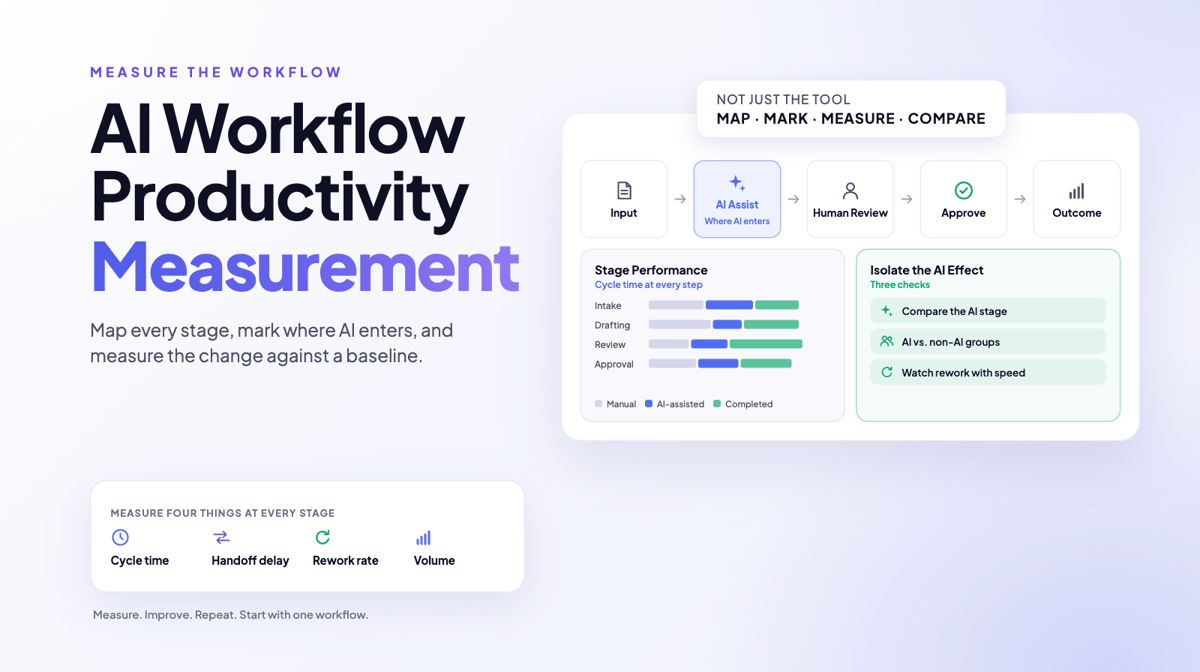

AI adoption is not proof of productivity. An AI tool can draft a response quickly while the support ticket still waits in an approval queue. A content team can generate more drafts while editors spend longer correcting them.
The measurement question is not just whether people use AI. It is whether AI changes the way work gets completed.
The best tools to measure AI workflow productivity depend on the process you need to understand. Larridin provides cross-tool workflow intelligence. LinearB is an option for engineering workflow measurement. Celonis and UiPath Process Mining help reconstruct business processes from system event data. A shared spreadsheet can establish an initial baseline before you invest in software.
These are different measurement approaches, not interchangeable answers. Choose based on the evidence you need, then test whether that evidence connects AI use to accepted work, quality and cost.
Key takeaways
- Measure the full workflow, including AI tools and the systems that receive their outputs.
- Track cycle time, handoff delay, rework and volume together. A faster stage can create a slower downstream process.
- Match the measurement tool to your scope: a single workflow, engineering delivery, business-system processes or cross-tool AI impact.
- Compare similar AI-assisted and non-AI work. Before-and-after results alone do not establish causation.
- Operational improvement strengthens an ROI analysis, but it does not automatically establish financial return.
Why workflow measurement matters when choosing a tool
Work moves through CRM platforms, project management systems, automation tools, collaboration applications and approval queues before it creates business value.
AI may handle only one step. It can summarize a document, draft a response, extract invoice fields or suggest code. Rule-based automation then routes the output, another system records it, and a person reviews or approves it.
Measuring only what happens inside the AI application misses what happens next. Did the draft reach review? Did the analysis reach the CRM? Did a recommendation change a decision? Did the output require correction?
Full-stack workflow measurement follows both AI and non-AI applications involved in the same process. That broader view helps distinguish a faster AI interaction from a genuinely improved business workflow.
Tools to consider for AI workflow productivity measurement
The following shortlist organizes the tools and approaches by measurement use case. It is not a universal ranking or a controlled performance benchmark.
Larridin Workflow Intelligence: cross-tool AI workflow measurement
Consider Larridin when your question is how AI changes work across applications and teams, rather than what happens inside one application.
Larridin's Workflow Intelligence observes how work moves across AI and non-AI tools, including tool sequence, time spent, transitions and friction patterns. It maps recurring workflows and compares AI-assisted and non-AI runs of the same workflow.
That connects adoption to an operational question: does the work move faster, encounter less friction or remain unchanged when AI is involved?
Larridin's Scout capture layer provides visibility into AI tool use. Workflow Intelligence adds the surrounding process context, helping leaders assess which workflows changed and where further investigation is needed.
Evaluation priority: Ask for evidence from a workflow that resembles your own. Confirm how workflow boundaries, comparable runs and incomplete observations are handled. Treat observed differences as evidence to investigate, not automatic proof that AI caused them.
LinearB: engineering workflow measurement
Consider LinearB when your starting point is the engineering delivery process, including pull request cycle time and review stages.
The measurement value comes from understanding where engineering work spends time. A faster code-generation step does not establish that review, revision, merge or deployment improved.
Evaluation priority: Determine how the engineering workflow data can be paired with AI-use information and quality measures. Track rework alongside cycle time so faster movement does not conceal additional correction work.
Celonis: business-process reconstruction
Consider Celonis when you need to reconstruct business processes using event data from existing systems.
Celonis uses process data to show how work flows through an organization, where inefficiencies occur and where actual processes differ from the expected path. This can support analysis of the surrounding workflow when AI is introduced into a business process.
Evaluation priority: Confirm that your system events identify the same work item across stages. Also establish how AI involvement will be recorded; reconstructing a process and attributing a change to AI are separate tasks.
UiPath Process Mining: bottleneck and automation analysis
Consider UiPath Process Mining when you want to visualize business-system processes, identify bottlenecks and find automation opportunities.
It uses data from business systems to reconstruct processes. That can help reveal whether time saved at an AI-assisted step disappears in a subsequent handoff or approval queue.
Evaluation priority: Ask which events and systems are required for your workflow, then test whether the resulting view captures waiting, exceptions and repeated work, not just the expected sequence.
Shared spreadsheets and existing system logs: an initial measurement baseline
For a narrowly defined workflow, a shared spreadsheet can be a practical starting point.
Put one work item on each row. Record stage entry and exit timestamps, AI involvement, handoffs, rework and completion status. Ticketing, engineering and finance systems may already contain useful timestamps and events.
Evaluation priority: Check whether the available records are consistent enough for comparison. Manual measurement becomes harder to maintain as workflows, systems and exceptions multiply.
Do not confuse a low-cost starting point with a permanent measurement capability. Use the initial analysis to identify which evidence you need to collect consistently.
How to choose the right measurement tool
Start with the business question, not the product demonstration.
- One defined workflow: Establish the stages and baseline using existing records before choosing broader software.
- Engineering delivery: Evaluate engineering workflow measurement alongside AI-use and quality evidence.
- Business processes recorded in enterprise systems: Evaluate process mining against the completeness of your event data.
- AI impact across tools and teams: Evaluate cross-tool workflow intelligence and comparisons of AI-assisted and non-AI work.
For every option, verify coverage, data requirements, privacy controls, workflow definitions and the ability to explain a result. A clear chart is not enough if the underlying comparison is weak.
How to measure productivity with the tools you choose
1. Map the real workflow
Trace recently completed work from beginning to end. Include unofficial handoffs, approval queues and exception paths.
Support work might move through intake, triage, drafting, review, response and resolution. Content might move through brief, draft, editorial review, fact-checking and publication. Engineering work might move through pull request creation, checks, review, revision, merge and deployment.
Define the start and end with the people who own the work. Software does not remove that responsibility.
2. Mark where AI enters
Identify the exact stages where AI is used, where it is available but rarely used, and where it is absent.
Also include systems that receive AI-generated outputs. CRM platforms, project management tools, automation platforms and collaboration applications belong in the measurement when they are part of the process.
3. Track the core signals together
Cycle time: How long does work remain in each stage and in the complete workflow?
Handoff delay: How long does work wait between stages?
Rework rate: How often is output returned, rejected or corrected?
Volume: How much work reaches completion, and how does its complexity or mix change?
Use consistent definitions. Measure stages with and without AI so that an apparent improvement can be examined in context.
4. Establish a representative baseline
If AI has not launched, measure the workflow first. If it has, use historical records when available or compare similar work with and without AI during the same period.
Document the measurement window, work-item mix and missing data. Avoid choosing a period simply because it makes the result look stronger.
5. Separate AI effects from other changes
Staffing, demand, policies, forms and other automation can change during an AI rollout.
Compare the stage AI actually changed, not just total workflow duration. Use comparable teams or work items where possible, and track quality and rework at the same time.
Lower cycle time with higher rework may mean unfinished work is moving downstream faster. Higher AI use with unchanged workflow performance may mean outputs are not improving the process.
6. Connect workflow evidence to business value
Bring measured workflows into a consistent portfolio view. Show where performance improved, where it remained unclear and where friction increased.
Then assess cost per unit of accepted work, net savings or capacity created. Include AI costs, implementation effort, verification and rework. Reduced elapsed time is not automatically reduced labor cost or realized financial savings.
Frequently asked questions
What are the best tools to measure AI workflow productivity?
The right shortlist depends on your scope. Consider Larridin for cross-tool AI workflow intelligence, LinearB for engineering workflow measurement, Celonis or UiPath Process Mining for business-process reconstruction, and spreadsheets with existing system logs for an initial baseline. Evaluate each against your actual workflow and evidence requirements rather than assuming one tool fits every process.
Why measure non-AI tools alongside AI applications?
Because value depends on what happens after the AI output is generated. Non-AI systems reveal handoffs, waiting, review, corrections and completion. Without them, you can measure AI use while missing its operational effect.
Is workflow automation the same as workflow measurement?
No. Rule-based automation executes predefined actions. AI-assisted automation can interpret context or generate outputs. Workflow measurement evaluates what happens across the process, including whether either type of automation improves performance.
Can workflow measurement prove AI ROI?
It provides operational evidence for an ROI analysis. Comparable workflow results can show changes in duration, friction, rework and completion. Financial return still requires a cost model and a defensible account of which benefits were actually realized.
Measure completed work, not isolated AI interactions
Start with one important workflow. Define its boundaries, establish a baseline and select tools that capture both the AI-assisted stage and the work around it.
The decision is whether to fund more AI activity or build a permanent capability to measure business outcomes. Workflow evidence makes that distinction visible.