

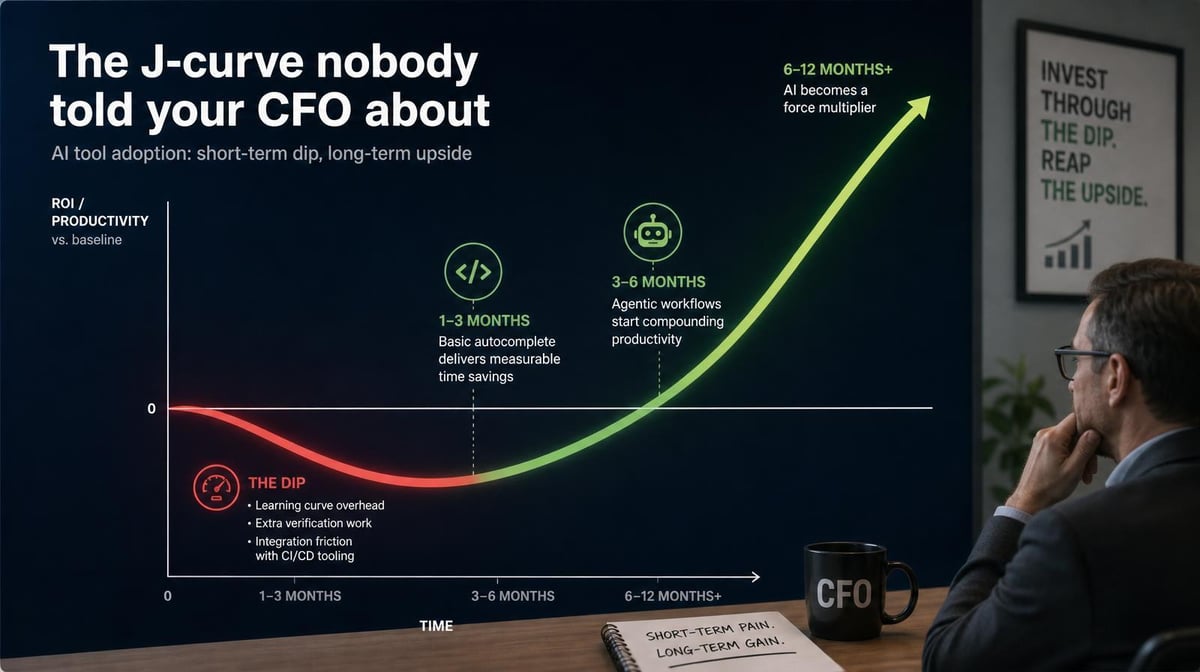

AI coding costs start immediately, but the productivity gains may not. A 90-day review can catch a team while it’s still learning the tools, changing its workflow, and absorbing more review work. That makes 90 days a useful checkpoint, but not necessarily enough time for a final ROI decision.
Key Takeaways
- DORA’s ROI guidance recognizes an initial productivity dip and describes the early learning cost as “tuition” that organizations should plan for.
- Larridin’s Developer Productivity Benchmarks 2026 don’t set one timeline by tool type. Time to ROI breakeven ranges from less than one month to more than six months, with average performers at three to six months.
- Give finance a baseline, specific checkpoints, and clear scale-or-stop rules. A dip should prompt review, not automatic cancellation or continued investment without a clear plan.
Why Early AI Coding Reviews Can Look Disappointing
A new AI coding tool can add work before it removes work.
Developers have to learn when the tool helps, how much context to provide, which tasks to avoid, and how to review the output. Teams may also need new security rules, testing practices, integrations, and approval paths. Meanwhile, licenses and token charges begin on day one.
DORA’s ROI of AI-assisted Software Development guidance describes this pattern as a J-curve. The organization pays a learning cost in the beginning while people and processes adapt before a tool creates value.
Not every rollout will dip, and not every dip will recover. Leaders should measure what’s happening inside the transition.
The size and length of the dip depend on the team, codebase, tool, task mix, review process, and rollout quality. A mature team with strong tests and clear workflows may reach breakeven quickly. Another may spend months fighting poor task selection, slow reviews, weak context, or expensive agent runs.
The 90-day review should answer whether the rollout is moving in the right direction. It shouldn’t assume that every organization reaches full ROI on the same date.
What the Evidence Can and Cannot Tell You
METR’s early-2025 randomized controlled trial found that experienced open-source developers took 19% longer on the tasks studied when AI tools were allowed, even though they believed AI had made them 20% faster.
That result is useful because it shows the difference between perception and productivity. It doesn’t establish a universal AI slowdown or a standard J-curve timeline. METR described the study as a snapshot of early-2025 tools in one setting.
In a February 2026 update, METR said developers were likely getting more benefit from newer tools, but selection problems made the later estimate unreliable.
Larridin’s benchmarks provide a more useful way to set expectations with finance. They group time to ROI breakeven by performance:
- 6+ months for below-average performers
- 3–6 months for average performers
- 1–3 months for good performers
- Less than 1 month for excellent performers
Those ranges show that the timeline depends on how effectively the organization uses the tools and controls cost and rework. Use them for planning, then refine your timeline with your own trend data.
3 Review Gates to Agree on Before Rollout
The CFO conversation gets easier when engineering and finance agree on the evidence and decision points before rollout.
1. Establish the Baseline and Success Criteria
Record the starting point for:
- Delivery speed and lead time
- Throughput adjusted for the complexity of the work
- Review time
- Change failure rate
- Code turnover and rework
- Current tool and labor costs
Then define what the investment is expected to improve. “Developers use AI” isn’t a business outcome. Faster delivery, lower rework, more durable output, or more capacity for high-value work can be.
Larridin’s Developer Productivity platform connects AI use with delivery, quality, code durability, cost, and ROI. That gives leaders a consistent baseline and follow-up view.
2. Use the 90-Day Review as a Checkpoint
At 90 days, show finance:
- Actual spend versus budget
- Weekly active use and team team adoption
- Delivery and review trends
- Quality, turnover, and rework
- The main constraint holding back value
- What the team will change next
This review should identify one of three paths: expand a rollout that is already producing durable value, fix a clear constraint, or stop a use case that is not improving.
AI Fluency can show whether teams are becoming more capable and comfortable with AI. Read that information alongside delivery and quality measures. Growing fluency is encouraging, but it doesn’t replace evidence that the work is improving.
3. Review ROI at the Expected Breakeven Window
At the expected breakeven window, compare the full cost with useful outcomes. Include licenses, token spend, implementation, review, and rework. Then ask:
- Did delivery improve?
- Did quality hold up?
- Did cost per useful outcome improve?
- Are the gains broad enough to justify expansion?
- Is the remaining problem fixable?
A team that misses its target shouldn’t automatically get an extension because “J-curves take time.” It needs a clear explanation, corrective action, and next decision date.
What a CFO-Ready Progress Update Should Show
A useful update fits the financial and engineering views together:
- What the organization spent
- What adoption changed
- What delivery and quality changed
- What is delaying or reducing the return
- What leaders will expand, fix, or stop
- When the next decision will be made
That’s stronger than promising a universal six- or 12-month payoff. It shows the CFO that the rollout is being managed instead of just asking finance to wait.
Frequently Asked Questions
How long does the AI coding productivity dip last?
There’s no universal duration. Larridin’s benchmarks place average time to ROI breakeven at three to six months, but the range runs from less than one month to more than six months. Team readiness, tool choice, task fit, cost, review capacity, and rework all affect the timeline.
Does an early productivity dip mean the rollout is working as expected?
Not necessarily. A dip can reflect normal learning and integration, but it can also reveal a poor tool fit, weak rollout, review bottleneck, or rising rework. Determine the cause rather than labeling every weak result a J-curve.
What should we measure at 90 days?
Measure spend, adoption, delivery, review time, quality, and rework against the baseline. Also identify the main constraint and the action being taken. The trend and corrective plan matter more than one isolated productivity number.
What if we did not establish a baseline before rollout?
Use the earliest reliable pre-rollout data available. If that’s not possible, establish a current baseline now and track forward consistently. The comparison will be less complete, but it’s better than continuing without one.
How do we keep a skeptical CFO from canceling too early?
Agree on the checkpoints, success measures, budget limits, and stop conditions before rollout. Then report the same measures at every review. Finance is more likely to support the next stage when the timeline includes measurable progress and a clear decision.
Track the Trajectory Without Excusing Weak Results
Larridin connects AI use, cost, delivery, quality, and ROI so engineering and finance can see whether a rollout is moving toward durable value or needs a different approach.
Book a discovery call to build a defensible AI coding ROI timeline.