

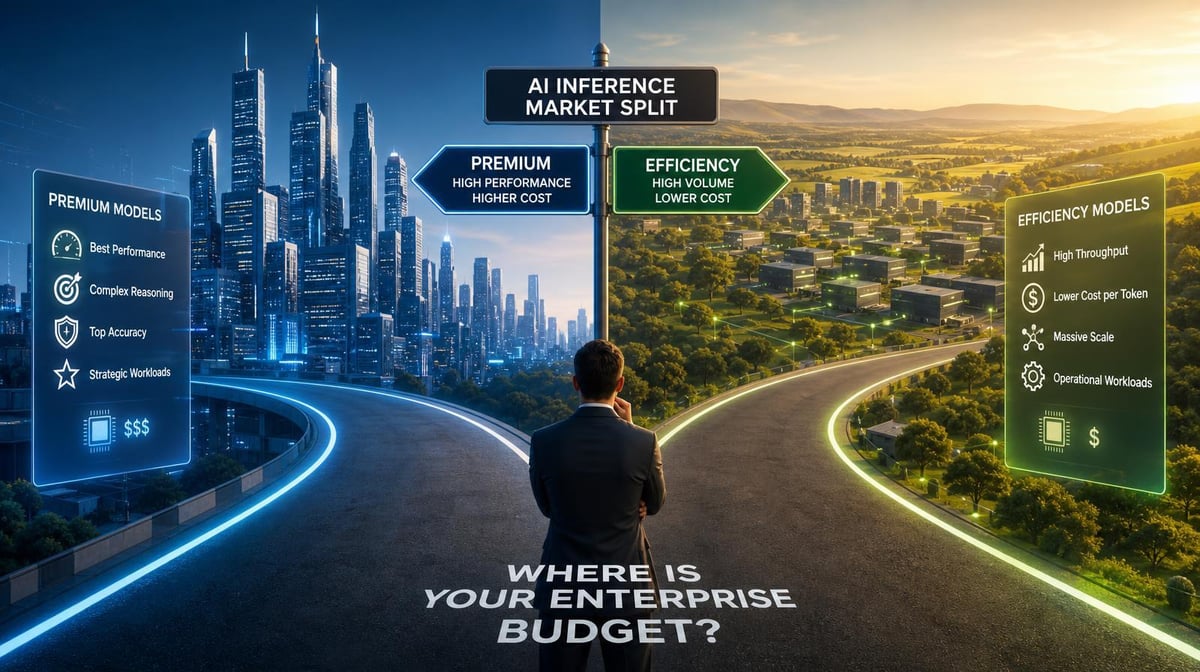

Most enterprise AI budgets were built on a single blended assumption about AI inference costs. That assumption no longer reflects a market moving in two directions at once — and your actual budget depends on which model tiers your workloads use.
Key Takeaways
- Axis Intelligence Research found the AI inference market has split. Mid-tier and budget model pricing fell 35.8% year over year, while frontier pricing doubled from January to July 2026 as newer, more capable model generations entered the market.
- Anthropic’s Opus 4.7 tokenizer change shows why per-token pricing isn’t the whole cost story. OpenRouter found 32–34% more native tokens for production-scale prompts compared with Opus 4.6, even though the listed per-token price did not change.
- When frontier and lower-cost tiers are moving in different directions, one blended AI cost assumption can hide what’s actually happening. Tier-aware budgeting starts with knowing which teams and workloads are using which models.
The Two Markets Are Not Competing — They Serve Different Functions
AI model pricing is moving in two directions: frontier models are getting more expensive, while mid-tier and budget models are getting cheaper.
Frontier models command a premium for expanded capabilities such as complex reasoning, long-context work, and agentic multi-step tasks. Axis reports that frontier pricing doubled from January to July 2026 as newer model generations displaced earlier ones.
Mid-tier and budget models have moved in the opposite direction. Axis found those prices fell 35.8% year over year, with budget models increasingly competing for high-volume workloads that do not require frontier capability.
That creates a budgeting problem for organizations that use both.
One overall AI cost number can hide which models are actually driving spend. A $50,000 monthly budget looks very different if most of it goes to lower-cost models versus frontier models. So the question becomes: which model tiers are your workloads actually using?
What a Tier-Aware Budget Looks Like
Identify Your Actual Model Tier Distribution
Start by identifying which model tiers teams are using and where the spend is going.
Larridin’s Token Spend & Insights shows AI consumption across models, teams, agents, projects, and use cases. That makes it possible to see whether spend is concentrated in frontier models, lower-cost tiers, or a mix of both rather than relying on one aggregate total.
Apply the Routing Framework to High-Volume Workloads
Once you know which model tiers teams are using, look for high-volume tasks where frontier models may be costing more than they’re worth.
The question is simple: does the frontier model deliver a meaningful quality or capability advantage for that task?
Our guide to frontier model routing covers that decision in detail. For budgeting purposes, the important point is knowing where the premium-model consumption sits before deciding whether it is justified.
Build a Forecast That Models Each Tier Separately
Don’t use one growth assumption for your entire AI budget. Forecast frontier, mid-tier, and budget model costs separately.
Axis found frontier pricing rising in the first half of 2026 while mid-tier and budget pricing fell. Those trends may change, but they’re already moving differently enough that one blended forecast can be misleading.
Build the forecast around the model tiers your teams actually use and how much each one contributes to spend.
The Tokenizer Change Factor
Model costs can also change even when the listed price stays the same.
OpenRouter’s analysis of Anthropic’s Opus 4.7 tokenizer found that the model produced 32–34% more native tokens than Opus 4.6 for production-scale prompts of 10K tokens or more. Smaller prompts showed increases of 42–45%.
That didn’t translate directly into an equivalent increase in cost. Caching and changes in completion length absorbed part of the difference. For prompts above 2K tokens, OpenRouter observed actual cost increases ranging from 12% to 27%.
The budgeting lesson is simpler than the tokenizer mechanics: a stable per-token price does not guarantee a stable cost per task.
Organizations that track actual consumption and task-level cost can see those changes. A budget based only on the listed token rate can miss them.
Frequently Asked Questions
What does “the market split” mean practically for our AI budget?
It means one overall cost assumption can hide what’s happening across the model tiers your teams use. Knowing how much spend goes to frontier, mid-tier, and budget models lets you forecast each one separately instead of treating AI inference as one cost category.
How do we know if a task genuinely needs frontier model quality?
Test it. Compare frontier and lower-tier models on the same high-volume tasks and have people who know the work judge the results. If the frontier model produces a meaningful and consistent advantage, keep the premium model. If a less expensive model performs well enough for the use case, it becomes a routing candidate.
Does the tokenizer change mean Anthropic’s pricing effectively went up without an announced price increase?
Yes, for many workloads. The listed per-token price stayed the same, but OpenRouter found actual costs rose 12–27% for prompts above 2K tokens because the new tokenizer produced more tokens. The exact increase depends on the workload.
Are commodity models safe to use for production workloads?
Yes, for the right workloads. Commodity models can work well in production when the task is well-defined and the model meets the required quality, reliability, and security standards.
Know Which Part of the AI Inference Market Is Driving Your Budget
Larridin’s Token Spend & Insights shows consumption across models, teams, agents, projects, and use cases, helping leaders see which model tiers are driving spend and build budgets around their actual workload distribution.
Book a discovery call to see your model tier spend distribution.