

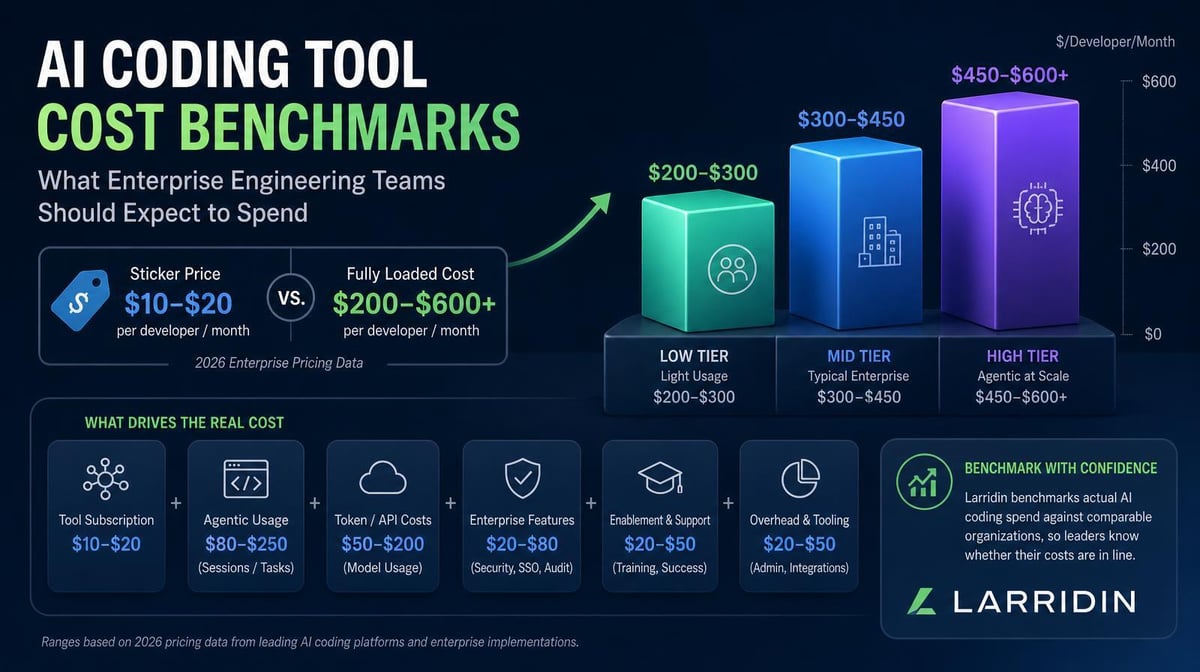

AI coding costs can start with a predictable seat price and climb quickly as teams add premium models, code review, cloud agents, and long-running workflows. A useful benchmark is a range based on your tool mix, usage patterns, operating costs, and durable delivery outcomes.
Key Takeaways
- Use three cost benchmarks to estimate total AI coding tool cost: contracted access, observed consumption, and full operating cost. The seat price is only the first layer.
- Build separate benchmarks for inline completion, interactive agent use, and automated or parallel agent workflows. Compare each with work that reaches production and lasts.
- Current vendor pricing shows how wide the starting range can be. GitHub Copilot Business costs $19 per user monthly, Cursor Teams Standard costs $32 per user monthly on an annual plan or $40 month to month, and Anthropic reports that Claude Code averages $150 to $250 per developer monthly across enterprise deployments.
Why One Per-Developer Benchmark Does Not Hold Up
AI coding tools don’t sell or measure the same unit.
GitHub Copilot combines a seat with pooled AI credits. Cursor combines seat tiers with included model usage and on-demand charges. Claude Code can run through subscription capacity or API-based token consumption.
Agent costs also vary within the same workflow. A 2026 study of eight frontier models on SWE-bench Verified found that agentic coding tasks used about 1,000 times more tokens than code reasoning and code chat in the study setup. Runs on the same task varied by as much as 30 times, and greater token use did not consistently improve accuracy.
Those differences make a single “industry average” inaccurate for budgeting.
The 3 Cost Benchmarks Every Team Needs
1. Contracted Access
Start with the minimum committed software cost.
GitHub Copilot Business costs $19 per user per month and includes 1,900 AI credits per user in a shared organizational pool. Copilot Enterprise costs $39 per user per month, includes 3,900 credits per user, and is available to GitHub Enterprise Cloud customers.
Cursor Teams Standard costs $32 per user per month with annual billing or $40 monthly. Premium costs $96 per user per month with annual billing or $120 monthly and includes five times the Standard usage.
For a 100-developer deployment, those prices have very different annual minimums:
- Copilot Business: $22,800
- Copilot Enterprise: $46,800, excluding any incremental GitHub Enterprise Cloud cost
- Cursor Teams Standard: $38,400 annually or $48,000 month to month
- Cursor Teams Premium: $115,200 annually or $144,000 month to month
These benchmarks are only for access and don’t include additional consumption, implementation, administration, review, and remediation costs.
2. Observed Consumption
The second benchmark shows what teams actually use once they have access.
Track AI credits, tokens, premium models, code review, cloud agents, background agents, API calls, and supporting infrastructure. Attribute the usage to the developer, team, repository, workflow, and business unit that generated it.
Anthropic says Claude Code costs average about $13 per developer per active day and $150 to $250 per developer per month across enterprise deployments. It also says costs vary widely with model selection, codebase size, parallel sessions, and automation.
At that documented average, 100 consistently active Claude Code users would generate a monthly usage line of roughly $15,000 to $25,000 before implementation or downstream labor. That is a Claude Code planning input, not a universal benchmark.
Build low, expected, and high consumption ranges from at least four weeks of actual usage. Separate interactive sessions from automated and parallel agent runs so one workflow does not distort the rest of the portfolio.
3. Full Operating Cost
The third benchmark adds the work required to deploy, govern, review, and support the tools.
Include:
- Security, legal, procurement, and implementation labor
- Identity, policy, repository, and workflow configuration
- Training, enablement, and support
- Usage monitoring and financial administration
- Human review, debugging, rework, and remediation
- Incident response, security findings, and maintenance
- Idle seats, overlapping tools, and unused commitments
Convert internal labor into cost using the organization’s loaded rates. Separate one-time rollout costs from recurring operating costs so the first year doesn’t distort the steady-state benchmark.
Larridin’s AI Coding Tool TCO framework explains how to organize these cost lines into one model.
Benchmark by Workflow, Not Just by Developer
Different AI workflows can cost very different amounts. Group costs by the work being done, not just by developer.
Inline Completion and Light Chat
This is usually the most predictable workflow because it uses fewer long-running agent loops and may be covered by a seat allowance. Benchmark seat utilization, accepted work that reaches committed code, and cost per durable change.
Interactive Agent Work
Developers assign bounded tasks, review the result, and intervene as needed. Track cost per completed task, retries, human intervention, review time, and whether the resulting work merges and lasts.
Automated and Parallel Agents
Background agents, scheduled runs, and parallel sessions can consume resources without continuous developer attention. Benchmark cost per run, failed loops, token variance, infrastructure, and human remediation.
Multi-Tool Workflows
A developer may use Copilot, Cursor, and Claude Code in the same delivery cycle. Don’t add each vendor dashboard’s user totals together. Normalize identities, time periods, repositories, and costs, then connect the combined activity to shared delivery and quality outcomes.
Our guide to tracking AI coding costs by team shows how to allocate this spend across repositories and business units.
How to Know Whether Your Spend Is High or Low
A high per-developer cost doesn’t automatically mean waste, and a low cost isn’t automatically efficient.
Compare total cost with durable outcomes:
- Define comparable teams, repositories, and workflows.
- Capture access, consumption, and operating cost for each segment.
- Connect spend with committed output, delivery speed, quality, code durability, and business priorities.
- Calculate cost per durable outcome, such as a production change that survives 30 or 90 days.
- Review the range monthly and reset assumptions when pricing, adoption, or workflow mix changes.
The 2026 State of FinOps report found that 98% of respondents who answered its AI-spend question now manage AI spend. The report also identified visibility, allocation, and value measurement as central challenges.
Larridin’s Token Spend & Insights brings costs across tools, teams, agents, workflows, projects, vendors, and models into one view. Pair that data with delivery and quality signals so leaders can see whether higher spending is producing more durable value.
Frequently Asked Questions
What should a 100-developer team budget for AI coding tools?
Start with what the selected tools cost, then add actual usage and organization-specific operating costs. A team using mostly Copilot Business has a different baseline from one with Cursor Premium seats or sustained Claude Code agent use. Use a range until the first several weeks of consumption and review data are available.
Is $150 to $250 per developer per month a reliable benchmark?
That’s Anthropic’s documented average for Claude Code across enterprise deployments, not a market-wide average for all AI coding tools. Use it to plan Claude Code scenarios, then replace the assumption with your own measured usage.
Why can two teams using the same tool have very different costs?
Model choice, repository size, task complexity, context length, agent retries, parallel sessions, automation, review burden, and rework can all change the total. Seat price may be identical while consumption and labor differ substantially.
How often should cost benchmarks be updated?
Review consumption, overages, utilization, and cost anomalies monthly. Revisit seat mix, workflow assumptions, labor, quality-related costs, and vendor pricing quarterly and before renewals.
Build a Benchmark Finance and Engineering Can Defend
Larridin connects AI coding spend with adoption, workflows, delivery, quality, and durable output. Leaders can compare tools and teams using the same cost model, identify where spending is rising, and decide which workflows justify more investment.
Book a discovery call to build your AI coding cost benchmarks.