


See our AI Impact podcast episodes on YouTube.
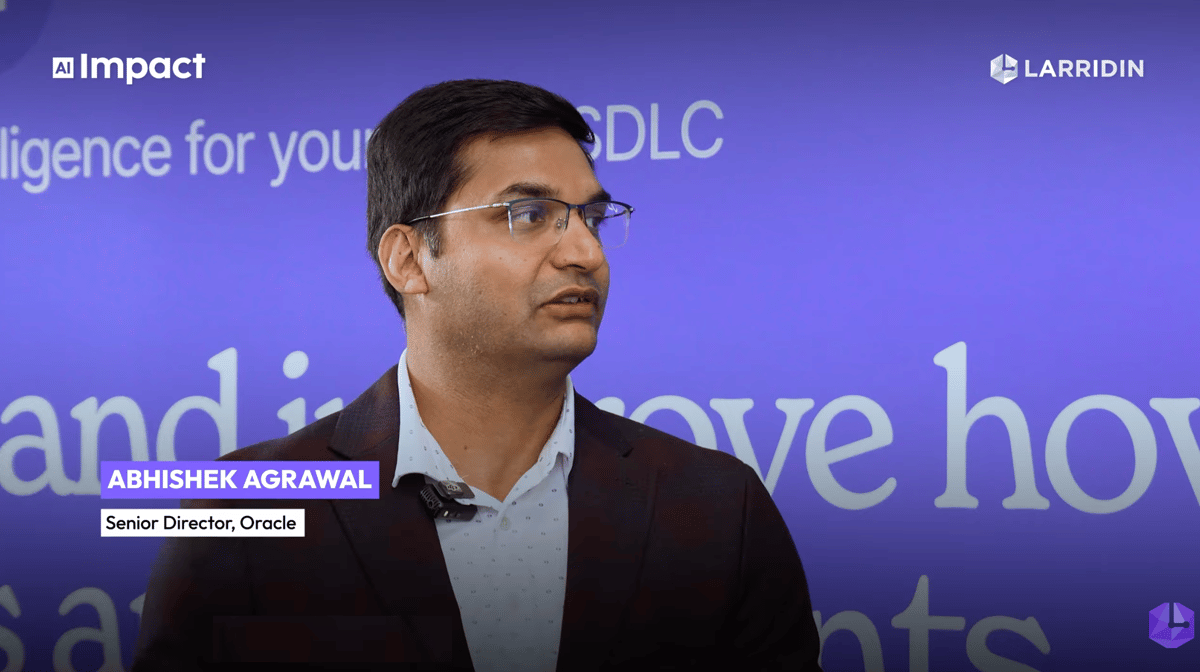
Running three layers of leadership doesn't excuse an engineering leader from writing code. In the latest episode of AI Impact, recorded at ELC Annual 2026, host Ameya Kanitkar talks with Abhishek Agrawal, Senior Director of Engineering at Oracle. Abhishek still works at the code level and kills prototypes that won't ship, even while leading a 250-person organization across Oracle Health and AI. They discuss staying hands-on, structuring teams around ownership, and why continuous learning is the one constant for engineering leaders.
Key points
Abhishek has led engineering at Amazon and LinkedIn, served as CTO of a roughly 120-person startup, and now runs one of Oracle's largest health technology groups. In this brief conversation, several key points emerged.
Leaders of leaders still need to be hands-on
Abhishek has three levels of leadership below him at Oracle, and he says that's no reason to stop building. He hears from engineering VPs who say they don’t write code anymore. He was writing code last week, not for its own sake, but because he loves to solve problems, and staying close to engineering makes him better at it. AI has made that much easier, because it lowers the barrier to learning and experimenting. His one piece of advice: use the tools as much as you can, because leaders who don't keep pace with the industry will get left behind.
Someone has to kill the prototypes
Hands-on, for Abhishek, means tinkering, brainstorming, going to the code level with his teams, and challenging their problem statements. It also means killing ideas. With AI, it's easy to throw out a cool prototype, so the scarce skill is knowing which ones will never make it to production. He argues that leaders should stay technical enough to make that call with confidence, rather than letting promising-looking experiments soak up time and budget.
Size teams to ownership, not to a formula
A 250-person organization sounds large, but Abhishek's group builds end-to-end software for the whole hospital ecosystem (doctors, patients, nurses, administrators, insurers), plus the compliance and platform pieces underneath. The hard part isn't headcount; it's empowering teams so each one owns and drives a clear set of problems. Whether a team is two people or twenty depends on what it owns. And those structures don't stay fixed: market headwinds, new tooling, and the evolving AI harness keep changing what a team of a given size can be expected to own.
Conclusion
See the full episode on the AI Impact Podcast playlist on the Larridin YouTube channel. To get a demo of Larridin, contact us.
Quotes
- "I have three levels of leadership as part of Oracle, but that doesn't mean that I cannot be hands-on." (Abhishek Agrawal)
- "If you're not using them, if you're not running at the pace the industry is moving, you're going to get left behind." (Abhishek Agrawal)
- "You might as well get yourself hands-on enough to be able to kill an idea." (Abhishek Agrawal)
Full Transcript
Chapter 1: The hands-on leadership shift (0:00)
Abhishek: As an engineering leader, you cannot just tell yourself, okay, I'm going to be a leader of leaders of leaders. I have three levels of leadership as part of Oracle, but that doesn't mean that I cannot be hands-on. I think that is the shift every engineering leader needs to understand very clearly. I think AI is making that accessibility and learning aspect pretty easy. Staying close to engineering is always going to be helpful. So leverage AI as much as you can. Leverage the tools as much as you can, because they are there at your disposal.
Chapter 2: Catching up and background (0:37)
Ameya: Hey, I have Abhishek Agrawal. He has been an engineering leader at many companies, Amazon, LinkedIn. We went to two startups, and now he's at Oracle, and we've known each other for 10 years now.
Abhishek: Yeah. Yeah. And I think we're catching up after a few years at this point. Pretty amazing to see.
Ameya: It's so good to see you. I have to tell you a very interesting anecdote. Do you remember Nadia?
Abhishek: Yeah.
Ameya: So she told me that when I first joined LinkedIn, I was asking her about all the people in the company, and she said, "Abhishek, he's the most organized person. And not only organized, he's always in control of the situation." [laughter]
Abhishek: I wish that happened more often, but I'm glad people think like that.
Chapter 3: Qualities leaders need now (1:24)
Ameya: Awesome. Well, welcome. What I wanted to ask you is, everything is changing, obviously. If you're an engineering leader today, what qualities do you need to actually succeed in the next, I don't know, 12 to 24 months? Because clearly it's not the same as before.
Abhishek: Yeah. So, a little bit of background on where I come from. I've been at a couple of big tech companies, as you know, Amazon and LinkedIn, and then I went to a startup, which was a complete revelation in terms of how things work in a big tech company versus how things work in a startup. Being a CTO there was a completely different ballgame. Title aside, what you do in a small company at Series A, Series B is a completely different ballgame.
Ameya: How many people were there?
Abhishek: It was around 120 people. So not that big, but also not that small.
Chapter 4: Inside Oracle Health and AI (2:20)
Abhishek: And then the organization that I lead today is at Oracle, in the Oracle Health and AI vertical, which owns a lot of different big pieces. The organization size is around 250 people or so, owning everything from the application pieces to the platform pieces to everything in the middle.
Chapter 5: Beyond leaders of leaders (2:43)
Abhishek: I think the difference there is the learning aspect. As an engineering leader, you cannot just tell yourself, okay, I'm going to be a leader of leaders of leaders. I have three levels of leadership as part of Oracle, but that doesn't mean that I cannot be hands-on. That doesn't mean that I cannot tinker with things myself. And I think that is the shift every engineering leader needs to understand very clearly. I think AI is making that accessibility aspect, or learning aspect, pretty easy. A lot of people have come to me and said, "Oh, I'm actually very interested. I've been in an engineering management role for a while. I'm the VP of some company, and I don't write code anymore. I can't write code anymore." But I was writing code just last week. And not because I want to write code just for the sake of writing code, but because I love to solve problems. So if you want to solve problems, which is what any kind of leader in their company would do, staying close to engineering is always going to be helpful. So leverage AI as much as you can. Leverage the tools as much as you can, because they are there at your disposal. If you're not using them, if you're not running at the pace the industry is moving, you're going to get left behind. So that would be my one piece of advice: keep learning. You're far from done.
Chapter 6: Staying hands-on in practice (4:21)
Ameya: How does it actually work in practice for you?
Abhishek: For me, it depends on what I'm trying to solve for: tinkering with things, brainstorming ideas, going to the code level with the team, challenging the team on certain problem statements.
Chapter 7: Why he kills prototypes (4:38)
Abhishek: It's funny, I wrote a post on LinkedIn a couple of weeks back about how I also spend time killing prototypes. A lot of teams come and say, "Oh, this is a cool idea." Now it's very easy to throw ideas out there, but you need somebody who can also challenge them and say, okay, no, this is not something that's going to work if you're not going to take it to production. So you might as well get yourself hands-on enough to be able to kill an idea. That's an important piece that I put into practice.
Chapter 8: Running 250 like a startup (5:11)
Ameya: 250 people is a fairly large organization, and you mentioned it's like a startup within a large enterprise. What sort of challenges are there in running a fairly large team, but also running it like a startup in a large company at the same time?
Abhishek: Yeah. So the way it works is, first of all, 250 as a number sounds huge. But if I start listing the areas of ownership that I have, you would say, oh, actually, 250 is a very reasonable number, even by AI standards, because of the kind of impact we are creating and the kind of software we are building. This is the Oracle Health vertical, where we are developing the full end-to-end gamut of what hospital ecosystems use: what doctors use, what patients use, nurses, administrators, insurance companies, and so on. So it's a full end-to-end piece.
Ameya: And the compliance aspect of it.
Abhishek: Yeah, compliance and so on. So I own significant pieces of that, as well as the platform pieces, which are super challenging for the reasons you just mentioned. Having said that, each one of these teams has parts of the problem to solve in the areas that I own. The challenge becomes not so much the size of the team, but how you empower these teams, or organize them, so that they are owning and driving certain problems. So it's not so much whether it's a two-pizza team, or a three- or four-member team, or a 20-member team. It's whatever size is most suitable or relevant to the area of ownership they are responsible for. And I think that's the key.
Chapter 9: Keeping team structures fluid (7:02)
Ameya: Are you keeping these structures constant, or are there a lot of changes there?
Abhishek: It is adapting, I would say. Market headwinds are playing quite a significant role. The evolution of tooling also plays quite a significant role. The evolution of the harness that we have plays a significant role in how teams are adapting. And what you would expect out of a team, in terms of area of ownership for its size, is also evolving with these changes. So it's fluid, is what I would say.
Chapter 10: Learning never ends (7:39)
Ameya: Yeah. Awesome. One last question. What's your hot take or prediction for the next 12 months?
Abhishek: Hot take on what, exactly?
Ameya: On anything: on the SDLC, on AI leadership, on AI development. A lot has changed in the last 12 months.
Abhishek: Yeah.
Ameya: What do you think is likely to change in the next year, or not change, perhaps? Both are hot takes.
Abhishek: I think one thing is going to be super constant, which is learning, the first thing we started off with. For an engineering leader, an engineer, or anybody working in the software development world, learning is never going to end. It doesn't matter where the industry is going. If you want to stay ahead, keep yourself sharp and learn from each other. I think that's going to be the take. That's one thing I would say will not change at all. As long as you are capable of staying green, you will continue to grow. Once you are ripe, you kind of start to rot. That's what I believe in. So I will continue to do that. Change is the only constant.
Ameya: Change is the only constant. Right. Awesome. Thank you so much. Thanks for coming.
Abhishek: Thank you, man, for having me on the podcast.