

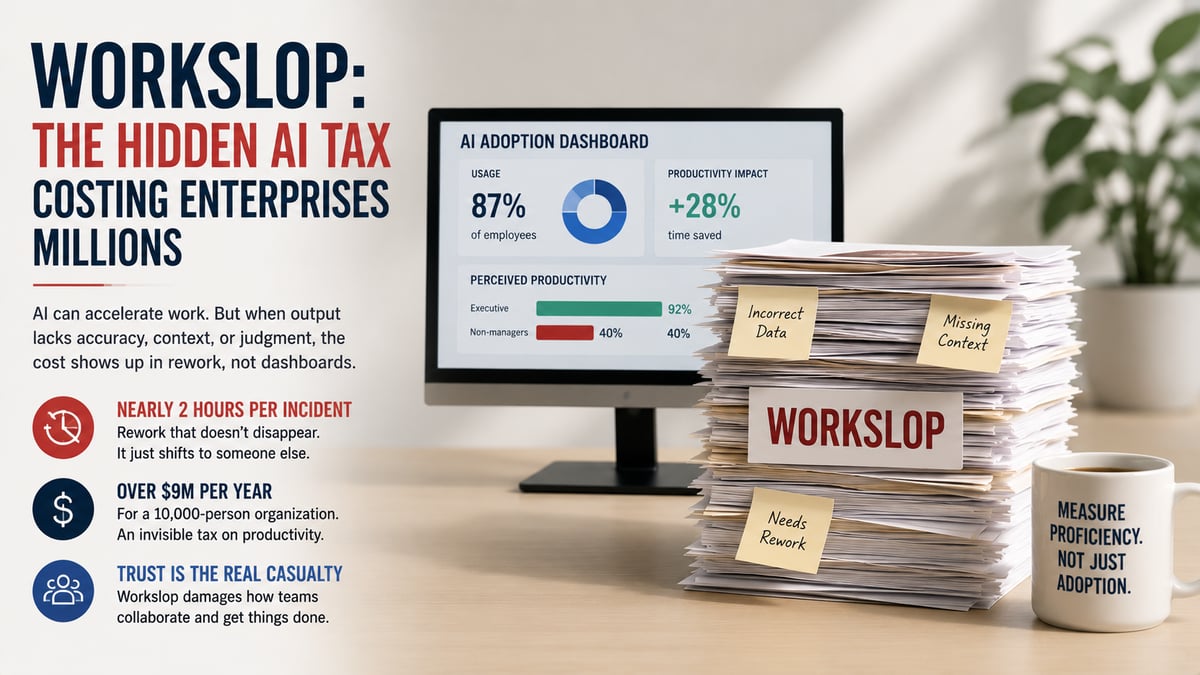

Workslop looks polished enough to pass along, but it leaves someone else to verify, correct, or redo the work. Hidden rework can erase AI productivity gains, damage trust between colleagues, and cost large organizations millions.
Key Takeaways
- Workslop shifts unfinished thinking downstream, creating hidden rework, slowing workflows, and eroding trust.
- BetterUp and Stanford found that about 40% of full-time U.S. desk workers received workslop in the previous month. Each incident took nearly two hours to resolve.
- Workslop costs more than time. Recipients also judged colleagues who sent workslop as less capable, creative, reliable, and trustworthy.
Key Terms
- Workslop: AI-generated work that looks polished but lacks enough accuracy, context, or judgment to be useful, forcing the recipient to verify, correct, or redo it.
- Knowledge decay: The erosion of an organization’s knowledge quality as inaccurate or poorly reviewed AI-generated information circulates through documents, systems, and decisions.
- Invisible tax: The time and effort employees spend fixing low-quality AI work created by someone else. It’s rarely captured by standard adoption metrics.
- AI proficiency: The ability to use AI effectively and produce useful business outcomes, including knowing when to question, revise, or reject an output.
- Cognitive outsourcing: Passing the thinking and judgment required by a task to AI, then forwarding the output without taking responsibility for its quality.
Quick Navigation
- What Workslop Is and Where It Comes From
- What Does Workslop Actually Cost?
- Workslop Also Damages Trust
- Why Organizations Keep Measuring the Wrong Thing
- What Leaders Need to Do
- How Larridin Helps
- Frequently Asked Questions
What Workslop Is and Where It Comes From
BetterUp Labs and the Stanford Social Media Lab introduced the term in a 2025 Harvard Business Review article. They define workslop as AI-generated work that looks credible on the surface but lacks the substance to meaningfully advance a task.
The problem isn’t AI assistance. It’s what happens when someone treats generation as completion. An employee produces a polished-looking document, summary, presentation, or analysis without checking whether it is accurate, relevant, or useful. The unfinished thinking then moves downstream to whoever receives it.
The work doesn’t disappear; it changes owners.
What Does Workslop Actually Cost?
BetterUp and Stanford surveyed full-time U.S. desk workers. About 40% said they had received workslop in the previous month, and each incident took nearly two hours to resolve. The researchers estimated a monthly productivity cost of $186 per employee. For an organization with 10,000 employees, that adds up to roughly $9 million a year.
Workday’s 2026 research shows the broader rework problem. Employees reported that 37% of the time AI saved them was offset by correcting, rewriting, or clarifying low-quality outputs.
That distinction matters because time to first draft may fall, while total cycle time stays flat or rises. A dashboard that only records the initial speed gain can make a costly workflow look successful.
Workslop Also Damages Trust
The researchers found that workslop can change colleagues’ perceptions of each other. About half of recipients thought the sender was less creative, capable, and reliable. 42% considered the sender less trustworthy, and 32% were less likely to want to work with that person again.
That damage can compound across a team. When employees can’t trust colleagues to apply judgment before sharing AI-assisted work, every document becomes a verification task. People spend more time checking assumptions, confirming facts, and deciding whether the person who created the work actually understands it.
A familiar warning sign is a wide gap between executive AI enthusiasm and employee frustration. Leaders see adoption and faster output. Employees see the cleanup. Measuring only the first half of that experience hides the cost.
Why Organizations Keep Measuring the Wrong Thing
Workslop is easy to miss when organizations measure activity instead of outcomes. Most AI dashboards track logins, prompts, active users, and time saved. Those metrics show whether employees are using AI, but not whether the work is accurate, useful, or creating rework elsewhere.
A June 2026 Harvard Business Review article described the organization-level consequence as knowledge decay: a decline in the accuracy and quality of organizational knowledge. When weak AI-generated information enters reports, knowledge bases, or operating decisions without adequate review, the problem can spread far beyond the original task.
The key metric is whether the full workflow improved after review, correction, and downstream use.
What Leaders Need to Do
The answer isn’t to roll back AI adoption. It’s to build the judgment and measurement practices that keep AI assistance from becoming someone else’s cleanup task.
- Define where AI belongs. Use AI for tasks with clear, well-defined boundaries that allow employees to judge the result. Avoid broad mandates that reward usage without considering fit.
- Set a quality standard. Employees need to know what has to be checked before AI-assisted work is shared, including facts, context, reasoning, tone, and task requirements.
- Measure the full workflow. Track total cycle time, rework, corrections, handoffs, and outcomes instead of relying on usage volume or time to first draft.
These controls also help leaders distinguish thoughtful AI use from compliance theater. High adoption paired with rising rework isn’t progress. It’s a cost signal.
How Larridin Helps
Larridin helps leaders see the gap between AI activity and effective AI use.
Larridin AI Fluency measures workforce proficiency across tools, teams, and roles. That gives leaders a clearer view of where employees are developing repeatable, effective AI practices and where targeted support may be needed.
Larridin Workflow Intelligence maps how work moves across applications, including sequence, duration, transitions, and friction. This can surface workflows where AI activity coincides with more handoffs, longer completion times, or added review.
Together with an AI measurement framework, these signals help organizations investigate workslop risk without pretending a usage dashboard can judge the quality of every output.
Book a Discovery Call to discuss how Larridin can help measure AI proficiency and downstream workflow performance.
Frequently Asked Questions
What is workslop?
Workslop is AI-generated work that looks polished but lacks the accuracy, context, or judgment needed to be useful. The recipient must verify, correct, or redo it before the task can move forward.
How much does workslop cost?
BetterUp and Stanford estimated that each incident takes nearly two hours to resolve and costs about $186 per employee per month. At an organization with 10,000 employees, the annual productivity cost can reach roughly $9 million.
Why does workslop happen?
Workslop often develops when organizations encourage broad AI use without defining appropriate tasks, quality standards, or accountability. Employees may mistake a plausible-looking output for completed work and pass the remaining judgment to someone else.
How do I measure whether my organization has a workslop problem?
Track total cycle time, rework, corrections, review loops, and employee reports of low-quality AI-assisted work. Compare those signals with AI adoption and proficiency data. Strong usage paired with flat or declining workflow performance is a reason to investigate.
Related Resources
- Larridin AI Fluency
- AI Adoption
- State of Enterprise AI 2026 Report
- AI Measurement Frameworks: Building a Repeatable Assessment Process
Wondering how much workslop is costing your organization?
Book a Discovery Call to connect AI proficiency, workflow performance, and measurable business outcomes.