



Published: August 8, 2025
Your employees are discovering breakthrough AI workflows every day and those innovations stay only with them when there’s no infrastructure to capture and scale them
Key Takeaway
Enterprise AI adoption today resembles the chaotic SaaS boom—uncoordinated spending without measurement frameworks. Companies deploy AI tools across workflows without understanding business impact or ROI. The result: rampant shadow AI creating cybersecurity risks, financial hemorrhaging from redundant AI solutions, and false metrics that mask failure. Organizations face a choice: embrace strategic measurement of AI capabilities now through data-driven frameworks, or face painful correction when stakeholders demand concrete evidence that AI investments deliver competitive advantage and revenue growth.
Key Terms
- Enterprise AI Adoption: The process of implementing GenAI , AI tools, and AI-powered automation across business processes, often characterized by uncoordinated deployment and lack of measurement frameworks.
- Shadow AI: Unauthorized AI tools and generative AI applications employees use independently—including ChatGPT and other language models—creating security vulnerabilities without governance oversight.
- AI ROI Measurement: Frameworks and metrics for quantifying business impact from AI initiatives, moving beyond vanity metrics to track real-world outcomes like cost reduction, revenue growth, and competitive advantage.
- AI Strategy: Coordinated approach to AI deployment across use cases, integrating AI capabilities into workflows with clear benchmarks, governance frameworks, and measurement of business processes improvements.
The Emperor's New Algorithms
Let's be brutally honest: most enterprise AI adoption today resembles the Wild Wild West—lawless, chaotic, and with a lot of fool's gold being peddled as the real thing. Companies are throwing obscene amounts of AI investments at AI tools without the slightest idea how to measure their effectiveness or ROI. It's the SaaS boom of 2020 all over again, but with potentially more devastating consequences for business impact.
Remember the pandemic-fueled SaaS explosion? Companies panic-purchased software solutions while employees worked from mountain lodges and beach villas. The aftermath? Crippling SaaS bloat, astronomical expenses at price points that couldn't be justified, and the painful realization that untangling this web of redundant AI systems would cost even more than the initial spending spree.
We're watching history repeat itself—but this time with artificial intelligence, and the stakes are exponentially higher for AI implementation across real-world use cases.
The Dangerous Illusion of AI Progress
Corporate boardrooms across America echo the same hollow demands: "What's our AI strategy?" The pressure from Wall Street, investors via LinkedIn and financial services analysts, and competitors has created a toxic ecosystem where the appearance of AI adoption matters more than actual revenue growth or business processes optimization.
The dirty secret? Most business leaders have absolutely no idea if their AI investments are delivering value.
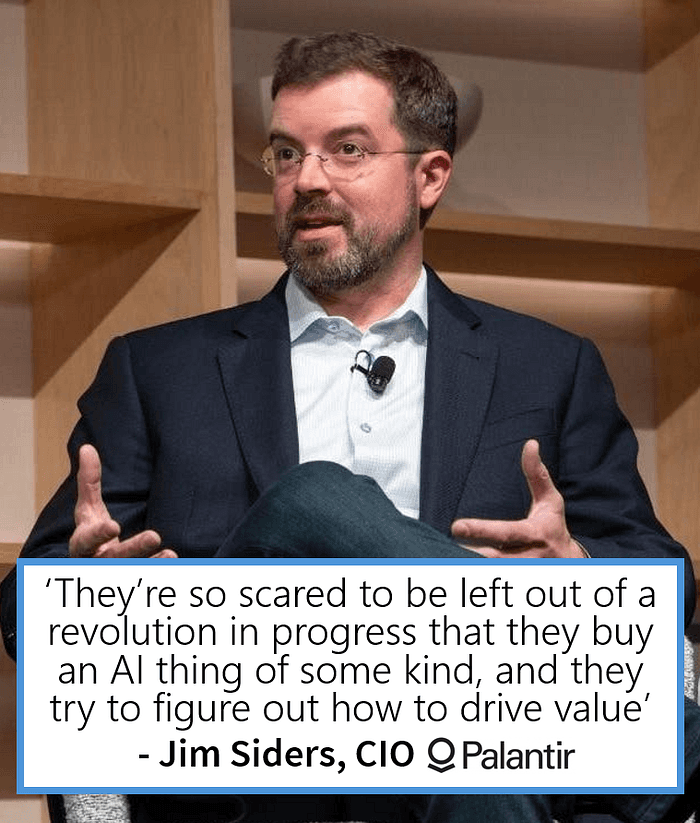
As Jim Siders, CIO of Palantir, aptly put it, companies are just "a bunch of hammers looking for nails." They're stockpiling AI solutions without clear AI use cases, coherent AI strategy, or—most critically—any frameworks to measure success through meaningful metrics and benchmarks.
Adding to this problem is the clear and present fear among executives I speak with that they're lagging the market, and more importantly, their competitors, in AI deployment and enterprise AI adoption. They worry about this regardless of whether generative AI is built into their existing AI systems or offered as dedicated AI applications. There are a wealth of AI solutions, and their collective aim is unambiguous: to innovate for massive, previously unimaginable corporate efficiency gains through automation and AI-powered workflows.
Why Your Company's AI Initiative Is Probably a Disaster
Let's examine the uncomfortable reality of enterprise AI adoption today:
Rampant Shadow AI
Employees across departments independently adopt AI tools—some approved, others not—creating massive cybersecurity vulnerabilities and data leakage risks. Your corporate secrets are being fed into public language models and GPT systems, while leadership remains oblivious to real-time security threats. ChatGPT, open-source AI models, and AI agents operate across workflows without governance.
Financial Hemorrhaging
The fragmentation of AI tooling means companies are paying for redundant AI capabilities across departments. We've seen enterprises with over 15 different AI writing assistants deployed across various teams—each with its own contract at different price points, security profile, and learning curve. This prevents cost reduction and optimizes nothing.
False Metrics
The few companies attempting to measure business impact are tracking vanity metrics like "number of employees trained" or "prompts generated"—meaningless figures that say nothing about business outcomes, competitive advantage, or ROI. Real-world function and outputs remain unmeasured.
The Elon Fallacy
Despite the perception and news about Twitter/X's dramatic headcount reduction while maintaining operations and driving true profitability, most companies lack understanding of which business processes can truly be automated or augmented by AI capabilities. This leads to unrealistic expectations about AI deployment and inevitable disappointment when AI initiatives fail to deliver promised advancements.
The Tragic Gap: Why Existing Solutions Fall Short
Some functions have historically been easier to measure—SDRs have calls and leads, AEs have close rate benchmarks, support has ticket deflection metrics—but these represent a tiny fraction of potential AI use cases. For the vast majority of knowledge work across healthcare, financial services, supply chain management, and software development, companies have no established frameworks to measure productivity improvements from enterprise AI adoption.
What's the ROI on a marketing team using AI for content creation and decision-making? How do you quantify the value of engineers using GitHub Copilot or other AI-powered coding assistants? What's the business impact of executives using AI assistant tools like Claude for strategic planning? How do fine-tuned AI models for specific use cases compare to general-purpose language models?
Most organizations don't know, don't measure through proper datasets and APIs, and frankly, don't want to know—because the answer might reveal their AI initiatives as expensive failures lacking clear AI strategy.
The Real-World Impact Across Industries
The challenge of measuring enterprise AI adoption spans every sector:
- Healthcare organizations deploy AI applications for diagnostics and patient care without frameworks to measure outcomes beyond cost reduction
- Financial services firms use AI to optimize trading and risk assessment, but struggle to benchmark performance against traditional methods
- Supply chain teams implement AI-driven forecasting without real-time visibility into accuracy improvements or business processes optimization
- Software development teams adopt AI tools across workflows, but lack metrics connecting AI-powered assistance to revenue growth
- Startups and enterprises alike pursue partnerships with AI vendors without clear benchmarks for success
The common thread? A rush to use AI without establishing how to measure whether these AI systems actually deliver competitive advantage. Business leaders discuss AI research advancements and the potential of new language models on LinkedIn, but few can demonstrate tangible business impact from their AI implementation.
The Choice Ahead: Measured Success or Expensive Chaos

The enterprise AI adoption space is approaching an inflection point. Companies can continue the current path of uncoordinated, unmeasured AI deployment—guaranteeing massive waste and eventual painful correction—or they can embrace accountability and strategic measurement now through proper frameworks and metrics.
The reckoning is coming, one way or another. The question is whether your organization will be ahead of the curve with data-driven AI governance, optimizing AI capabilities across real-world use cases, or caught flat-footed when the board finally asks for concrete evidence that AI investments in generative AI tools, AI agents, and AI applications are paying off through measurable revenue growth and competitive advantage.
The future belongs to organizations that measure what matters through high-quality datasets, establish clear benchmarks for AI use cases, track business impact across workflows, and optimize AI systems based on real-time outputs. These organizations will leverage artificial intelligence not as a buzzword or checkbox exercise, but as a genuine driver of business processes automation, cost reduction, and strategic decision-making.
I believe the future belongs to organizations that measure what matters. The time for AI accountability is now—whether the AI industrial complex, with its ecosystem of startups, open-source initiatives, and high-priced consultants, is ready for it or not.
This post was previously published on Medium