

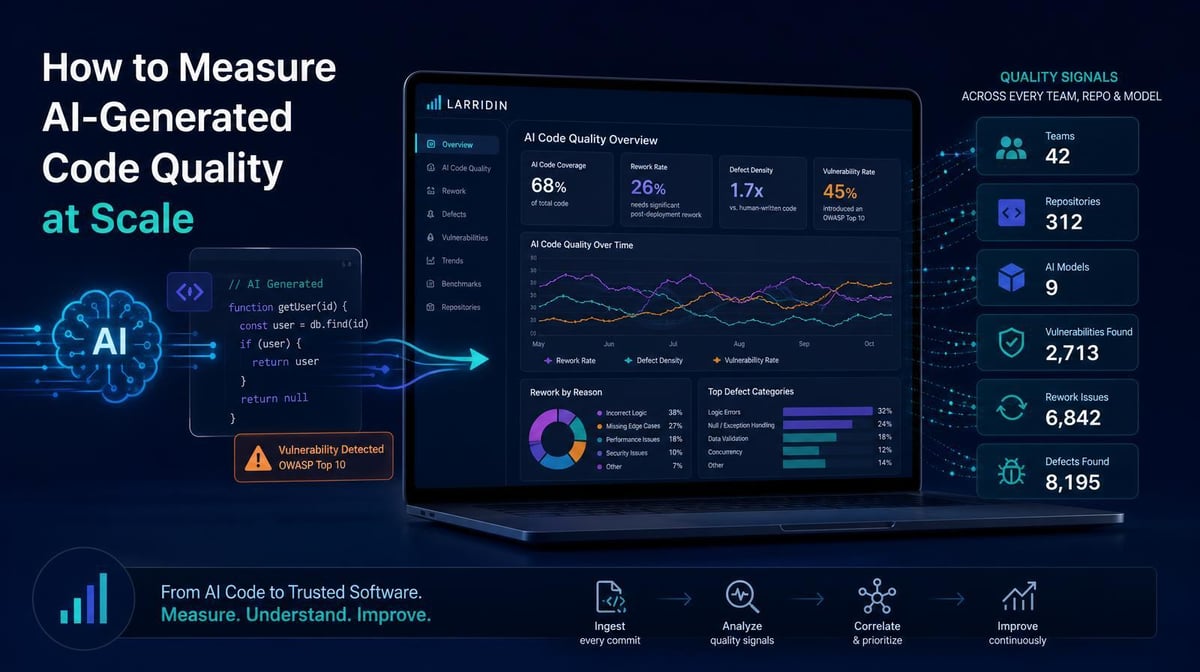

AI code can look good in review, compile cleanly, and still create problems after it ships. Enterprise quality measurement has to follow AI-assisted code into production.
Key Takeaways
- Veracode’s Spring 2026 update found that AI-generated code introduced known security flaws in 45% of tests across more than 150 large language models. Security performance has stayed near the same level even as syntax accuracy has exceeded 95%.
- New Relic’s 2026 State of AI Coding report found that 74% of respondents said at least 25% of AI-generated code required significant post-deployment rework, while 78% reported more production incidents.
- Measuring AI-generated code quality at scale requires tracking downstream quality signals by code source across the engineering organization, not relying only on spot audits or individual tool dashboards.
Why Standard Quality Metrics Are Not Enough
Standard code quality measurement was designed for human-written code. Static analysis, code review pass rates, and test coverage are all useful signals. But they don’t show whether code will behave correctly in production or distinguish the quality of AI-assisted work from human-only work.
That gap matters at enterprise scale. In New Relic’s survey, 82% of respondents said more than half of their weekly code output was AI-generated or significantly refactored by AI. Without source attribution, leaders can’t tell whether rising rework, incidents, or turnover are concentrated in AI-assisted work.
5 Quality Signals That Matter for AI-Generated Code
1. Security Vulnerability Rate by Code Source
Veracode’s longitudinal testing found that, across all models and tasks, only 55% of generation tasks produced secure code when no security guidance was provided. Syntax accuracy now exceeds 95%, but security performance has stayed largely flat.
Track vulnerability rates by code source, model, language, and task type. This gives security and engineering leaders a clearer view of where AI-assisted development creates additional risk and where stronger controls are needed.
2. Code Revert Rate at 30 and 90 Days by Code Source
Code turnover shows whether work survives after it ships. In one Larridin customer environment, AI-assisted code had a 0.2% revert rate versus 15.16% for human-only code. In another, AI code share rising to 56% coincided with 30-day turnover climbing 64.7%.
Your organization’s results are what matter. Our revert rate measurement article explains how to compare AI-assisted and human-only code over consistent time windows.
3. Rework and Post-Deployment Incident Rates by Code Source
New Relic found that 74% of respondents said at least one-quarter of AI-generated code required significant post-deployment rework. Tracking rework and incidents by code source shows whether that pattern applies in your environment and whether it changes as AI code share grows.
Larridin’s AI Dev Productivity platform connects AI-touched commits to downstream incident, rework, and quality data, providing attribution that native tool dashboards don’t.
4. Review Depth for AI-Assisted Pull Requests
High acceptance or merge volume doesn’t prove that AI-assisted code was meaningfully scrutinized. Larridin’s 2026 Developer Productivity Benchmarks warn that unusually high suggestion acceptance rates can indicate uncritical acceptance and recommend checking whether accepted work survives review and production without disproportionate rework.
Track reviewer participation, review time, comments, requested changes, and approval patterns for AI-assisted pull requests. These signals expose governance gaps that aggregate review metrics can hide.
5. AI Code Share as a Leading Indicator
AI code share provides context for downstream quality trends. Rising AI code share with stable or improving rework, incident, and turnover rates suggests the deployment is scaling without obvious quality erosion. When those measures rise together, leaders have a clear reason to investigate.
Our code turnover article explains how repeated rework can accumulate as technical debt.
Measuring Quality Across the Full Tool Stack
Many engineering organizations use multiple AI coding tools, including Cursor, Copilot, and Claude Code. Measuring quality at scale requires consistent attribution across the stack rather than separate views inside each vendor’s dashboard.
Larridin tracks AI-assisted code quality signals, including rework and defect patterns, across tools and teams. Leaders can compare outcomes by tool and determine whether the differences are meaningful enough to affect enablement, governance, or procurement decisions.
Frequently Asked Questions
How do we measure AI code quality without reading every AI-generated commit?
Track downstream behavioral signals instead of manually inspecting every commit. Revert rates, rework rates, incident rates, and review patterns create an aggregate quality picture and capture failures that passed initial review.
What is a concerning AI code quality pattern at the team level?
Rising AI code share combined with rising revert, rework, or incident rates in the same period warrants investigation. One signal may have another explanation, but several moving together can indicate that quality is deteriorating as AI-assisted output grows.
Does AI code quality vary significantly by tool?
Veracode found meaningful variation by programming language, vulnerability type, and model category. Most standard models clustered around a 55% security pass rate, while some reasoning models reached 70% to 72%. Internal measurement is more useful than assuming any tool performs consistently across tasks and codebases.
How does AI code quality relate to change failure rate?
AI code quality affects change failure rate when AI-assisted work that passed review causes production incidents above the organization’s baseline. Tracking change failure rate by code source connects AI quality measurement to a delivery-health metric engineering leaders already use.
Track AI Code Quality Across Your Engineering Organization
Larridin tracks AI-assisted code quality signals, including rework and defect patterns, across teams and tools so leaders can identify quality erosion before it becomes a larger production problem.
Book a discovery call to set up AI code quality tracking.