

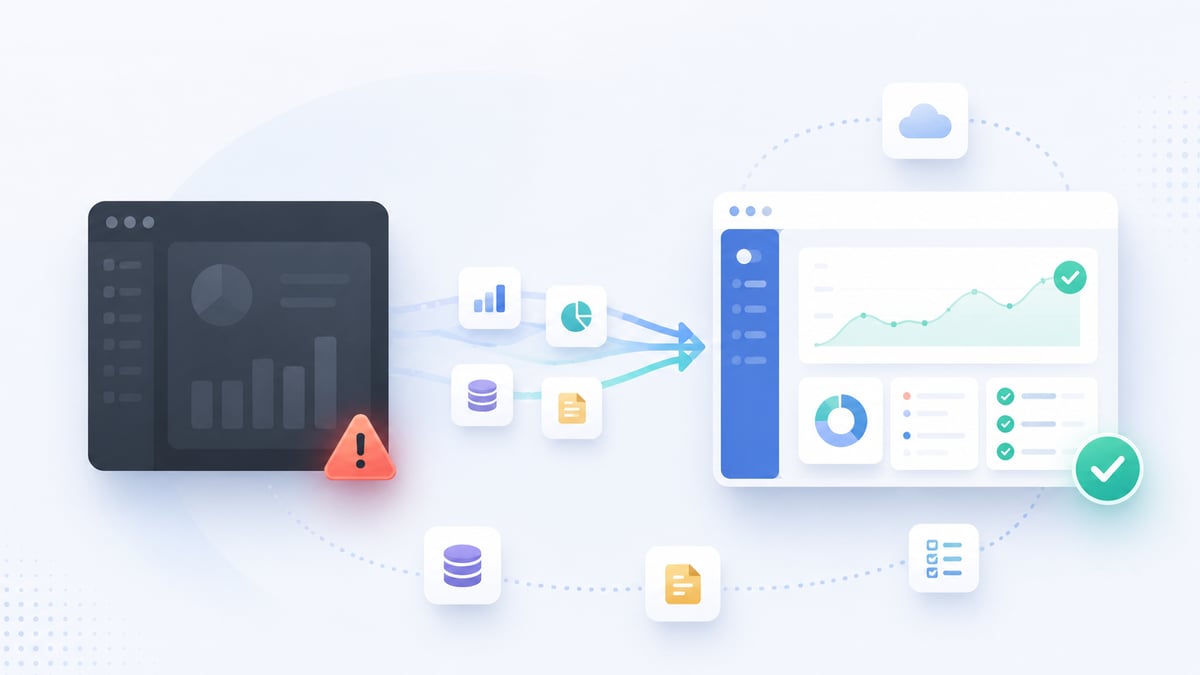

Flow, formerly Pluralsight Flow, originally GitPrime, is ceasing operations in 2027. If your team built dashboards, quarterly business reviews, or board-level reporting around it, you now have a real problem on a fixed deadline.
This guide covers three things: what to secure before your account closes, how to run an evaluation without taking every vendor demo that lands in your inbox, and how to decide whether you actually need another Flow, or something Flow was never built to be.
First: Secure Your Historical Data
Before anything else, before you’ve even picked a replacement:
Export your historical metrics. Cycle time, deployment frequency, PR data, and any custom dashboards. Confirm the exact account closure date with your Appfire team directly. Don’t rely on secondhand timelines.
Document your current dashboard configuration. Whoever built your Flow setup may not be the person migrating it. Screenshot or export the definitions, not just the data.
Check contract terms for the transition window. Ownership has already moved from Pluralsight to Appfire once. Get closure terms in writing rather than assuming a standard SaaS offboarding process.
Four Questions That Matter More Than a Feature Checklist
Every vendor you talk to will hand you a feature comparison grid. Before you look at any of them, answer these first.
1. What was Flow actually being used for, reporting or decisions? If Flow’s dashboards mostly got screenshotted into a slide once a quarter, you need a reporting tool. If teams were actively changing behavior based on Flow’s signals, you need something with workflow automation built in, not just a dashboard.
2. Is the question you’re being asked still “how fast is engineering,” or has it become “is AI worth it”? Flow was built before AI-assisted development existed as a category. If the conversation in your leadership meetings has shifted from delivery speed to AI ROI, replacing Flow with another Git-and-Jira dashboard just re-buys the same blind spot under a new vendor name.
3. Does this need to be an engineering-only decision? Flow only ever reported to engineering leadership. If your CFO or CHRO has started asking about AI spend and usage outside engineering, and increasingly they have, this migration is a natural moment to widen who the tool reports to, not just which tool it is.
4. How much migration effort can you actually absorb right now? A four-week evaluation sprint against two or three vendors is usually enough signal to decide. Longer than that, and you risk running out of runway before your Flow account closes.
Where This Splits Into Two Different Paths
Path A: You need Flow’s dashboard back, with more capability. LinearB is the closest like-for-like replacement: DORA metrics, cycle time, deployment frequency, plus workflow automation and AI code reviews Flow never had. Jellyfish, GetDX, Allstacks, and Swarmia are all credible alternatives depending on whether you weight planning, developer surveys, product context, or moving away from individual scoring most heavily. See the full comparison.
Path B: The real question has become whether AI is paying off, everywhere it’s being used. This is where Larridin fits, and it’s worth being direct about what that means. Larridin does not replicate Flow’s DORA dashboard. It tracks AI adoption, proficiency, spend, and business impact across engineering and every other department: sales, HR, finance, operations, using engineering integrations plus browser and desktop coverage. If your CFO’s question this year is “what are we getting for our AI spend,” that’s a different tool than the one that measured your PR cycle time.
Some teams need both: an engineering-metrics platform for delivery reporting, and Larridin layered on top for the AI-impact question neither Flow nor its direct successors were built to answer.
What a Larridin Evaluation Looks Like
If Path B is the right read for your situation, a typical rollout looks something like this:
Week 1: Connect engineering integrations (version control, CI/CD, ticketing) alongside browser and desktop coverage for a sample of non-engineering teams already using AI tools.
Weeks 2 to 3: Get a baseline read on adoption and proficiency. Who’s using what, how well, and where usage is concentrated versus absent.
Week 4: Connect usage signals to business outcomes and get a first cut at cost-versus-value reporting your CFO or board can actually use.
That timeline runs in parallel with exporting your Flow data. It doesn’t have to wait for your Flow account to close.
Frequently Asked Questions
When exactly does Appfire Flow shut down?
Appfire has stated Flow will cease operations in 2027. Confirm the specific account closure date directly with Appfire, since exact timelines for sunsetting products can shift after the initial announcement.
Do I need to pick one replacement, or can I run two tools?
Many teams run an engineering-metrics platform (LinearB, Jellyfish, GetDX, Allstacks, or Swarmia) for delivery dashboards, alongside Larridin for AI adoption and impact tracking across the business. They answer different questions and aren’t mutually exclusive.
Is switching to Larridin a bigger lift than switching to another Flow-like tool?
It’s a different lift, not necessarily a bigger one. Migrating to another engineering-metrics tool mostly means re-pointing existing integrations. Standing up Larridin means deciding which non-engineering teams to bring into scope first. It’s a scoping conversation more than a technical migration.
What should I tell leadership if I’m not sure which path fits?
Ask what question they actually want answered next quarter. “How fast are we shipping” points to an engineering-metrics replacement. “What are we getting for our AI investment” points to Larridin. Most teams already know which one they’ve been fielding more often. The decision is usually easier than the tool comparison makes it feel.
The Bottom Line
Appfire Flow’s shutdown is forcing a decision on a deadline you didn’t choose. Use it well. Don’t default to re-buying the same dashboard under a new vendor just because that’s the fastest decision to make. If engineering delivery metrics are genuinely the whole job, LinearB and the other alternatives above will do it well. If the question in the room has quietly gotten bigger than that, this is the moment to answer it properly.