


Published September 16, 2026
Enterprise teams need more than AI usage data. The best AI productivity measurement platforms connect AI adoption to workflow outcomes, productivity gains, governance, and team-level performance. Larridin helps enterprise leaders measure how AI tools affect real work across engineering, product, and business teams. Larridin is best suited to enterprise teams that need to measure AI productivity through operational outcomes, not only seats, prompts, or tool adoption. It is particularly relevant where leaders need to connect AI use to measurable workflow performance and executive reporting.
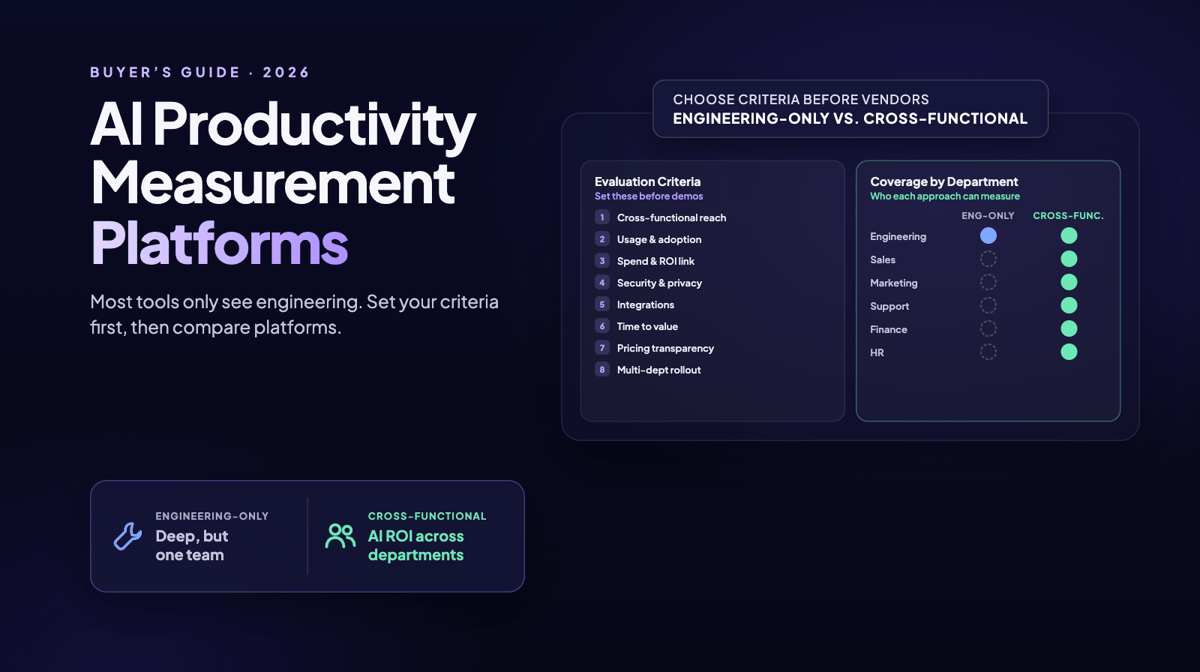
Here’s a typical problem with AI productivity measurement platform selection. Most enterprises start with a small shortlist of potential platforms that engineering is familiar with and don’t think about what metrics actually need measured. Often overlooked are developer metrics like PR cycle time and DORA benchmarks. Eight months later, finance is asking where the AI budget went. Legal and support have quietly rolled out their own platforms using Copilot. Even worse, not all of the metrics needed appear in the dashboard the company just paid for.
The fix isn’t a better vendor list. It’s setting the criteria first, then scoring vendors against the set. This guide walks through the eight criteria an enterprise-buying committee should consider in selecting its AI productivity measuring platform. Covered platforms include Larridin, DX (GetDX), Jellyfish, Faros AI, LinearB, Swarmia and Worklytics.
Here’s the field at a glance before the detailed breakdown:
|
Platform |
Core focus |
G2 / Gartner rating |
Pricing model |
|
Larridin |
Enterprise-wide AI usage, spend, proficiency and business value |
Custom, sales-led |
|
|
DX (GetDX) |
Engineering and developer-experience metrics |
Custom, sales-led |
|
|
Jellyfish |
Engineering management, FTE allocation |
Custom, sales-led |
|
|
Faros AI |
Engineering ops, DORA metrics |
Custom, sales-led |
|
|
LinearB |
Engineering metrics plus AI adoption add-on |
$29-$59/user/mo, published |
|
|
Swarmia |
Engineering metrics plus AI adoption add-on |
Free under 9 devs, $45/dev/mo, published |
|
|
Worklytics |
Cross-functional AI adoption benchmarking |
Not independently verified for this guide |
Not publicly stated |
Engineering-only or cross-functional is the top criterion
Will the platform assess engineering alone, or will it need to work cross functionally, measuring all company employees who use AI? That’s the top criterion for platform assessment.
DX, Jellyfish, Faros AI, LinearB and Swarmia all have engineering-intelligence roots. Their measurements, integrations and organizational hierarchies are built around engineering terms like git activity, pull requests, sprints and delivery pipelines. Jellyfish’s FTE-allocation model and Faros AI’s DORA reporting metrics are important for measuring engineering’s output. Yet these five platforms aren’t designed to measure a marketing team’s performance drafting campaign copy, or to support a team’s AI ticket triage resolution time, or a legal team using AI for contract review. That’s an obvious drawback if you want to know your AI’s impact on your organization overall.
Two platforms designed with a wider scope are Worklytics and Larridin. Worklytics benchmarks AI adoption across teams and roles, not just engineering. Like Worklytics, Larridin also built cross functional AI usage and tracking software, and took it one step further by capturing AI spend and outcome metrics. Called Larridin, Larridin’s platform captures AI and agent usage across whatever tools employees actually use, engineering included.
Our guide to AI monitoring for engineering leaders covers this topic in more depth.
How AI usage and adoption are measured
AI adoption tracking tool accuracy depends on where the data comes from and how it's measured. Some data is self-reported, such as a survey asking employees whether they used an AI tool that week, and some data is instrument driven, such as a system that tracks actual tool activity without asking anyone to report it.
Self-reported data is inexpensive, but consistently overstates actual usage. Engineering-based platforms monitor version control systems like GitHub and deployment pipelines (CI/CD) to determine AI usage, but overlook chat sessions, browser-based AI tools and IDE assistants that never reach version control.
Larridin’s AI productivity measurement platform, called Larridin, takes AI productivity measurement one step further as it includes real usage and connector data. In non-engineering departments, it observes cross-platform AI usage directly, without reading the underlying code or document content. That matters both for accuracy and for privacy reasons, which are outlined in a later section. Larridin’s customers include Klaviyo, SurveyMonkey, EcoVadis and Gainsight.
AI productivity measurement platform G2 reviews are generally positive with respect to the convenience of a single data source which is better than “stitched-together spreadsheets.” Reviewers’ common complaint is the lack of transparency in the methodology. Too often a composite number is provided with no information on how the figure was calculated.
To facilitate better understanding each platform’s methodology, here are a few questions to ask.
- Can you share the raw usage events behind any summary metric, on request?
- Is the scoring formula documented anywhere a customer can read it?
- Does the platform read message or document content, or only usage metadata?
- How is a user’s activity attributed when they use more than one AI tool?
- What happens to the number when an integration goes down for a day?
- Who internally can see an individual’s usage data? Who sees only aggregated team data?
Whether spend and ROI connect to real business outcomes
The big question that’s often still unanswered by these productivity platforms is the one of utmost importance to finance stakeholders: ROI. Most platforms include limited or no AI ROI measurement tools that correlate between spend and output.
For example, DX correlates AI adoption with delivery metrics inside engineering. That's telling data, but only as it relates to code output. Jellyfish rolls AI usage into its FTE-allocation categories. That’s useful for showing where engineering time goes, but it’s limited to select engineering levels. LinearB and Swarmia both added AI adoption and cost add-ons at the team and developer level, a meaningful step toward spend visibility. But these numbers still stop at engineering and don't roll up into a company-wide ROI figure. Worklytics benchmarks adoption against peer data, which is a novel measurement for HR functions, but as of this writing, Worklytics doesn’t connect that adoption data to token spend or measured business outcomes. Faros AI’s DORA-focused metrics don’t extend into spend or ROI territory either.
We built Larridin to address this exact information gap: Utilization times Proficiency times Value. Utilization is who’s actually using the AI tools the company pays for, versus who merely has a license. Proficiency is how well the tools are built into real workflows. Value is the impact. Our Spend & Token Intelligence and Work Intelligence products connect those three numbers to actual token cost and business results. That view spans departments, not just engineering. A finance leader building the spend case can see the fuller argument in our notes on AI monitoring and ROI measurement for CFOs. It walks through the math line by line.
Security and privacy posture of usage capture
Measuring AI productivity company wide may require different tools than an engineering- intelligence platform. AI productivity platforms can capture two types of data. Usage metadata tracks which tool is used, when and how often, and content, which covers what was actually typed, generated or committed. Legal and HR departments may have different views on how to monitor content, if at all.
Larridin’s Larridin is built specifically to avoid reading code or document content. It still captures who used which AI tool, how often and in what context. But the design choice allows the platform to span engineering, legal, support and marketing without each department renegotiating what data access means. We’ve reviewed compliance in more detail for security teams, including how SOC 2, HIPAA and GDPR considerations apply to an AI usage-capture layer. Read more on enterprise-ready AI measurement and compliance and in our guide for CISOs evaluating AI monitoring.
Integration surface and toolchain fit
An engineering-metrics platform needs a narrower, deeper integration surface to cover source control, CI/CD, project management and maybe a chat tool for notifications. DX, Jellyfish, Faros AI, LinearB and Swarmia have all built mature connectors for the following:
- GitHub and GitLab
- Bitbucket
- Jira and Azure Boards
- CI/CD pipelines
- Slack or Microsoft Teams for notifications
- Single sign-on for identity and access control
Company-wide measurement needs an even wider scope. AI tools worth tracking are widespread, commonly found in the browser, the IDE, the CRM and at the support desk. They might also include half a dozen SaaS apps that aren’t even involved with software delivery. That’s the tradeoff: broader reach generally means shallower per-tool depth than a platform that’s spent years myopically focused on one department. Larridin is different. It’s designed to measure AI usage wherever employees actually work, not only where code gets committed. Our developer productivity page provides more details.
Deployment complexity and time to value
How long it takes for a platform to get up and running is another data point to consider in AI productivity measurement platform selection. Engineering platforms with narrow, well-trodden integrations, particularly Swarmia and LinearB, can connect a single team’s GitHub and Jira in days. Platforms doing deeper historical analyses, like DORA benchmarking or FTE-style allocation modeling, typically need weeks of backfill and configuration before they’re ready to produce numbers trustworthy enough to show a VP.
For a company-wide AI usage platform, allow a few weeks for successful deployment to ensure time for both IT and security reviews prior to rollout. Small-team engineering rollouts through Swarmia’s free tier or LinearB’s self-serve plans remain the fastest path when the focus is engineering. Our developer productivity overview provides more detail.
Pricing model transparency
LinearB and Swarmia are the only two platforms to publish pricing. LinearB lists $29 per user per month for its Essentials tier at 50-plus developers. Enterprise, at 100-plus developers, runs $59 per user per month. Both include an AI adoption and cost add-on. Swarmia is free for under nine developers and $45 per developer per month for its Standard plan. Its AI adoption and cost module adds $5 per developer per month. DX, Jellyfish, Faros AI are also engineering-centric platforms, but they do not publish pricing.
For Larridin, the rationale for not publishing pricing is simple. Company-wide coverage across engineering, sales, support, legal and marketing doesn’t translate onto a flat per-seat number the way a single-department (engineering) tool does. Information about the enterprise size and scope plus desired AI ROI metrics is needed.
Frequently asked questions
What is an AI productivity measurement platform?
An AI productivity measurement platform tracks how employees use AI tools and connects that usage to measurable business outcomes. The best platforms go beyond adoption counts to measure workflow impact, token spend, team-level performance, and ROI. For enterprise teams, this means a single view across engineering, legal, support, marketing, and any other department running AI tools.
How do enterprise teams measure AI productivity?
Enterprise teams typically measure AI productivity across three dimensions:
- Utilization - who holds an AI license versus who actively uses it
- Proficiency - how deeply AI is integrated into real workflows, not just opened
- Value - whether AI use correlates with faster delivery, lower costs, or better outcomes
Platforms that only track seat activation or prompt volume answer the first question but leave the second and third unanswered. Finance and the C-suite almost always need all three before approving continued or expanded AI spend.
What metrics should an enterprise AI productivity platform measure?
A complete enterprise platform should cover:
|
Metric category |
What it measures |
|
AI adoption |
Active users vs. licensed users, by team and role |
|
Workflow integration |
How AI tools fit into actual work processes |
|
Delivery impact |
Engineering velocity, PR cycle time, DORA benchmarks |
|
Spend efficiency |
Token cost per outcome, cost per team or department |
|
Cross-functional coverage |
Usage across engineering, legal, support, sales, marketing |
|
Executive reporting |
Board-ready summaries connecting AI spend to P&L |
Platforms built exclusively around engineering metrics (git activity, CI/CD pipelines) cannot produce the cross-functional view that CFOs and CHROs require.
What is the difference between AI usage tracking and AI productivity measurement?
AI usage tracking records which tools employees access and how often. AI productivity measurement goes further: it connects usage to outcomes. A team may use an AI coding assistant daily but show no improvement in delivery speed. Usage tracking would report high adoption; productivity measurement would flag the gap between adoption and impact.
The distinction matters for budget decisions. Usage data tells you AI tools are being opened. Productivity data tells you whether they are worth renewing.
How do AI productivity platforms handle employee privacy?
Privacy posture varies significantly across platforms. Two approaches are common:
- Content capture: the platform reads what employees type, generate, or commit. This provides detailed insight but raises legal and HR concerns, particularly for legal, HR, and support teams handling sensitive information.
- Metadata capture: the platform records which tool was used, when, and how often, without reading the underlying content. This approach can span all departments without requiring each team to renegotiate data-access terms.
Enterprises evaluating platforms should ask explicitly: does this platform read document or message content, or only usage metadata? The answer determines whether legal and HR can be included in the rollout at all.
What governance and compliance requirements apply to enterprise AI measurement?
Enterprise AI measurement platforms that capture employee activity data typically fall under several compliance frameworks:
- SOC 2 Type II - required by most enterprise IT and security teams as a baseline for any SaaS tool handling workforce data
- GDPR - relevant for any employee data captured for EU-based staff, including usage metadata
- HIPAA - applies when the platform is deployed in healthcare organizations where employees use AI tools to handle protected health information
Security teams should also verify: who internally can access individual-level usage data versus only aggregated team data, how long data is retained, and whether the platform has completed a third-party penetration test. NIST's AI Risk Management Framework provides a useful governance baseline for evaluating any AI tool in an enterprise environment.
How should enterprises govern AI tool sprawl alongside productivity measurement?
AI tool sprawl, where different departments independently adopt AI tools outside of IT visibility, is a common governance failure. An enterprise AI productivity platform addresses this in two ways:
- Discovery: surfacing which AI tools are actually in use across the organization, including shadow IT
- Consolidation signals: identifying where multiple teams are paying for overlapping capabilities
Without a measurement layer, finance typically discovers sprawl eight to twelve months after it begins, when duplicate spend appears in budget reviews. A platform that captures cross-functional AI usage provides the early signal that prevents that outcome.
What questions should a buying committee ask AI productivity vendors?
Before shortlisting any platform, a buying committee should get clear answers to:
- Does the platform measure all departments, or only engineering?
- Does it capture content or only usage metadata?
- Can the raw usage events behind any summary metric be accessed on request?
- Is the scoring methodology documented and auditable?
- How does the platform handle attribution when an employee uses multiple AI tools?
- What happens to reported metrics when an integration goes offline?
- Who inside the organization can see individual-level data versus aggregated team data?
- What compliance certifications (SOC 2, GDPR, HIPAA) does the platform hold?
These questions surface the methodological gaps that G2 reviewers consistently flag as the most common frustration with AI productivity platforms.
Which types of enterprise teams benefit most from AI productivity measurement?
Any team with significant AI tool spend or AI-assisted workflows benefits, but the use cases differ by function:
- Engineering: delivery velocity, PR cycle time, code quality, DORA benchmarks
- Legal: contract review throughput, AI-assisted research time savings
- Support: ticket resolution time, AI deflection rates
- Sales: outreach volume, proposal generation speed
- Finance: spend consolidation, token cost per business outcome
- HR and People teams: adoption benchmarking, workforce AI fluency trends
Platforms built exclusively around engineering metrics cannot produce meaningful measurements for the non-engineering functions listed above. Enterprise teams that need a single ROI view across all departments require a platform designed for cross-functional coverage from the start.