

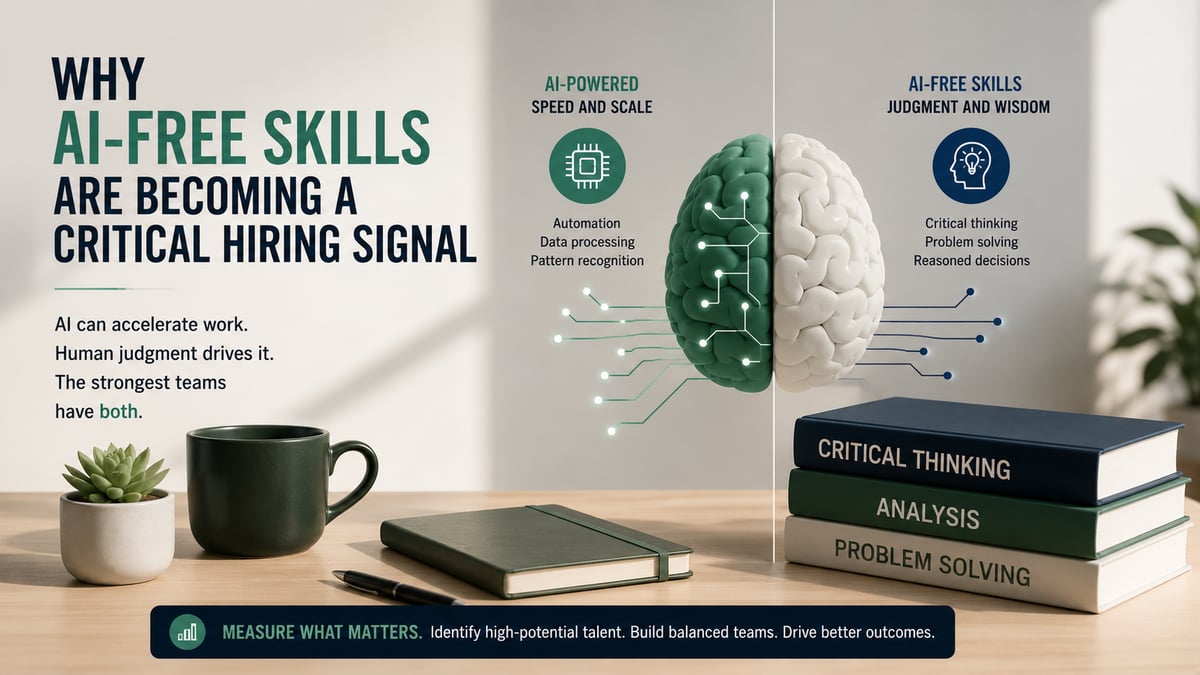

AI can help people work faster, but it can also make weak judgment harder to see. As organizations scale GenAI, the workforce question is shifting from who can use AI to who can still think clearly without it. For enterprise leaders, AI-free skills are becoming a measurable signal of judgment, readiness, and long-term workforce risk.
Key Takeaways
- Gartner predicts that 50% of global organizations will require AI-free skills assessments through 2026 as critical thinking atrophy from GenAI use becomes a workforce concern.
- Wharton researchers call the issue cognitive surrender: after consulting AI in reasoning tasks, participants adopted incorrect AI answers more than 80% of the time.
- The goal isn’t to roll back AI adoption. It’s to measure whether people can think well with AI and without it, then build workforce strategy around both capabilities.
Key Terms
- AI-free skills: Cognitive capabilities, including critical thinking, independent analysis, judgment under uncertainty, and reasoned decision-making, that an employee can demonstrate without AI assistance.
- Cognitive surrender: A term Wharton researchers use for adopting AI outputs as one’s own reasoning with minimal scrutiny, even when the output is wrong.
- Skills atrophy: The gradual erosion of a capability through disuse. Consistent offloading of thinking to AI can weaken the underlying capacity to do that thinking independently.
- AI proficiency: The ability to use AI tools effectively, evaluate outputs critically, and judge when and how to apply them.
- Human+AI workforce: Larridin’s term for the combined productivity equation: value comes from humans and AI systems working in tandem, each contributing what they do best.
Quick Navigation
- What the Research Actually Shows
- Why This Is a Workforce Strategy Problem, Not Just a Hiring Problem
- The Right Frame Is Human+AI
- How Larridin Helps
- Frequently Asked Questions
What the Research Actually Shows
MIT Media Lab: Weaker Brain Connectivity in LLM Users
An MIT Media Lab preprint studied 54 participants writing essays with either an LLM, a search engine, or no tools. Its EEG analysis found the brain-only group showed the strongest, most distributed connectivity, search engine users showed moderate engagement, and LLM users showed the weakest connectivity. LLM users also reported the lowest ownership of their essays and struggled to quote their own work afterward.
The study is small and not peer-reviewed, so it shouldn’t be treated as proof that AI use causes cognitive decline. The useful enterprise takeaway is narrower: when people offload the thinking step too early, they may produce acceptable work while doing less of the underlying reasoning.
Wharton: Cognitive Surrender and Error Acceptance
Wharton researchers Steven Shaw and Gideon Nave use “cognitive surrender” to describe what happens when people adopt AI’s answer as their own with minimal scrutiny. In their experiments, participants solved reasoning problems with optional AI access. They consulted ChatGPT more than half the time, and once they did, adoption rates were high. When the AI answer was incorrect, participants still adopted it over 80% of the time.
This is the risk that CIOs and people leaders should watch for: AI can improve output when it’s right, but if they don’t apply their own critical judgment, they’re often more confident in flawed reasoning. The issue isn’t AI adoption. It’s whether the organization can tell the difference between informed AI use and deferred judgment.
Gartner: 50% of Organizations Requiring AI-Free Assessments
Gartner’s 2026 strategic predictions turn the same concern into a talent signal. It expects critical-thinking atrophy due to GenAI use to push 50% of global organizations to require AI-free skills assessments that measure what candidates and employees can do without AI assistance. It also predicts that by 2027, 75% of hiring processes will include certifications and testing for workplace AI proficiency.
The two predictions dovetail around the same workforce question: whether people can still exercise judgment when AI is part of the workflow. AI-free assessments test whether employees can reason without AI. AI proficiency testing measures whether they can use AI without becoming dependent on it.
That’s the hiring signal. Employers need people who can evaluate AI output, catch weak reasoning, and know when the decision still belongs to the human.
Why This Is a Workforce Strategy Problem, Not Just a Hiring Problem
These findings don’t mean frequent AI users lack independent judgment or that AI-free work is automatically better. The data highlights how organizations need better measurement. A high-usage employee may be building real AI fluency, or they may be deferring judgment to the tool. Usage data alone can’t tell the difference.
Most organizations track utilization: who uses which tools and how often. They don’t track whether AI use is developing competence or creating dependency.
In our work with clients, the organizations navigating this best measure AI proficiency alongside utilization. They can see who’s using AI effectively, who needs enablement, and where the human side of the workflow needs stronger training, review, or guardrails. That distinction is becoming a strategic talent variable.
The Right Frame Is Human+AI
AI-free skills and AI proficiency shouldn’t be treated as opposing priorities. The stronger workforce model is Human+AI: people who can reason independently, use AI deliberately, and evaluate machine output before it enters business decisions.
That model only works when the human side brings real capability. Hiring for independent critical thinking, developing AI fluency on top of it, and measuring both gives leaders a stronger foundation than adoption metrics alone. The future workforce advantage won’t come from using AI everywhere. It’ll come from knowing where AI improves work, where human judgment must stay active, and where dependency is starting to look like productivity.
How Larridin Helps
Larridin measures AI proficiency across your organization: who uses AI tools effectively, where usage is generating value, and where teams may be developing dependency instead of durable capability. Our AI Fluency framework tracks the human side of the productivity equation alongside adoption and impact data, giving HR and people leaders the evidence to develop both deliberately.
Knowing where your workforce stands on AI proficiency today is necessary to build the human+AI balance that will be required during the next hiring cycle.
Book a Discovery Call to see how Larridin measures AI readiness across your teams.
Frequently Asked Questions
What are AI-free skills assessments?
AI-free skills assessments measure how well a candidate can think and make decisions without AI assistance. They test critical thinking, problem-solving, evidence evaluation, and judgment. They’re emerging because employers need to know whether candidates can reason independently, not just assemble strong AI-assisted work.
What is cognitive surrender?
Cognitive surrender is a term Wharton researchers use to describe the tendency to adopt AI’s answer as one’s own reasoning with minimal scrutiny. In Wharton’s experiments, participants who consulted AI accepted incorrect AI answers more than 80% of the time. For organizations, the risk is that AI can make flawed reasoning feel more confident and harder to spot.
Why require AI-free assessments if AI is useful?
Because AI fluency and independent judgment are different skills, and both matter. Workers who only perform well with AI assistance may struggle when models make errors, when edge cases happen, or when decisions require genuine human accountability. The goal is a workforce that can think independently without AI and work effectively with it.
How do I measure AI proficiency in my workforce?
Measuring AI proficiency requires more than tracking usage rates. It means assessing whether employees can evaluate AI outputs critically, identify errors, adapt AI-generated work to specific contexts, and judge when to use AI and when not to. Larridin’s AI Fluency framework measures these dimensions, giving people leaders a real picture of workforce capability rather than a proxy metric based on adoption.
Related Resources
Want to know where your workforce stands on AI proficiency before your next hiring cycle?
Book a Discovery Call and get the full picture of human and AI capability across your teams.