

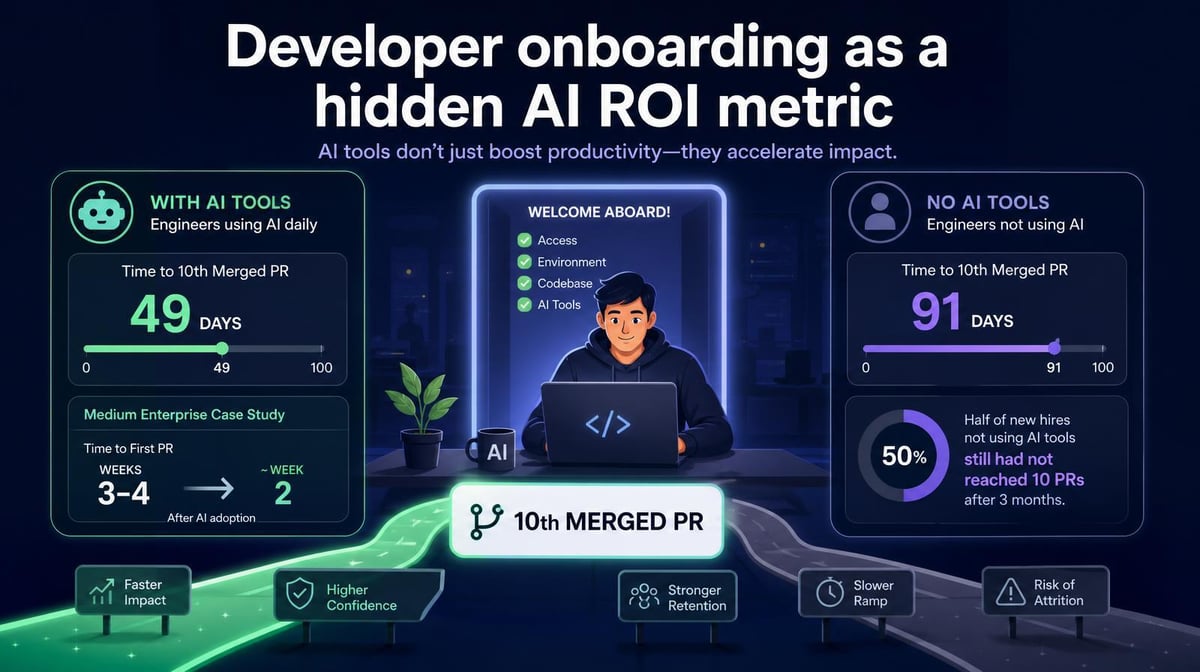

New developers spend much of onboarding learning an unfamiliar codebase, team practices, and the context behind existing systems. AI coding tools can help with tasks such as explaining code and answering questions about unfamiliar functions. But that doesn’t automatically mean they shorten onboarding.
Research gives engineering leaders a reason to measure whether AI is helping newer developers ramp faster. A study of GitHub Copilot experiments at Microsoft, Accenture, and a Fortune 100 manufacturer found larger productivity gains among short-tenure and junior developers than their more experienced peers.
The study didn’t measure onboarding time. That means the ROI case has to come from your own ramp data.
Key Takeaways
- Research suggests less-experienced and short-tenure developers may see larger productivity gains from AI coding tools, making new-hire ramp time worth measuring separately from overall developer productivity.
- Faster output isn’t enough to prove better onboarding. Track contribution milestones alongside quality, rework, and review load to see whether new developers are becoming productive without creating more downstream work.
- There’s no universal benchmark for how many days AI should save during onboarding. Compare similar groups of new hires against your own baseline and treat faster ramp time as capacity unlocked rather than automatic payroll savings.
What the Research Actually Shows
Researchers analyzed GitHub Copilot experiments involving nearly 5,000 developers at Microsoft, Accenture, and a Fortune 100 electronics manufacturer.
Across the three companies, access to Copilot increased developer output by about 26%. The researchers also found a consistent directional pattern by experience: short-tenure developers increased output by 27% to 39%, while longer-tenure developers saw smaller gains of 8% to 13%. Junior developers showed gains of 21% to 40%, compared with 7% to 16% for senior developers.
There’s an important caveat. The researchers said those subgroup estimates were noisy, and the differences were generally not statistically significant.
They also weren’t measuring onboarding. At Microsoft, “short tenure” meant developers below the company’s median tenure, which the researchers said was somewhere between two and four years.
So the study doesn’t prove that AI cuts new-hire ramp time by a specific percentage or number of days. It supports a narrower idea: experience level may affect how much developers benefit from AI tools.
That makes onboarding a useful place to look for the effect in your own organization.
Why AI Could Matter During Developer Onboarding
A major part of onboarding is learning how an unfamiliar codebase works.
GitHub’s own guidance for engineers learning new codebases recommends using Copilot Chat to ask questions about unfamiliar code, summarize methods, and explore potential gaps in tests. It presents AI as one tool alongside hands-on exploration, pair programming, documentation, telemetry, and help from experienced teammates.
That distinction matters. AI provides another way for a new developer to find and understand information while they ramp. The question is whether that support helps new developers ramp faster in your organization.
4 Things to Measure for Onboarding ROI
1. Time to Defined Contribution Milestones
Pick milestones that reflect how your teams actually ramp.
That could include:
- Time to first substantive PR
- Time to a defined number of merged PRs
- Time to independently own a task
- Time to reach the team’s expected contribution range
Avoid treating the first PR as the entire onboarding story. A small documentation fix and a production change can both count as one PR while representing very different levels of contribution.
Compare the same milestones across similar new-hire groups before and after widespread AI adoption.
2. Quality and Rework
A developer reaching contribution milestones faster is useful only if the work holds up.
Pair ramp speed with measures such as review cycles, rework, incidents, and code turnover. Larridin’s Developer Productivity Benchmarks 2026 similarly recommend evaluating engineering output alongside quality rather than using activity alone as the productivity score.
If AI-assisted new hires produce more output but that code requires substantially more rewriting, the apparent onboarding gain may be smaller than it first seems.
3. Review and Support Load
Onboarding also uses experienced-engineer capacity.
Track how much review, mentoring, and hands-on help new developers need during the first 30, 60, and 90 days. Don’t assume AI reduces that burden. Measure whether it does.
A new hire who reaches useful contribution milestones earlier while requiring less routine help can free experienced developers for other work. If review and support demand increases instead, include that cost in the ROI calculation.
4. AI Usage Within the New-Hire Cohort
Access to an AI tool doesn’t mean every new developer uses it the same way.
Track whether new hires are actually using AI, how consistently they use it, and how AI usage changes as they become familiar with the codebase. Then compare those patterns with ramp speed and quality.
This helps separate “the company deployed an AI coding tool” from the more useful question: whether new developers who meaningfully use the tool are ramping differently.
How to Build the Onboarding ROI Case
Start with your own baseline. Look at comparable developers by role, experience, team, and type of work. Compare onboarding groups using consistent 30-, 60-, and 90-day windows.
For each group, track:
- Contribution milestones
- AI adoption and usage
- Delivery or throughput
- Review and rework
- Code quality
- Experienced-engineer support time
Then compare the improvement with the cost of the AI tools.
Larridin’s AI coding tool ROI framework recommends treating time saved as capacity unlocked rather than direct cash savings. The same logic applies to onboarding.
Include tool licenses, usage-based costs, implementation, training, and any additional review or rework when evaluating the return.
The goal is to determine whether AI is changing ramp time in your organization and whether the resulting work justifies the cost.
Frequently Asked Questions
Does research prove that AI coding tools shorten developer onboarding?
Not yet. Research has found larger productivity gains among short-tenure and junior developers, but that isn’t the same as directly measuring new-hire onboarding time. Organizations should measure their own onboarding groups rather than applying a universal ramp-time estimate.
Why might newer developers benefit more from AI coding tools?
Newer developers often have more questions about unfamiliar code, patterns, APIs, and development tasks. AI tools can help explain code and surface information, but they don’t replace codebase knowledge, documentation, mentoring, or technical judgment.
What’s the best onboarding metric?
There isn’t one universal metric. Use defined contribution milestones that fit your organization, then pair them with quality and rework measures. A faster first PR is much less useful if the work requires substantial correction afterward.
Should senior engineer support time be included in onboarding ROI?
Yes, if you can measure it reliably. Mentoring and review consume engineering capacity. If AI helps new developers become more self-sufficient, that change can be part of the ROI case. If support requirements increase, include that as well.
How should we compare new-hire groups?
Keep the comparison as consistent as possible across role, experience, team, codebase, and measurement window. AI usage should also be measured rather than assumed from license access.
Measure the Ramp, Not the Anecdote
The strongest case for AI coding tools during onboarding won’t come from a generic claim that AI makes new developers faster.
It will come from showing that your new hires reach useful contribution milestones sooner, their work holds up, and the added capacity is worth what the tools cost.
Larridin’s AI Dev Productivity platform connects AI contribution with engineering delivery, quality, and ROI signals so leaders can measure AI impact using their own development data.
Book a discovery call to measure how AI is affecting developer productivity across your engineering organization.