


AI coding agent sessions can score high on effectiveness and still produce few merged PRs. Larridin Spark data reveals the gap between agent activity and merged code, plus the engineering practices worth examining.
TL;DR
The Short Answer
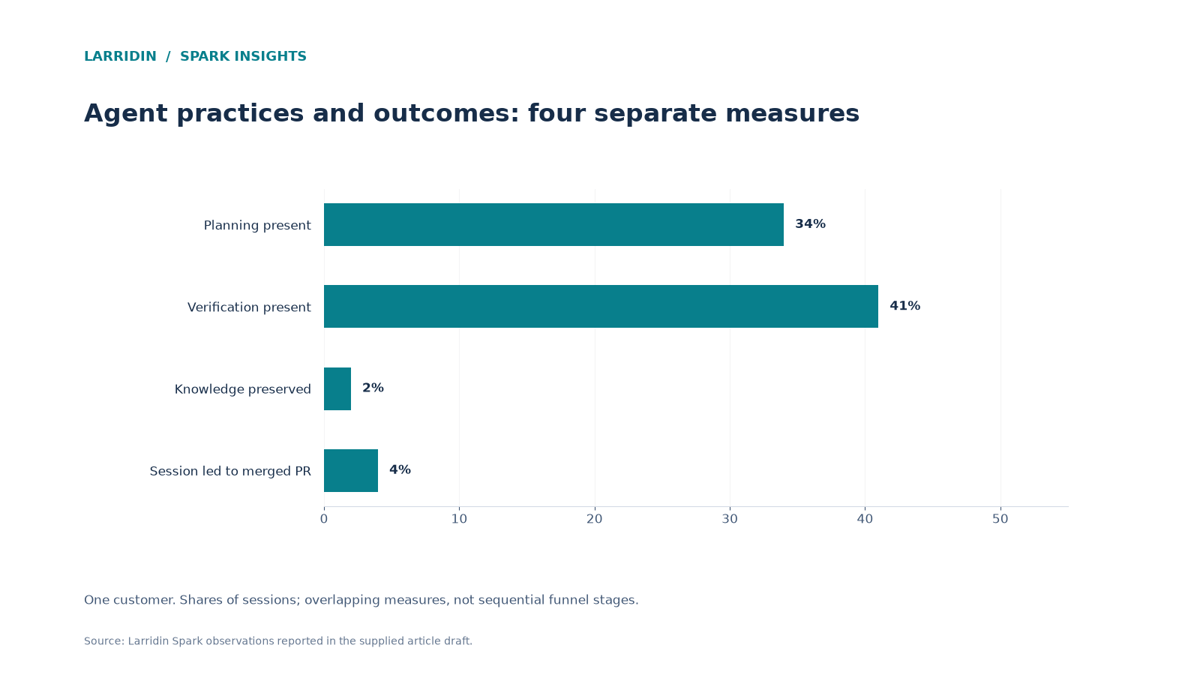
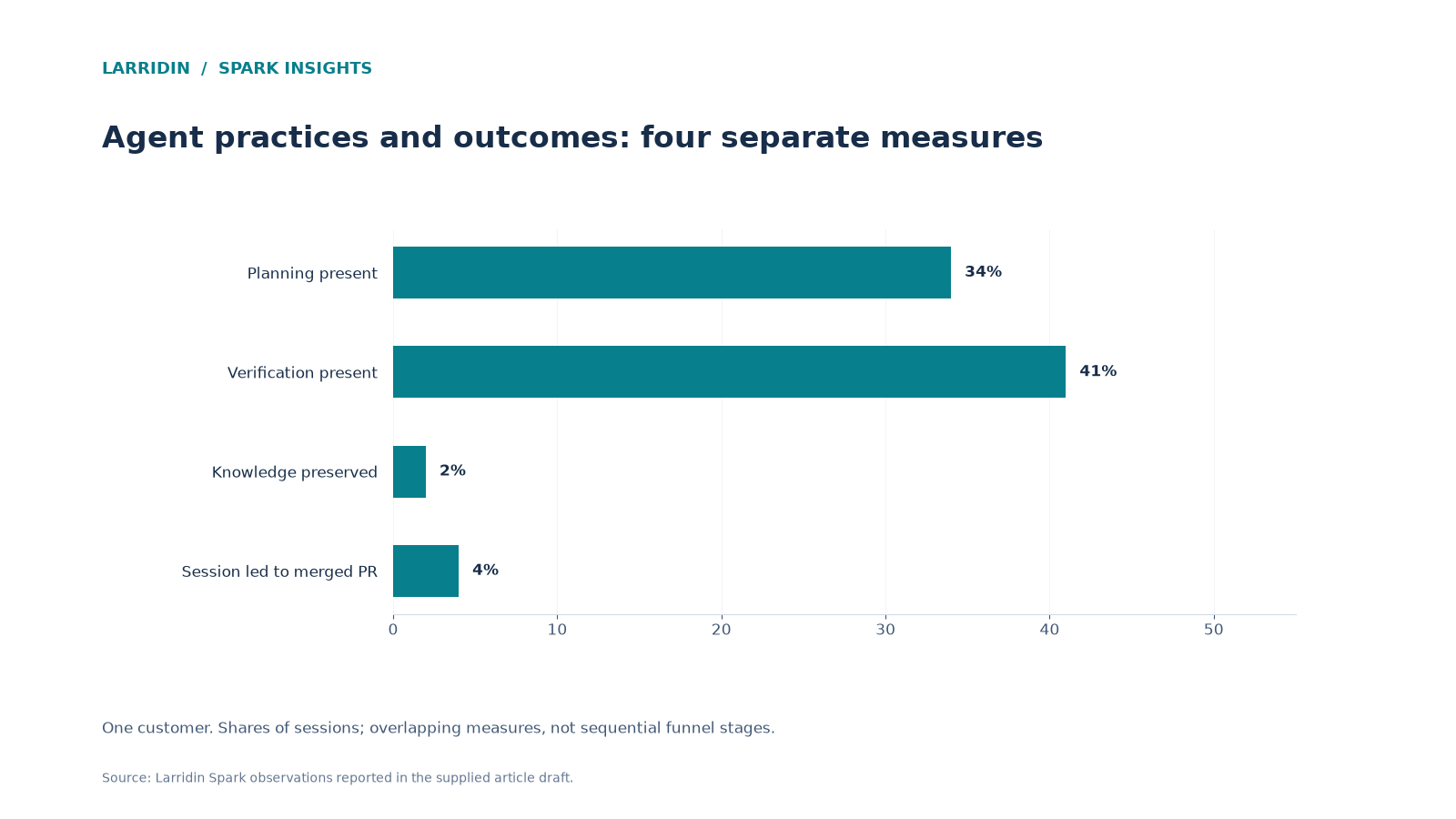
At one Larridin customer, just 4% of AI coding agent sessions led to a merged PR, despite an Agent Effectiveness Score of 91 out of 100. Planning appeared in 34% of sessions, verification in 41%, and knowledge preservation in just 2%. These gaps give engineering leaders specific practices to investigate, rather than relying on agent adoption or session counts alone.
Key Wins
- See why high agent effectiveness doesn’t mean shipped code
- Learn three engineering practices worth examining when sessions don't produce merged code
- Get a checklist your engineers can use in their next agent session
What’s a Spark Insight?
A Spark Insight is a data-backed finding Larridin surfaces automatically from how your teams actually use AI, flagging the patterns worth a leadership conversation.
Who This Matters To
CTO · VP Eng · Engineers
Quick Answers
| If you’re asking… | The answer | Go deeper |
|---|---|---|
| How many AI coding agent sessions result in shipped code? | In one Larridin customer, 4% of agent sessions led to a merged PR; in another, 10% did. | The data |
| Why don’t AI coding agent sessions ship code? | A session without a merged PR isn't necessarily a failure. Investigate task scope, verification, review, and how sessions connect to downstream work. | Why it happens |
| How do I get more value from AI coding agents? | Plan before the session, verify the output, and save what the agent learned so the next session starts ahead. | The checklist |
| How should I measure AI coding agent cost-effectiveness? | Compare cost per merged-PR outcome alongside other quality and delivery metrics. | How to measure |
Coding agent activity doesn't always translate into merged code. Some sessions produce exploratory work, while others may stall during testing, integration, or review. To understand the gap, engineering leaders need to look beyond session counts.
What You’re Struggling With, and How to Fix It
| What you’re struggling with | What you actually need | How Larridin helps | Proof from Spark data |
|---|---|---|---|
| “Our engineers use agents constantly, but I don’t see more shipped code.” | A link between sessions and shipped outcomes | Tracks how many agent sessions lead to merged PRs | One org: 4% of sessions led to a merged PR |
| “The agent seems effective, so why no results?” | A view of what happens around the agent | Shows planning, verification, and knowledge-preservation rates | One org: planning 34%, verification 41%, knowledge preservation 2% |
| “I can’t tell if agent spend is worth it.” | Cost per merged-PR outcome | Compares cost per outcome by agent | Two agents in one org: $29.62 vs. $10.97 per shipped outcome |
| “Every session starts from scratch.” | A way to carry context forward | Shows how often sessions preserve knowledge for reuse | One org: 2% of sessions preserved knowledge |
What This Means for You
If you’re a CTO
The question you’re asked: “What are we getting for our coding agent spend?”
What to do: Report the share of sessions resulting in merged PRs and cost per outcome, alongside code quality. Compare tools on results, not adoption alone.
For more on measuring engineering results, see AI Monitoring for Engineering Leaders.
If you’re a VP of Engineering
The question you’re asked: “How do we get more from the agents we already pay for?”
What to do: Review how often sessions include planning and verification. Compare those practices with downstream outcomes before choosing where to focus training.
For more on measuring agent sessions, see Agent Effectiveness.
If you’re an engineer
The question you’re asked: “How do I get my agent sessions to ship?”
What to do: Write a short plan before starting, check the output before opening a PR, and save useful context for future sessions.
For more on checking AI-generated code, see What Is Verification Discipline?
What the Sparks Data Shows
- 4% at 91/100: In one customer, 4% of AI coding agent sessions led to a merged PR despite an Agent Effectiveness Score of 91 out of 100. Planning appeared in 34% of sessions, verification in 41%, and knowledge preservation in 2%.
- 10% Outcome Success: In a separate customer, 10% of agent sessions resulted in a merged PR. Two coding agents each had 91% adoption.
- $29.62 vs. $10.97: Cost per merged-PR outcome for those two coding agents in the second customer, a difference of about 2.7x.
Why Do Most AI Coding Agent Sessions Never Ship Code?
A low session-to-merge rate can point to problems with task scope, verification, integration, or review. It doesn't tell us the reason by itself.
An agent session can produce useful work without leading directly to a merged PR. But when very few sessions reach that outcome, leaders should examine how work is planned, checked, and passed into the development process.
In one Larridin customer, agent effectiveness scored 91 out of 100, yet just 4% of sessions led to a merged PR.
Spark callout: In the same org, only 34% of sessions included planning and 41% included verification. Just 2% preserved knowledge for future sessions.
Myth: A high Agent Effectiveness Score means most sessions produce merged code.
Reality: In one organization, the score was 91 out of 100, but just 4% of sessions led to a merged PR.
What Practices Should Engineering Teams Examine?
Planning, verification, and knowledge preservation.
Planning means defining the task, scope, and acceptance criteria before the agent starts. Verification means running tests and checking output before opening a PR. Knowledge preservation means saving what the session learned, such as context files, decisions, and notes, so the next session doesn’t start from zero.
None of these is complicated. They’re ordinary engineering discipline applied to a new kind of collaborator.
How Should You Compare Coding Agent Costs?
Start with cost per merged-PR outcome.
Session counts and token spend measure activity and expense. Cost per merged-PR outcome connects that expense to a defined result. In one organization, two agents with identical adoption rates differed by about 2.7× on this measure. Compare the results alongside code quality and work complexity before making tool decisions.
A Checklist for Agent Sessions That Ship
- Plan first. Write the task, scope, and definition of done before the session starts.
- Verify before the PR. Run tests and review the output yourself.
- Preserve knowledge. Save context, decisions, and notes for the next session.
- Track session-to-merge rate. Larridin's Outcome Success metric measures the share of agent sessions that result in merged PRs.
Frequently Asked Questions
What is a good session-to-merged-PR rate for AI coding agents?
There's no universal benchmark. Two Larridin customer examples showed rates of 4% and 10%, but those aren't industry benchmarks. Track your own trend and investigate what the sessions are intended to accomplish.
What is agent effectiveness?
Agent effectiveness measures how well engineers work with AI coding agents, including how they define tasks, guide agent sessions, and verify the resulting code. Larridin's Agent Effectiveness Score combines these behaviors into a single measure.
Does a more expensive coding agent ship more code?
Not necessarily. At one customer, two agents with identical adoption rates had different costs per merged-PR outcome. That doesn't establish which produced more or better code.
Spark a Discussion About What Your Coding Agents Actually Ship
See session-to-merge rates and cost per shipped outcome in your org, and bring them to your next engineering leadership meeting.