

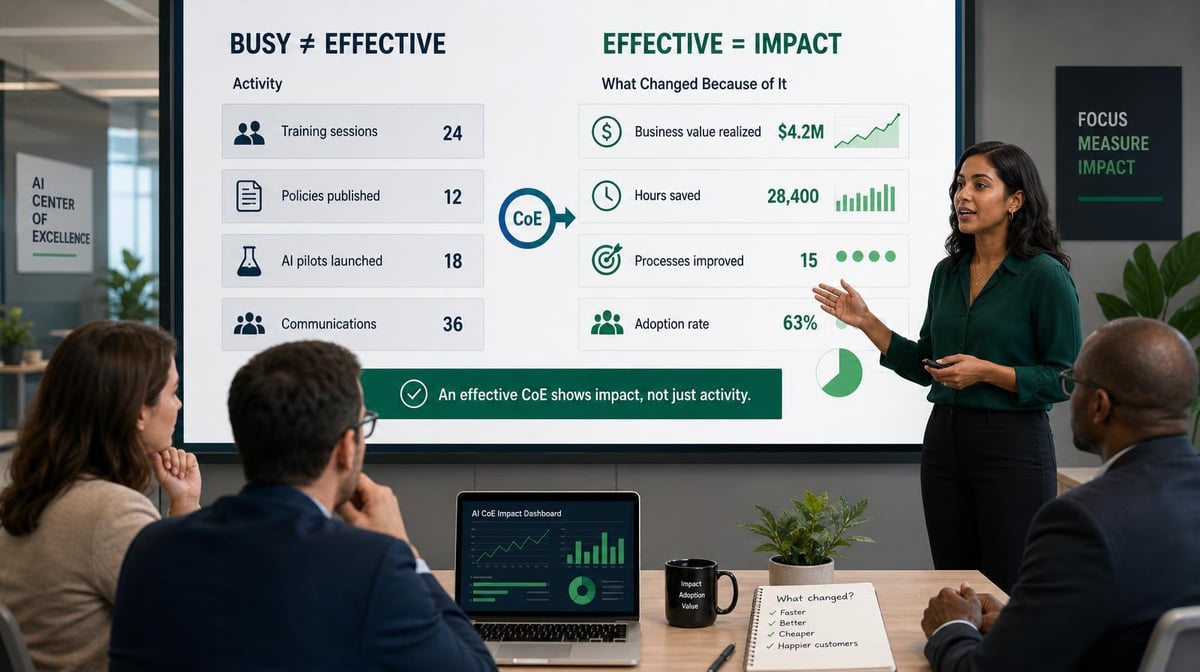

A busy AI Center of Excellence can point to training sessions, policies, and pilots. An effective one can show what changed because of them.
Key Takeaways
- Judge an AI CoE by what changes after its programs run, not just how many trainings, policies, or pilots it produces.
- A useful scorecard covers adoption, proficiency, governance, cost control, and business outcomes.
- Pair every major CoE activity with a result: training with adoption or proficiency, policies with compliance, pilots with production or business outcomes, and spend oversight with cost performance.
Start With What Changed
Microsoft's Cloud Adoption Framework for an AI Center of Excellence recommends tracking AI adoption rates, compliance levels, project cycle times, and other measures of business impact. Those metrics show what changed, while training sessions, published policies, and tools evaluated show what the CoE did. Both matter, but effectiveness comes down to whether that activity produced a measurable result.
5 Areas to Score
1. Adoption
CoE activity: Training employees, approving tools, and launching pilots.
Measure instead: Whether the people and teams targeted by those programs actually use the approved tools.
Useful measures include:
- Active adoption by team or function
- Adoption growth after training or enablement
- Percentage of approved pilots that reach production
2. Proficiency
CoE activity: Running training and skills-development programs.
Measure instead: Whether people become more capable AI users afterward.
Microsoft recommends skills assessments as part of building organizational AI capabilities. Compare proficiency before and after enablement rather than relying on attendance or satisfaction surveys.
Larridin's AI Fluency provides one way to measure that change.
3. Governance
CoE activity: Publishing policies and establishing a use-case review process.
Measure instead: Whether people follow those policies and whether the review process works.
Useful measures can include:
- Percentage of submitted use cases completing review
- Average review cycle time
- Compliance with approved AI policies
- Changes in unsanctioned AI usage
A policy count tells you the CoE created rules. These measures tell you whether those rules changed behavior.
4. Cost Control
CoE activity: Reviewing AI purchases, budgets, and use cases.
Measure instead: Whether the organization gets better control of AI costs as the program scales.
Track measures such as:
- Cost to move a use case from approval to production
- AI spend growth compared with usage growth
- Spend by tool, team, initiative, or agent
- Reduction in underused licenses or unnecessary tools
Microsoft's named CoE KPI list doesn't include cost control, so this is an additional scorecard dimension for enterprise AI programs.
5. Business Outcomes
CoE activity: Launching and supporting strategic pilots.
Measure instead: Whether those initiatives produce a documented business result.
Microsoft recommends pilots that demonstrate business value. Tie each major initiative to a baseline and an outcome such as:
- Lower cycle time
- Reduced cost
- Higher revenue
- Fewer errors
- Increased throughput
The strongest evidence is a before-and-after result from your own deployment, not an industry productivity estimate applied later.
Pair Each CoE Activity With an Outcome
A simple scorecard should make the relationship visible:
- Training completed → adoption or proficiency change
- Policies published → compliance change
- Use cases reviewed → review cycle time and production rate
- Pilots launched → business outcome
- AI spend reviewed → cost and utilization change
If the CoE can report the activity but not what changed afterward, that’s a program status update, not evidence of effectiveness.
For ROI claims specifically, look for a documented baseline and a specific deployment. Without those, the number is an estimate rather than measured ROI.
Combine CoE Reporting With Measured Data
The CoE will naturally have its own program data: training completion, policy publication, review queues, pilot status, and budgets.
Pair that with data showing what happened afterward.
Larridin AI Adoption can show whether usage changes after CoE programs. AI Fluency can show whether proficiency improves. Cost and business-outcome data can show whether the organization is getting more value as the program matures.
That combination lets leadership see both what the CoE did and whether it worked.
Frequently Asked Questions
What should an AI Center of Excellence measure?
Measure both program activity and results. A useful effectiveness scorecard covers adoption, proficiency, governance, cost control, and business outcomes, with each area tied to measurable change.
How do you prove an AI CoE is creating business value?
Start with a baseline for a specific initiative, then measure what changes after deployment. Depending on the use case, that could include cycle time, cost, revenue, errors, or throughput.
Measure AI CoE Effectiveness With Larridin
Larridin brings together the data an AI CoE needs to evaluate adoption, proficiency, spend, and business impact. AI Adoption measures usage, AI Fluency measures proficiency, Token Spend & Insights provides cost visibility, and AI Impact connects AI activity to business outcomes.