Everything enterprise leaders need to know about AI adoption — from definitions and measurement frameworks to maturity stages and common pitfalls.
- AI adoption is not a single number. It spans an entire ecosystem of foundation models, AI-first products, AI-augmented features, homegrown systems, and autonomous agents — measured across four layers: Usage, Depth, Breadth, and Segmentation.
- Increasingly AI Adoption & AI Usage is linked to increased employee productivity . In fact, multiple firms including Meta, Amazon and Accenture have started linking AI adoption and AI usage with employee performance and use it as one of the factor in compensation / promotion decisions
- The four-layer framework makes adoption actionable. Moving beyond login counts to engagement depth, tool portfolio breadth, and team-level segmentation transforms adoption from a vanity metric into a management tool.
- Adoption without proficiency is activity without value. There is a 6x productivity gap between AI power users and average employees (OpenAI). High adoption with low proficiency means your organization is generating activity, not results.
- Shadow AI is a visibility failure, not a security failure. 83% of enterprises report Shadow AI growing faster than IT can track. You cannot govern what you cannot see.
Frequently Asked Questions
What is AI adoption in an enterprise?
AI adoption is a multi-dimensional phenomenon spanning an entire ecosystem of foundation models, standalone AI products, AI-enhanced features in existing software, homegrown systems, and autonomous AI agents — not just usage of a single tool like ChatGPT or Microsoft Copilot. An organization where 80% of employees use ChatGPT but nothing else has a very different AI adoption profile than one where 60% of employees use a diverse portfolio of AI-first, AI-augmented, and vertical tools across their daily workflows. The second organization is almost certainly extracting more value — even though its "adoption rate" for any single tool is lower. For a comprehensive breakdown, see Larridin's AI Maturity Measurement framework.
What are the four layers of AI adoption measurement?
The four layers are: Usage (are people showing up?), Depth & Engagement (is it becoming a habit?), Breadth (how wide is the tool portfolio?), and Segmentation (where is adoption happening and where isn't it?). Each layer answers a progressively harder question — and most organizations stop at layer one. Larridin's AI Proficiency Maturity Model maps how these layers evolve as organizations advance through maturity stages.
Why is measuring AI adoption important for enterprises?
Measuring AI adoption is critical because Adoption is shown to drives productivity, creates competitive advantage, and establishes accountability for AI investments.
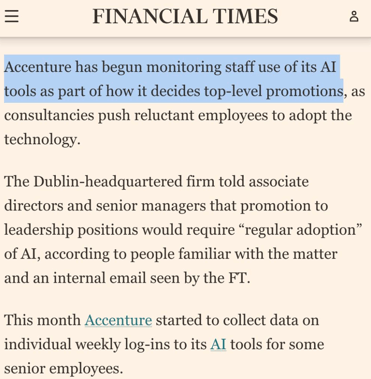
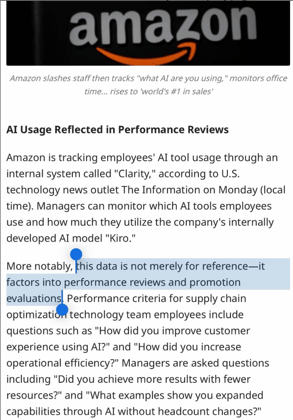
Increasingly, enterprises are treating AI adoption as a direct proxy for productivity improvement. Accenture, Amazon, and Meta have all recently begun tying employee performance reviews to AI usage and adoption — perhaps the strongest signal yet that using AI is becoming a baseline expectation, not a differentiator, and that organizations see a clear link between adoption and measurable productivity gains.
What are the main barriers to measuring AI adoption?
The top barriers include unclear responsibility for measurement (30.5%), fragmented ownership across teams (27.7%), no correlation between usage and outcomes (24.4%), and inadequate data infrastructure (15.0%). These aren't technical problems — they're organizational ones. The AI Adoption Workbook provides a step-by-step guide for assigning ownership, building measurement infrastructure, and connecting usage data to business outcomes.
How do you classify AI tools in an enterprise?
Larridin classifies AI tools along three dimensions: autonomy level (agentic, AI-first, or AI-augmented), modality (text, code, image, audio, video, or multimedia), and scope (horizontal general-purpose or vertical domain-specific). This classification matters because it fundamentally changes how you think about adoption — a diverse portfolio of tools across autonomy levels and modalities signals deeper maturity than high usage of a single horizontal tool. See how this classification applies in practice with Larridin's AI Tracker data for companies like Procter & Gamble and JPMorgan.
What is the AI adoption spectrum?
The adoption spectrum ranges from non-user (hasn't engaged with AI) to explorer (tried a few times), regular user (uses multiple times per week), power user (uses extensively daily), and AI-native user (AI deeply integrated into how they work). The gap between regular user and AI-native is where the real value lives — and where most organizations stall. Assessing Workforce AI Proficiency explains how to diagnose where your workforce sits on this spectrum and what it takes to move them forward.
What are the stages of AI adoption maturity?
The five stages are: AI Curious (sporadic experimentation), AI Exploring (one or two tools deployed unevenly), AI Scaling (multiple tools with formal measurement), AI Embedded (AI in daily workflows with full governance), and AI-Native (AI as the default way of working). Organizations don't advance linearly — they often mature unevenly across departments, with pockets of transformation coexisting alongside areas still experimenting. The AI Proficiency Maturity Model details the specific metrics, capabilities, and governance controls that define each stage.
What are common mistakes in measuring AI adoption?
Common mistakes include measuring only a single tool instead of the ecosystem, counting licenses instead of actual usage, ignoring depth and quality of engagement, treating adoption as a one-time measurement, and failing to segment by team, function, or location. The most damaging mistake is conflating adoption with impact — high usage doesn't mean high value. The AI Maturity Measurement framework explains how to build a measurement stack that avoids these pitfalls.
Which business functions are leading in AI adoption?
Product (18.9%), Customer Success (14.3%), and Engineering & IT (12.6%) lead in AI hiring and adoption, while Finance (4.7%) and Legal & Compliance (5.6%) lag behind — a 4x gap between top and bottom functions. This variance is the signal, not noise: knowing where your organization sits by department is what transforms adoption from a vanity metric into a diagnostic tool. Larridin's AI Tracker shows how this plays out at specific enterprises, including Gartner.
What is Shadow AI and why does it matter?
Shadow AI is the use of unauthorized AI tools by employees, often with personal accounts, creating data exfiltration risks and governance blind spots. 84% of organizations discover more AI tools than expected during audits. Measuring adoption helps identify Shadow AI use and guide employees to official sanctioned accounts — turning a governance risk into a measurement opportunity. The CIO Playbook maps governance controls for Shadow AI detection at each maturity stage, and the AI Adoption Workbook includes a Shadow AI audit template.
Related Resources