

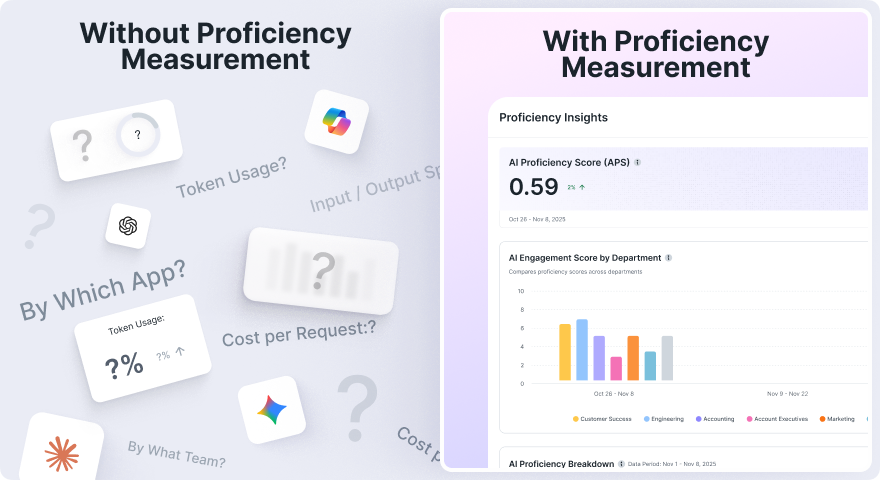

Key Takeaway
AI readiness depends on workforce proficiency. Organizations that systematically assess and improve how employees use artificial intelligence achieve 3.2 times higher productivity gains than those treating AI adoption as an unmeasured experiment. Knowing where your organization sits on the AI readiness maturity scale—from Beginners to Leaders—guides your assessment approach and your path to measurable business value.
Quick Navigation
- The AI Readiness Maturity Scale
- Why Workforce Proficiency Determines AI Readiness
- Assessing AI Proficiency by Readiness Level
- Getting Started with Proficiency Assessment
- Frequently Asked Questions
Key Terms
- AI Readiness: An organization's preparedness to adopt, govern, and scale artificial intelligence. AI readiness includes strategy, infrastructure, AI governance, and workforce proficiency to use AI tools effectively.
- Workforce AI Proficiency: The measurable ability of employees to use AI tools and AI systems to achieve business outcomes. It goes beyond basic usage to cover AI skills, strategic application, and business value creation.
- AI Readiness Maturity Spectrum: The four categories of enterprise AI adoption—Beginners, Practitioners, Advanced, and Leaders—each with distinct AI governance, measurement, and workforce proficiency capabilities relative to others in the same enterprise.
- Utilization × Proficiency × Value Framework: Larridin's measurement methodology that looks at who uses AI (utilization), how well they use it (proficiency), and what business value it drives.
- Shadow AI: Unauthorized or ungoverned AI tools adopted outside official IT oversight, creating visibility challenges that undermine AI readiness and proficiency assessment.
- AI Skills Gap: The measurable difference between current workforce AI proficiency and the capabilities required to achieve strategic objectives and full AI readiness.
The AI Readiness Maturity Scale
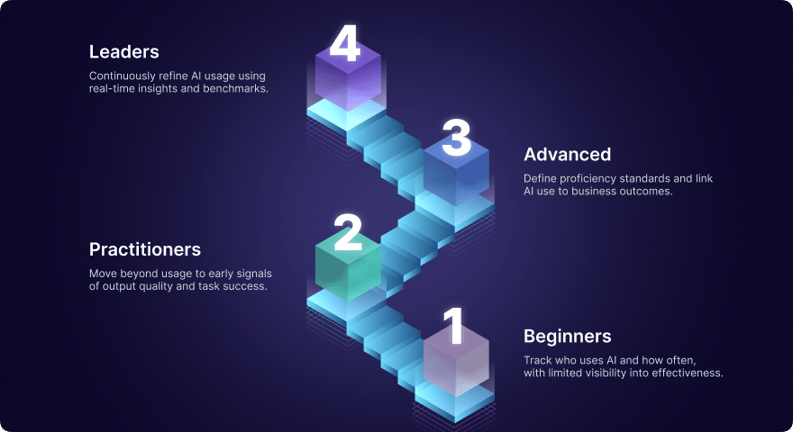
AI readiness varies dramatically across enterprises. According to the Larridin State of Enterprise AI 2025 report, organizations fall into four AI readiness categories that shape their workforce proficiency assessment approach.
- AI Readiness Beginners (18%)
Limited AI deployment, minimal AI governance, and ad hoc usage patterns. AI is treated as an experiment, and leaders struggle to establish baseline visibility into AI adoption and workforce AI skills. - AI Readiness Practitioners (41%)
Broader AI adoption, but inconsistent workforce proficiency. Multiple AI tools are used across departments without clear use cases, governance frameworks, or measurement needed for true AI readiness. - AI Readiness Advanced (32%)
Systematic AI deployment with emerging AI governance frameworks. These organizations measure workforce proficiency and tie AI usage to business outcomes, recognizing that AI readiness requires knowing how well employees apply AI. - AI Readiness Leaders (9%)
Comprehensive AI strategies with robust measurement, AI governance, and continuous optimization initiatives. These organizations report 3.2 times higher productivity gains than Beginners because they systematically measure workforce AI proficiency and scale best practices.
Organizations cannot achieve true AI readiness without measuring workforce proficiency. You cannot improve AI skills if you never measure them.
Why Workforce Proficiency Determines AI Readiness
Understanding workforce AI proficiency is foundational to AI readiness. Larridin's State of Enterprise AI 2025 report reveals that 84% of organizations discover more AI tools than expected during audits. Discovery shows what AI technologies exist. Proficiency shows how effectively people use them.
Usage Doesn't Equal Readiness
Many organizations confuse AI usage with workforce proficiency. Usage metrics show who logged into an AI tool and how often. Proficiency assessment shows whether those users achieve meaningful business outcomes.
According to EY's 2025 Work Reimagined Survey, 88% of employees use AI in their daily work, but only 5% use it in advanced ways that transform how they work. This gap explains why usage metrics alone cannot indicate AI readiness.
Consider two content managers using AI writing assistants daily. Manager A generates twice as much content, but needs heavy editing. Manager B produces less content, but creates publication-ready work that drives measurable engagement. Usage metrics celebrate Manager A. Proficiency measurement highlights Manager B as the high performer worth replicating.
Three Advantages of Measuring Proficiency
Organizations that measure workforce AI proficiency can:
- Identify power users whose practices can be scaled into organizational capability.
- Pinpoint AI skills gaps before they become competitive disadvantages.
- Prove business value of AI by linking proficiency improvements to measurable outcomes.
The 9% classified as AI Readiness Leaders achieve 3.2 times higher productivity gains than Beginners. Not because they have better AI technologies or bigger budgets, but because they know which practices work and replicate them through targeted AI development programs.
For CFOs, proficiency measurement turns “we spent $5 million on AI tools” into “we improved AI proficiency scores by 40% in sales, driving a 23% increase in pipeline velocity.” For CIOs managing AI governance, it reveals how competently users apply AI systems, surfacing AI risks and training opportunities. For CAIOs, proficiency metrics show where enablement resources generate the highest impact.
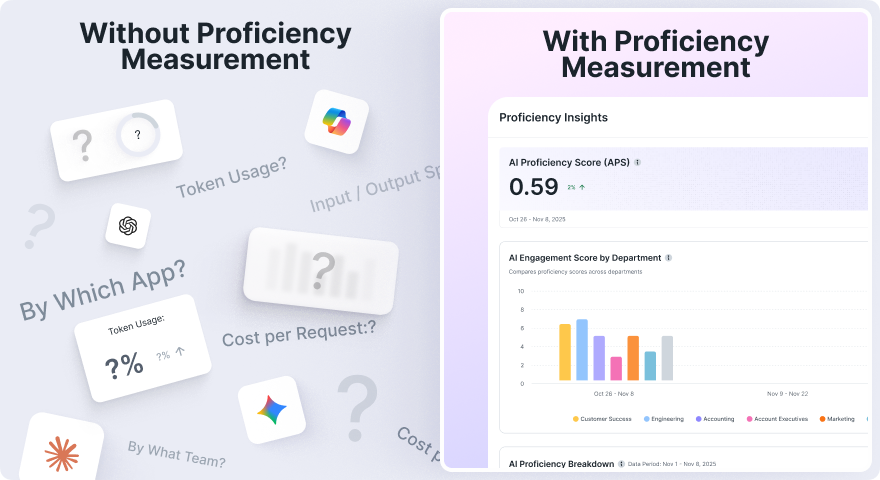
Without proficiency measurement, enterprises fund AI experiments without knowing which will succeed. With it, they turn AI adoption into competitive advantage—the foundation of true AI readiness.
Assessing AI Proficiency by Readiness Level
Your AI readiness maturity determines your assessment approach. Attempting advanced analytics without basic visibility wastes resources.
AI Readiness Beginners: Establish Baseline Visibility
Answer basic questions: Who uses AI tools? Which AI technologies? How frequently? Focus on identifying early adopters and understanding AI adoption patterns. Larridin research shows that 83% of organizations report employees installing AI tools faster than security teams can track.
AI Readiness Practitioners: Identify Effectiveness Indicators
Move beyond logins. Measure task completion rates, output quality scores, and AI literacy. Categorize groups as novice (struggling with basic prompting), intermediate (applying AI to standard use cases), or advanced (achieving measurable operational efficiencies). For the 41% in this category, the goal is moving from scattered proficiency to systematic capability development.
AI Readiness Advanced: Implement Systematic Benchmarking
Deploy proficiency benchmarking tied to business outcomes. Create role-specific frameworks defining what “good” looks like for different AI use cases.
According to McKinsey research, organizations that fundamentally redesign workflows around AI capabilities are nearly three times more likely to achieve significant business impact. Integrate proficiency data with performance management and business intelligence tools to build continuous feedback loops.
AI Readiness Leaders: Deploy Continuous Optimization
Implement real-time proficiency analytics with predictive capabilities. The 9% at this level answer questions like: “When we improved sales team AI proficiency from 6.2 to 7.8, pipeline velocity increased 31%.” This requires sophisticated data governance, but delivers compounding competitive advantages.
Getting Started with Proficiency Assessment
Ready to strengthen AI readiness through workforce proficiency measurement? Use this roadmap to get started.
Step 1: Assess Your AI Readiness Level
Determine where your organization is on the AI readiness scale. Maturity level determines your starting point.
Step 2: Establish Visibility into AI Adoption
Identify what AI tools and AI systems exist and who uses them. Include shadow AI so you see your full AI ecosystem.
Larridin Scout maps your AI landscape in days, revealing usage patterns across departments, teams, and other defined groups.
Step 3: Define Role-Specific Standards
Work with functional leaders to create role-specific proficiency benchmarks. What does “proficient” look like for sales using AI for prospecting, engineers using AI agents for code review, or analysts using generative AI for data analysis?
Step 4: Track Key Metrics
Measure multiple dimensions for complete AI readiness visibility:
- Usage foundation: Which teams use each AI tool, how often, and how quickly adoption grows across the organization.
- Technical proficiency: Prompt quality scores for generative AI, feature utilization rates, troubleshooting efficiency.
- Strategic application: Use case alignment scores, task complexity distribution, whether AI-generated work gets used in business processes.
- Outcome achievement: Time saved, output quality scores, productivity gains, revenue or cost impact from AI-enhanced work.
- Comparative benchmarks: Group scores versus organizational benchmarks, trends over time, and growth trajectories.
Step 5: Connect Assessment to Development
Identify lower-proficiency teams or groups that need targeted training. Spot high-performing teams whose AI practices can be documented and scaled. Develop learning pathways based on AI skills gaps and measure enablement effectiveness through proficiency scores.
Larridin accelerates AI adoption through proven AI agents, prompt libraries, and strategic knowledge transfer, enabling systematic proficiency improvement.
Step 6: Drive Executive Visibility
Create dashboards showing AI proficiency trends and AI readiness progress. Develop team or role-based proficiency profiles. Produce board-ready reporting that connects AI proficiency to business value.
AI readiness leaders measure proficiency because measurement drives accountability, and accountability drives operational efficiencies and competitive advantages.
Step 7: Continuously Optimize
Review proficiency standards regularly as AI technologies evolve. Conduct annual reviews to confirm your framework still aligns with business strategy and drives intended outcomes. AI readiness leaders treat proficiency measurement as compounding competitive advantage, not a one-time compliance checkbox.
Frequently Asked Questions
How long does it take to establish AI readiness assessment?
Basic AI usage visibility can be established in about 30 days. Comprehensive proficiency measurement frameworks typically require 90 to 120 days across an enterprise, though insights start accumulating immediately.
What's the ROI of implementing AI readiness assessment?
Organizations that systematically measure workforce AI proficiency achieve 3.2 times higher productivity gains than those without measurement frameworks. Business value comes from eliminating wasted spending, accelerating proficiency development, and scaling best practices.
Should we measure proficiency on Shadow AI tools?
Yes. Shadow AI often reveals where employees find the most value from AI technologies. Discovery and measurement enable informed decision-making about AI governance, AI risks, and official tool adoption.
How do we define proficiency standards for new AI capabilities like generative AI?
Start with outcome-based definitions. What business results should a proficient user achieve? Work backward from business value to define required AI skills. Involve early adopters in creating initial standards, then refine them based on measurement data.
What's the relationship between AI readiness and AI governance?
AI governance provides the framework for responsible AI use, while workforce proficiency ensures employees can effectively apply AI tools within those parameters. Strong governance without proficiency leads to compliance without business value. Strong proficiency without governance creates AI risks. Both are essential to AI readiness.