


Your organization has AI pilots underway. Can you measure which ones should scale?
Key Takeaway
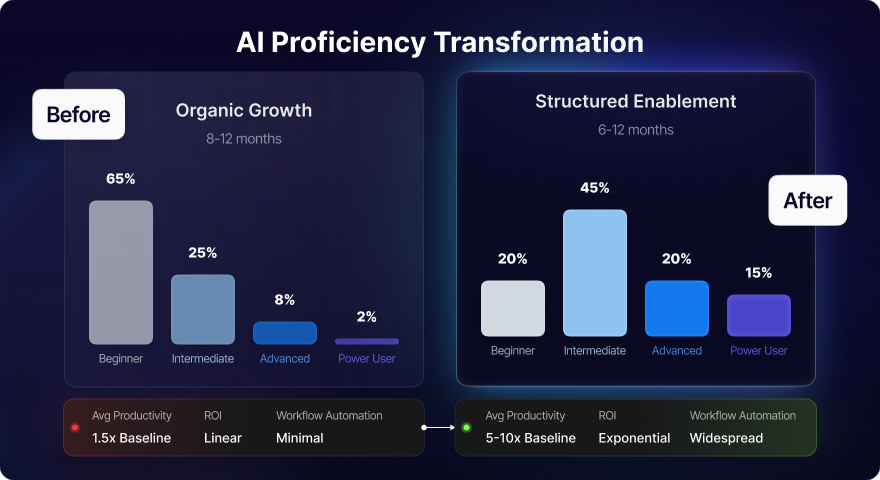
According to MIT CISR research, organizations in early stages (stages 1 and 2) of AI maturity tend to have financial performance below industry average, while those in later stages (stages 3 and 4) perform well above. The greatest financial impact comes from progressing from pilot programs (stage 2) to scaled AI ways of working (stage 3). AI maturity measurement provides the roadmap to connect AI initiatives to business value through systematic advancement.
Quick Navigation
- The Four Stages of AI Maturity
- Key Dimensions to Measure
- Building Your Maturity Assessment
- Tracking Progress Over Time
- Advancing Your AI Maturity
- From Assessment to Action
- Speeding AI Adoption
Key Terms
- AI Maturity: The stage of development organizations reach as they adopt AI technologies and integrate them into operations, culture, and business strategy.
- Maturity Model: A framework describing stages of capability development from initial experimentation to optimized, scaled adoption.
- AI Readiness Index: Assessment tool measuring organizational capabilities across dimensions like strategy, governance, data, and technology.
- Benchmark: Standardized metrics comparing AI progress against industry standards or best practices.
- Use Cases: Specific applications of AI technologies solving business problems or improving workflows.
The Four Stages of AI Maturity
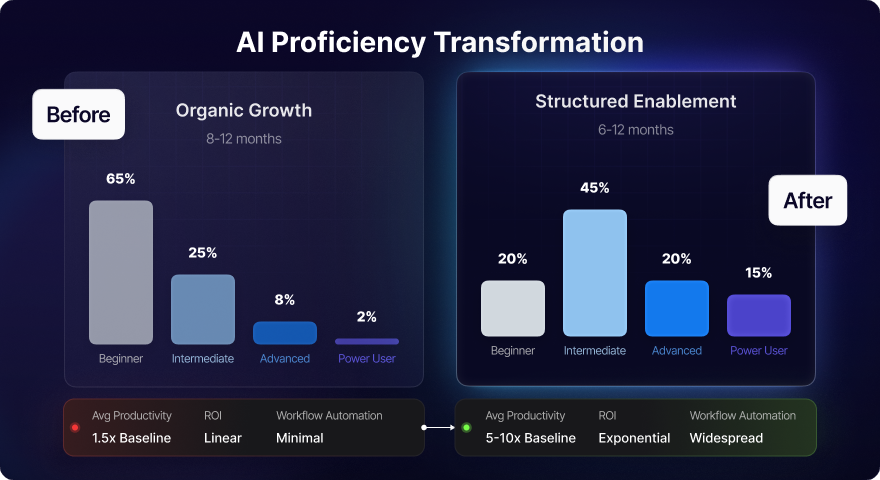
The MIT CISR report describes organizations as advancing through four predictable stages in AI adoption.
- Stage 1 (currently at 13% of organizations): Building awareness through AI literacy, formulating AI governance policies, experimenting with AI tools.
- Stage 2 (currently at 23%): Running pilots to prove value, tracking metrics, developing capabilities. Cultural challenge: enabling AI-powered decision-making at the frontline.
- Stage 3 (currently at 46%): Scaling successful practices, embedding AI into workflows, redesigning processes. Financial performance moves above industry average.
- Stage 4 (currently at 18%): Continuously optimizing AI models, measuring business value systematically, integrating AI into digital transformation.
Note that fewer than half of organizations (46%) are “below the line” - that is, in the first two stages - in the current survey. In a previous survey (2022), 62% of organizations were in the first two stages, a decrease of roughly 25%.
Key Dimensions to Measure
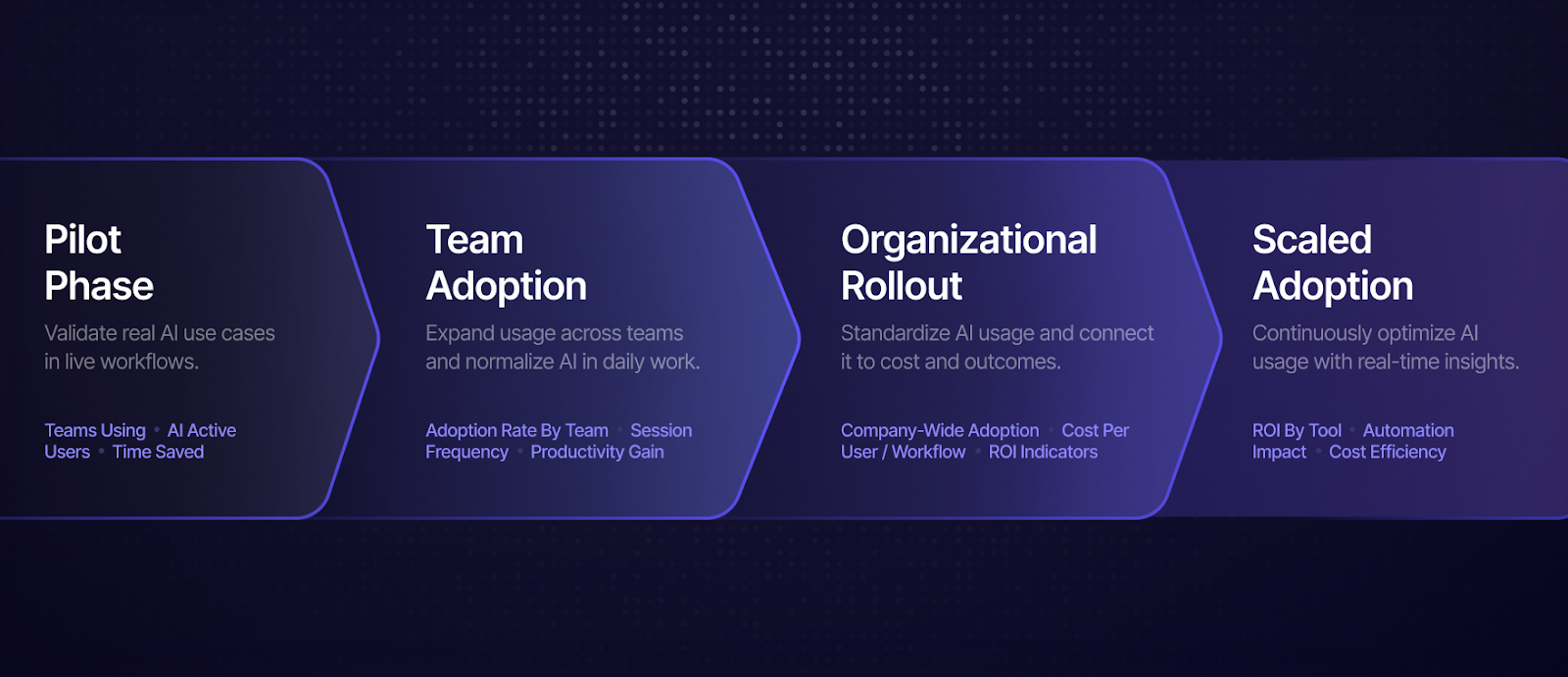
The Gartner AI Maturity Model evaluates seven areas of AI readiness:
- Strategy
- Product
- AI governance
- Engineering
- Data sources
- Operating models
- Culture
According to Gartner, key steps toward moving forward in AI maturity include:
- Measuring strategy alignment by connecting AI initiatives to business strategy.
- Tracking data governance practices and infrastructure supporting AI workloads.
- Assessing AI skills development, from AI literacy to advanced capabilities.
- Evaluating responsible AI policies, including explainability requirements and human validation processes.
According toGartner, 34% of low-maturity and 29% of high-maturity organizations cite data quality as top challenges, which shows that even advanced organizations face fundamental issues.
Building Your Maturity Assessment
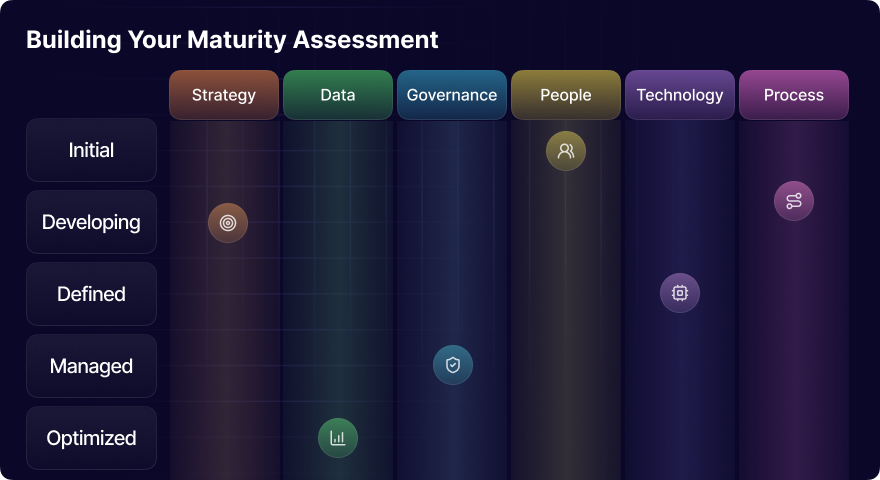
Start by using an AI readiness index to establish baseline capabilities. TheCNA AI Maturity Model provides 52 topic areas and 450 milestones to help organizations assess current state and set up a roadmap for growth.
Follow these steps to move forward in your AI maturity.
Conduct Self-Assessment
Compare your activities against maturity model indicators. Identify which stage you occupy across different dimensions. Some areas might be stage 3, while others remain in stage 1. Uneven progress is normal as organizations optimize different capability areas at different speeds.
Set Target Maturity Levels
Not every organization needs stage 4 across all dimensions. Target maturity is a function of your organization’s mission, resources, and business strategy. Identify which capabilities matter most for your AI adoption goals and competitive positioning. Focus investment where advancement drives the most business value.
Create Phased Roadmap
Break advancement into phases to gradually move up the maturity curve. Use frameworks such as CMMI for AI, providing structured process improvement approaches. Prioritize gaps between current and target capabilities based on business impact and resource requirements.
Tracking Progress Over Time
AI maturity measurement is ongoing. Suggested steps include tracking progress quarterly using consistent metrics. Establish a baseline, documenting the starting point across several dimensions, such as: AI adoption levels, AI tools usage, data sources quality, workforce AI skills, and business outcomes from existing initiatives.
Monitor key indicators, such as the percentage of processes with AI integration, the number of scaled use cases beyond pilots, adoption rates, the rate of data governance compliance across your organization, and training completion. Benchmark against industry standards where available.
According to the Larridin State of Enterprise AI Report, 88% of leaders believe AI measurement determines market winners. With that in mind, link maturity advancement to operational efficiency gains, customer experience improvements, and revenue impact. Show how moving from stage 2 to stage 3 is likely to improve financial performance for your organization.
Advancing Your AI Maturity
MIT CISR research identifies four challenges in moving from stage 2 to 3:
- Aligning AI investments with goals
- Architecting modular platforms
- Creating AI-ready teams
- Synchronizing work redesign with AI capabilities
Once those four challenges are clear, it helps to translate them into practical priorities by stage.
- Early stages: Improve data quality, run small pilots, teach AI literacy, rally champions. Try focused experiments. Reach out to others for best practices.
- Middle stages: Build systematic innovation, establish AI governance frameworks, create reusable assets, embed AI into workflows. Benchmark against companies in your industry.
- Advanced stages: Continuously optimize, measure ROI systematically, scale best practices, integrate AI into digital transformation. Benchmark against other leaders across industries. Engage with providers like Microsoft for ecosystem partnerships.
From Assessment to Action
AI maturity measurement only creates value when it drives action. Use assessment results to guide investment, prioritize initiatives, and track progress toward business goals.
Organizations that improve AI maturity over time get more value from AI. They make data-driven decisions about AI adoption, scale successful AI practices across operations, and unlock the potential of AI for competitive advantage. McKinsey research finds that high performers focus on six areas: strategy, talent, operating model, technology, data, and adoption.
Start measuring AI maturity today. Conduct a baseline assessment, identify target capabilities, create a phased roadmap, track metrics showing progress, and connect advancement to business value. Organizations that measure and advance AI maturity will be the ones that optimize artificial intelligence for sustainable competitive advantage.
Speeding AI Adoption
As an old management cliche states elegantly, “that which gets measured gets done.” Measurement of AI usage, including AI dashboards, is critical to making progress. (link to article, Building an AI Usage Dashboard That Drives Action)
Larridin provides industry-leading AI dashboards that measure progress and inform action. Even if you have experience in building dashboards internally, you may find that engaging with Larridin for AI measurement saves you time and money, with better quality and support. If you don’t have such experience, working with an established provider can greatly accelerate your AI implementation efforts.
If you want to work quickly to progress in your use of AI, improve your company’s financial performance as a result, and make the journey easier and more productive by partnering with Larridin, consider reaching out for a demo.
Ready to measure and advance your AI maturity?