


Shadow AI tools may be processing sensitive data. Can your IT team even see them?
Key Takeaway
According to the Larridin 2025 State of Enterprise AI Report, 90% recognize AI governance as a major blind spot, while 50% face shadow AI and unauthorized tool adoption. An effective AI governance framework requires continuous monitoring, risk assessment, and human oversight across the AI lifecycle — from AI development through AI deployment. Responsible AI governance balances innovation with ethical standards, regulatory compliance, and data protection.
Quick Navigation
- The Shadow AI Crisis
- Core Elements of AI Governance
- Building Effective AI Governance
- Implementing Your Framework
- Building Trust Through Governance
- From Chaos to Control
Key Terms
- AI Governance Framework: Structured approach defining how organizations manage AI systems through policies, governance structures, and decision-making processes.
- Responsible AI: AI practices for ethical use of artificial intelligence that follow AI principles, ethical guidelines, and regulatory frameworks.
- Shadow AI: Unauthorized AI tools and AI applications that bypass governance structures and create potential risks.
- Ethical AI: AI development and AI deployment with ethical standards, AI ethics principles, and trustworthy AI practices.
- Risk Assessment: Systematic evaluation of AI-related risks, potential risks, and risk level across AI systems and use cases.
The Shadow AI Crisis
According to research from Larridin, 83% of employees install AI tools faster than security teams can track them. 42% of organizations found that employees bypassed IT controls. 41% face AI tool sprawl across departments. This creates security risks, including potential data leaks, GDPR violations, and regulatory compliance failures.
Using shadow AI to process personal data and sensitive data creates high-risk scenarios. Healthcare organizations may face HIPAA compliance issues. Financial services firms could violate the EU AI Act. Without visibility into AI technologies, governance practices fail before they start.
Core Elements of AI Governance
AI governance falls into several related categories; we recommend the following best practices for each.
Governance Structures and Stakeholders
Establish clear governance structures that define stakeholders’ roles. Create an AI governance framework with decision-making processes that cover AI initiatives, AI adoption, and use of AI across business operations. Include data governance committees, AI ethics boards, and risk management teams in your efforts to ensure responsible AI governance.
Regulatory Compliance and Frameworks
Address regulatory requirements such as the EU AI Act and GDPR, the US NIST AI Risk Management Framework, and OECD AI Principles. Map AI regulations to governance practices. Ensure that data protection, data privacy, and data security meet regulatory frameworks. Conduct audits to validate compliance across AI systems.
Risk Assessment and Mitigation
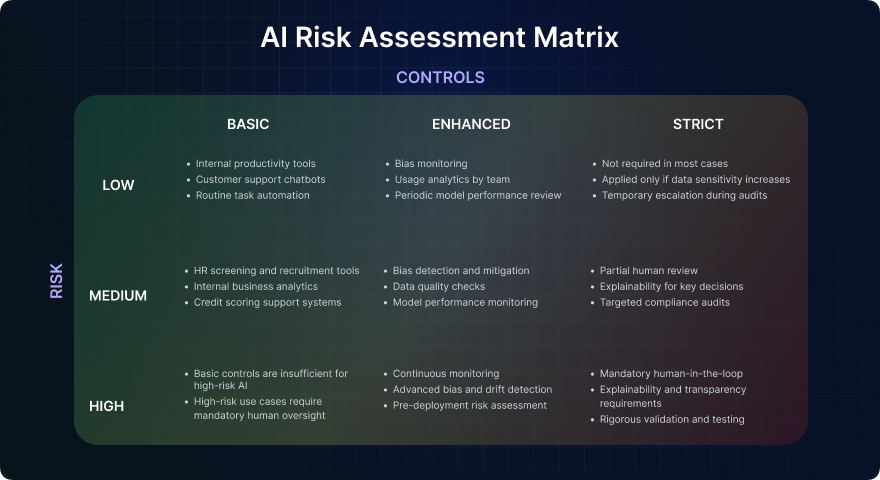
Implement systematic risk assessment to evaluate AI-related risks, including algorithmic bias, data quality issues, and vulnerabilities. Assess the risk level for each use case. High-risk AI applications require enhanced human oversight, explainability requirements, and validation processes. Mitigation strategies should address potential risks before AI deployment.
Building Effective AI Governance
Take the steps needed to establish effective governance of AI. Following are best practices that we’ve identified.
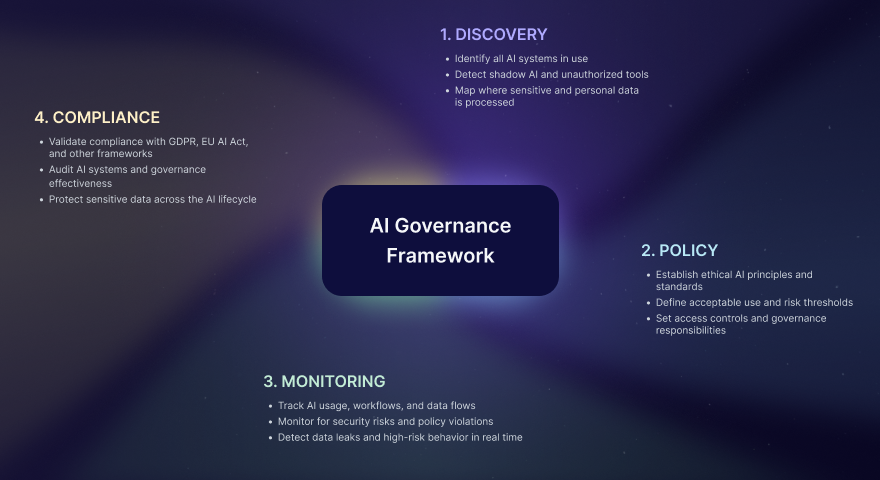
Discovery and Visibility
You can’t govern what you can’t see. Deploy continuous monitoring tools for real-time visibility into AI tools, AI models, machine learning systems, and generative AI platforms. Discover shadow AI through automated detection. Track inputs, outputs, and workflows where AI systems connect to datasets, training data, and sensitive data.
Ethical Standards and AI Ethics
Establish an ethical AI framework grounded in ethical principles. Address ethical considerations, including fairness, transparency, accountability, and explainability. Define AI principles to guide AI development and AI practices. Create ethical guidelines for AI decisions involving personal data, algorithmic decision-making processes, and AI-driven automation that affects stakeholders.
Access Controls and Data Security
Implement access controls to limit who can use AI tools, deploy AI models, and access training data. Ensure data protection through encryption, the use of secure APIs, and controlled data flows. Ensure compliance through governance practices to enforce data privacy, GDPR requirements, and protection of sensitive data across the AI lifecycle.
Implementing Your Framework
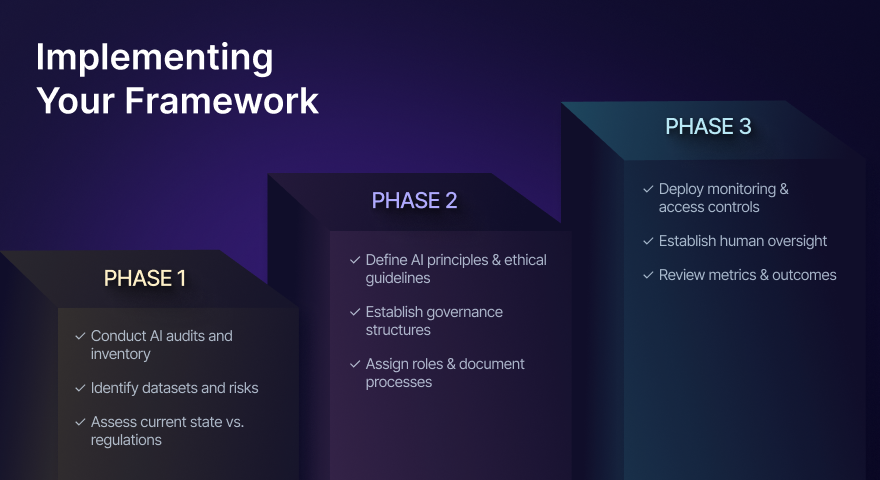
Move from policy to practice through a structured approach that connects governance structures to daily workflows.
Phase 1: Establish a Baseline
Conduct comprehensive audits to discover all AI technologies and AI applications in use and what they’re being used for. Map AI systems to business operations, identify high-risk applications, document datasets and data sources, and assess current state against regulatory requirements. This baseline enables validation of AI governance effectiveness.
Phase 2: Create an AI Governance Framework
Develop an AI risk management framework that aligns with NIST guidance and OECD principles. Define relevant principles for AI, establish ethical guidelines, create governance structures, assign stakeholder responsibilities, and document decision-making processes. Address regulatory compliance for the EU AI Act, GDPR, and sector-specific AI regulations.
Phase 3: Implement Controls and Monitoring
Deploy continuous monitoring to track AI adoption, usage patterns, and AI outcomes. Implement access controls to restrict high-risk AI systems. Establish human oversight for algorithmic decision-making. Create metrics to measure effectiveness of governance practices. Monitor for security risks, data leaks, and potential risks requiring mitigation.
Building Trust Through Governance
Effective AI governance builds trust with stakeholders, regulators, and customers. Trustworthy AI requires transparency about AI practices, explainability of AI decisions, accountability for AI outcomes, and validation that AI solutions meet ethical standards.
Address ethical considerations proactively. Healthcare organizations should ensure that AI models used for diagnosis meet explainability requirements. Financial services should validate that algorithmic decision-making processes avoid bias. Social media platforms should implement content moderation AI with human oversight. Each sector has unique ethical AI challenges that require governance practices to be tailored to sector-specific and even company-specific needs.
Responsible AI governance protects against reputational damage from AI failures. Non-compliance with regulatory frameworks creates legal risk. Poor data governance opens the door to data leaks. Inadequate risk assessment allows vulnerabilities. These failures damage stakeholder trust and reduce competitive advantage.
From Chaos to Control
Organizations with effective AI governance transform shadow AI into strategic AI initiatives. They streamline AI adoption while maintaining responsible AI governance. Continuous monitoring provides real-time visibility. Risk assessment guides decision-making. Ethical guidelines ensure AI technologies serve business and societal interests.
Start building your AI governance framework today. Discover all AI systems, including shadow AI. Establish governance structures defining stakeholder roles. Create an AI risk management framework addressing regulatory compliance, implement continuous monitoring with metrics, and ensure human oversight for high-risk AI decisions. Strong AI governance is not restriction — it is the foundation enabling trustworthy AI at scale.
To supercharge your efforts, consider making Larridin part of the solution. Larridin provides state-of-the art monitoring, so you start identifying shadow AI right away, not after months of internal effort and delays to competing projects. To see Larridin in action, reach out for a demo.
Ready to gain visibility and control over your AI landscape?