


Published: April 22, 2025
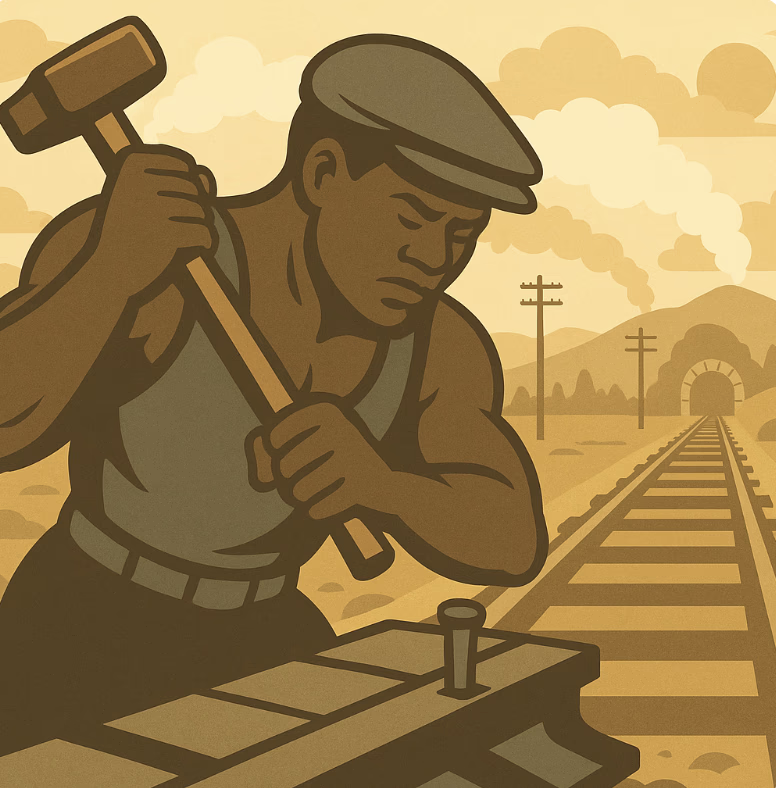
John Henry raced a steam drill and won—but it killed him. The future of AI isn't about competing with machines; it's about partnering with them.
Key Takeaway
The future of AI lies in augmentation, not competition. Just as tractors enhanced farming and Excel transformed accounting, artificial intelligence tools handle repetitive tasks while humans focus on critical thinking and decision-making. Organizations must provide training, clear guidelines, and support to help employees partner with AI systems safely. The future of AI isn't people racing against machine learning algorithms—it's people working alongside AI-powered tools to be more productive and strategic.
Key Terms
- Future of AI: Evolution of artificial intelligence from generative AI and large language models toward AI systems that augment human capabilities through automation and enhanced decision-making in real-world use cases.
- AI Augmentation: Using AI tools and AI technology to enhance human work rather than replace it, enabling workers to focus on complex problem-solving while AI agents handle routine tasks.
- Human-AI Partnership: Collaborative approach where AI-powered systems streamline workflows while humans provide judgment, empathy, and strategic thinking that optimize outcomes.
- AI Implementation: Organizational process of deploying AI capabilities with training, frameworks, and guidelines to ensure safe, productive use of AI across teams.
Growing up, one of my favorite stories was the legend of John Henry, the "steel-driving man." Born with a hammer in his hand, he was the best railroad worker there was, renowned for his strength and skill. The story goes that he raced against a steam-powered drill to dig a tunnel. John Henry won, proving his incredible prowess, but the effort cost him his life. It's often told as a tale of human spirit versus the machine, but I see it differently—as a cautionary tale about the cost of competing against technology instead of collaborating with it.
Technology Augmentation: Not a New Idea
The idea of technology augmenting human work isn't new, despite the current hype around artificial intelligence. At home in Montana, I don't know any farmers who till vast fields without tractors, relying solely on manual labor. I certainly don't know any accountants who forgo tools such as Excel to manage complex datasets by hand. For decades, we've embraced tools that make us more efficient, handle laborious tasks, and allow us to achieve more than we could alone.
Tractors didn't replace farmers; they allowed farmers to cultivate more land and produce more food. Excel didn't replace accountants; it enabled them to perform more complex data analysis and provide greater strategic value. This is the real future of AI—augmentation, not replacement.
Generative AI: The Next Evolution
Generative AI is the next evolution in this story. While the possibilities of AI technology are vast—from ChatGPT and large language models to AI agents and virtual assistants—I believe its most powerful immediate AI impact lies in its ability to automate the redundant, repetitive, and often tedious parts of our jobs through machine learning and automation.
Think about the time spent summarizing notes, drafting standard emails, searching for information across disparate AI systems, or formatting reports. These are the modern equivalents of manually driving steel spikes. AI tools can handle these workflows efficiently, freeing up human workers to focus on critical thinking, creative problem-solving, complex negotiations, and building relationships—the areas where human insight and empathy truly shine.
The future of AI isn't about AI-powered robotics or autonomous vehicles replacing humans in everyday life. It's about AI-driven algorithms and natural language processing helping us optimize our work, streamline operations, and make better decisions in real-time across use cases from healthcare to supply chain management.
The Critical Role of Organizations
However, making this transition to the future of AI shouldn't fall solely on employees' shoulders. Companies have a crucial role and responsibility in navigating this shift through AI development initiatives. We can't simply introduce powerful new AI capabilities and expect everyone to adapt seamlessly and safely to these emerging technologies.
Organizations should provide:
- Support & Training. Helping employees understand how AI tools like chatbots, GPT models, and AI-enabled systems can genuinely assist them in their specific roles, not just expecting them to figure out the use of AI independently. This includes frameworks for understanding AI models, deep learning concepts, and how OpenAI, IBM, NVIDIA, Amazon, and other AI companies' technologies work in real-world applications.
- Clear Guidelines. Establishing policies around how AI should be used is critical for cybersecurity and AI regulation compliance. For example, you absolutely wouldn't want employees uploading sensitive company data into an unprotected public AI model or large language models (LLMs) without proper safeguards. Clear do's and don'ts are essential for security, sustainability of AI initiatives, and compliance with emerging AI regulation frameworks.
- Focus on Augmentation. Framing artificial intelligence as a partner or assistant through AI-powered tools, designed to enhance human capability rather than replace it entirely. This means emphasizing AI advancements and breakthroughs from DeepMind, OpenAI, and other AI companies as enabling technologies that work alongside humans, not artificial general intelligence (AGI) that replaces decision-making.
The Future of AI: Partnership, Not Competition
John Henry didn't have the option to partner with the steam drill; his story was framed as a zero-sum competition that mirrored the Turing test of man versus machine. Today, we have a choice in shaping the future of AI. The future AI isn't about people racing against neural networks and algorithms; it's about people working alongside Gen AI, new AI capabilities, and AI technology breakthroughs.
By embracing AI systems to handle burdensome tasks through automation and providing the right support through training and frameworks, we can empower our teams to be more productive, more strategic, and, ultimately, find more value in their work. This applies across industries—from healthcare professionals using AI for data analysis to startups leveraging big data and computational power to optimize operations, to established companies deploying AI-driven tools across their supply chain.
The future of AI we're building isn't a podcast-worthy dystopia where machines dominate. It's a future where artificial intelligence augments human capability, where machine learning helps us make better decisions, and where AI technology enables us to focus on what humans do best—creative thinking, empathy, complex problem-solving, and building meaningful relationships.
That's the future of AI worth pursuing. Not a race against the machine, but a partnership with it.