


You approved $8M in AI spending. The audit committee asks for ROI data. Your dashboards show 30 AI tools in use. Then, Larridin discovers 150+ AI systems, $2M in redundant licenses, and zero correlation between spend and output. The board questions your financial controls during the largest artificial intelligence investment wave in corporate history.
Key Takeaway
As CFO, you face a financial paradox: 81% of leaders report difficulty quantifying AI investments, and 79% cite untracked budgets as a growing concern. Kyndryl Holdings research found that 61% feel increased pressure to prove ROI. Independent AI monitoring provides real-time visibility to track spend, eliminate waste, optimize AI model usage, and correlate investments to business metrics. It transforms AI from uncontrolled expense to documented advantage.
Quick Navigation
- The CFO's AI Measurement Crisis
- What CFOs Must Monitor Across AI Systems
- Larridin: Independent AI Monitoring for Financial Control
- Frequently Asked Questions
Key Terms
- Unsanctioned (“shadow) AI Spend: Untracked AI expenditures outside procurement, such as individual LLM subscriptions or subscriptions put on personal or business credit cards. It fragments budgets, without visibility into AI workloads or use cases.
- AI Observability: Real-time monitoring of AI systems, including model performance, response times, and anomaly detection, to track usage, prove ROI, and optimize workflows.
- Token Management: Tracking token consumption and API costs across LLMs, such as OpenAI, Claude, other models, and the AI-powered applications that depend on them, to control spend and prevent waste.
- ROI Metrics: Performance metrics that correlate AI deployment costs to productivity gains. This enables decision-making based on measurable business value, not vendor projections.
The CFO's AI Measurement Crisis
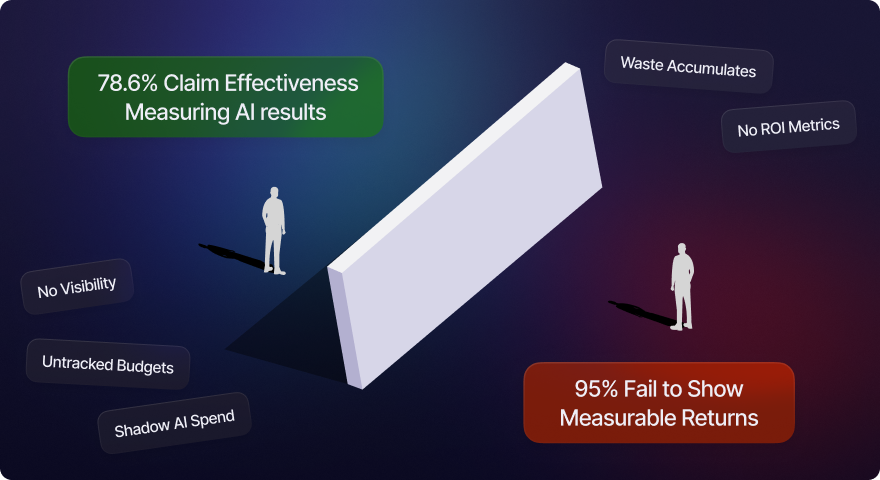
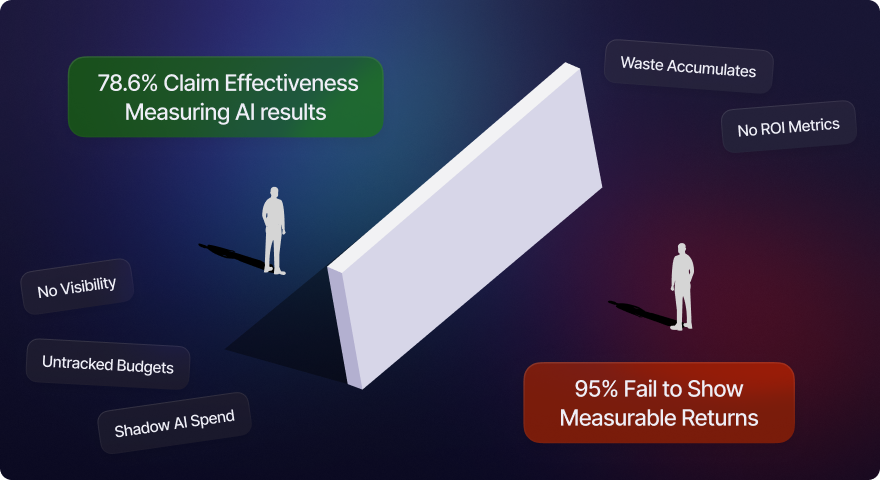
According to Larridin research, CFOs approve budgets they cannot track. AI spending fragments across departments without visibility. Investment decisions lack ROI measurement data. Waste accumulates faster than value creation.
The paradox: 78.6% claim effectiveness measuring AI results, but don’t have standardized metrics and infrastructure visibility. MIT research found 95% of enterprise AI initiatives fail to show measurable returns within six months. Without baseline visibility or consistent benchmarks, ROI measurement is guesswork.
What CFOs Must Monitor Across AI Systems
Effective monitoring solutions address four financial dimensions.
1. Token Management and Spend Optimization
- Track total expenditure across all platforms and LLM APIs. According to Larridin's February 2026 research, enterprises usually discover 150+ AI applications versus roughly 30 expected.
- Monitor utilization rates, identify bottlenecks in AI pipelines that cause cost overruns, and optimize machine learning workloads.
Real-time data ingestion from monitoring tools reveals which AI agents and automation workflows drive costs above thresholds. AI tool overlap can create redundant licensing and waste, especially as AI features get bundled into existing SaaS applications.
2. ROI Metrics and Value Realization
According to CFO research, time saved doesn't equal value.
- Measure productivity with financial quantification.
- Track revenue impact from AI-enabled capabilities, not efficiency claims.
- Calculate cost avoidance through reduced errors and faster cycle times.
- Establish payback periods by initiative.
Time saved doesn’t automatically translate to ROI. Tie AI initiatives to revenue impact, cost reduction, or measurable productivity gains, then track payback by use case.
3. AI Observability for Cost Governance
- Monitor AI systems end-to-end including model performance, latency, response times, and potential issues, before they cause outages or downtime.
- Application monitoring reveals which AI models deliver value, versus those that burn resources without measurable output.
- Track model drift and validation metrics to troubleshoot quality degradation.
- Implement anomaly detection across workflows to identify cost spikes and usage patterns that require remediation. Kubernetes and cloud infrastructure monitoring shows that GPU and CPU allocation supports AI deployment, which enables root cause analysis when costs exceed projections.
4. Risk Management and Compliance
- Calculate compliance violation costs and data privacy exposure.
- Track potential data breach impact from unmonitored AI agents processing sensitive information.
- Monitor audit readiness through automated validation and data ingestion controls.
- Evaluate insurance considerations as AI risk becomes material.
Organizations with formal policies are 2.2x more likely to demonstrate ROI because governance maturity enables scale.
Larridin: Independent AI Monitoring for Financial Control
Larridin Larridin provides CFOs with AI usage telemetry that transforms AI from an untracked expense to a measured investment:
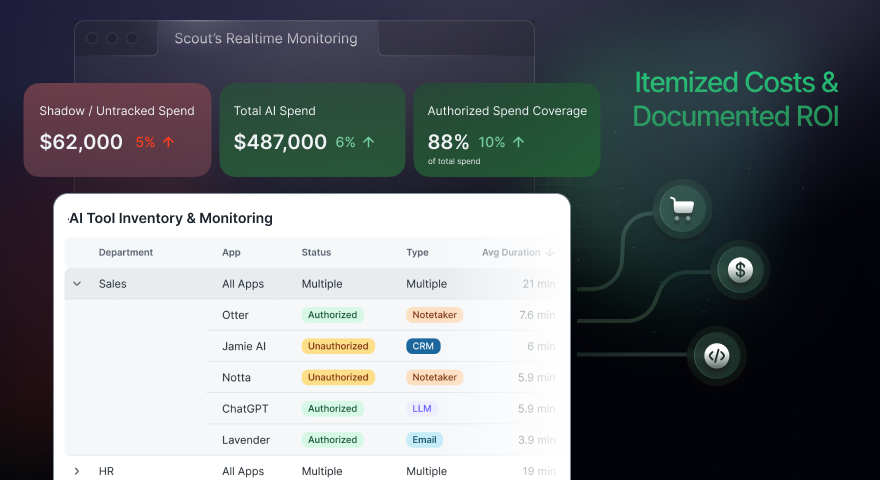
- Discover actual spending patterns across all AI systems, including unsanctioned (“shadow”) AI that bypasses procurement, with real-time dashboards showing who spends what, and where there’s redundancy.
- Optimize AI model spend by connecting usage data to business outcomes and distinguishing investments that drive productivity from those that create more busywork.
- Build comprehensive analytics that quantify productivity gains, revenue impact, cost savings, and payback periods by use case with board-ready visualization.
- Optimize vendor contracts using performance metrics that show which monitoring tools and AI applications deliver value versus wasted capacity.
- Establish financial controls with cost allocation models, spend thresholds, and automated alerts to prevent budget variance across AI workloads.
Frequently Asked Questions
How does Larridin track AI workloads across different model APIs and platforms?
Larridin monitors application-level AI usage through a centrally distributed browser plug-in. The platform captures activity across OpenAI, Claude, Gemini, and hundreds of other LLM APIs regardless of procurement method.
Larridin ingests telemetry data in real time and tracks which AI agents employees use and what workflows they enable, while providing token consumption visibility across different use cases. This observability reveals shadow AI spend, identifies bottlenecks in automation pipelines, and enables troubleshooting when costs exceed thresholds. Larridin's monitoring tools provide end-to-end visibility that transforms fragmented AI systems into managed infrastructure you can optimize and control.
What performance metrics does Larridin provide for AI ROI measurement?
Larridin delivers comprehensive metrics that help connect spend to outcomes. The platform quantifies productivity ROI, measuring time saved and multiplying by specified labor rates. Larridin tracks cost per interaction, latency, response times, and model accuracy across AI models. The dashboards visualize utilization rates, identify model drift requiring validation, and measure revenue impact from AI-powered capabilities.
Larridin monitors anomaly detection for cost spikes, tracks remediation efforts for quality issues, and calculates payback periods by use case. These performance metrics provide board-ready data that demonstrates measurable returns through real-time observability rather than vendor projections.
How quickly can Larridin deploy monitoring solutions for budget planning?
Larridin typically deploys in one day, with initial visibility within the first week. Within 30 days, you have baseline data on total spend, utilization rates, shadow AI discovery, and productivity metrics. This rapid deployment allows Larridin-generated ROI data to be used in quarterly board presentations and annual budget cycles. The platform's real-time data ingestion enables continuous financial tracking rather than periodic surveys.
Larridin scales horizontally across thousands of users without performance degradation, automatically monitoring CPU and GPU workloads, Kubernetes infrastructure, and cloud AI applications as your AI deployment expands.
Can Larridin help optimize AI infrastructure costs and prevent outages?
Yes. Larridin's AI observability helps identify infrastructure inefficiencies that cause cost overruns. The platform monitors GPU and CPU allocation, tracks machine learning pipeline bottlenecks, and provides anomaly detection for potential issues before they cause disruptions or downtime.
Larridin reveals which AI agents and automation workflows consume excessive resources, which enables root cause analysis for cost optimization. The monitoring tools identify underutilized capacity you can eliminate and high-value AI applications worth expanding. This end-to-end observability optimizes infrastructure spend, while maintaining user experience and preventing outages through predictive alerts.
How does Larridin ensure data privacy and compliance for AI monitoring?
Larridin provides documentation for audit trails about which AI systems are in use, who uses them, what data they process, and how spend allocates across the lifecycle of each AI deployment. This visibility supports regulatory compliance by identifying if there are any AI agents processing sensitive information without proper governance.
Larridin's monitoring maintains comprehensive validation records that show auditors AI spend is managed with appropriate controls, ROI is measured systematically, and decisions are based on documented business value. The platform's data privacy controls and zero data retention policy reduce compliance risk and associated costs of regulatory violations.
Are you ready to transform untracked AI spend into documented competitive advantage?
About Larridin
Larridin is the independent AI impact measurement platform that quantifies usage, proficiency, and impact across humans and agents, which enables trusted AI governance at scale.