


Key Takeaway
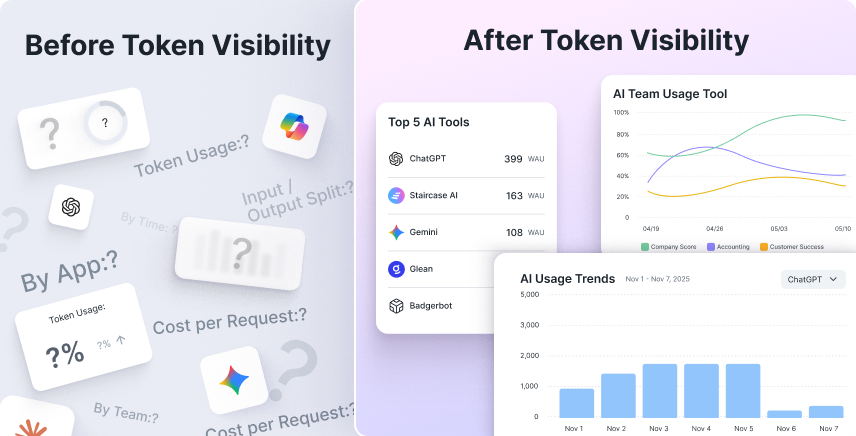
Without visibility into AI token consumption, finance leaders operate blind while costs accumulate.85% of enterprises miss their AI infrastructure forecasts by more than 10%, and 80% miss by more than 25%. Organizations that establish comprehensive AI usage analytics to track token consumption patterns, compare spending across teams and applications, and build usage-based forecasts transform unpredictable AI costs into manageable investments.
Quick Navigation
- The Token Visibility Crisis
- Understanding Token Economics
- Essential AI Usage Analytics
- Building Token Visibility
- Using Visibility for Cost Management
- Strategic Benefits Beyond Cost Control
- Frequently Asked Questions
Key Terms
- AI Token Consumption: The actual usage of computational units (tokens) when processing AI requests. Each token represents approximately three to four characters of text.
- AI Usage Analytics: Systematic tracking and analysis of how AI tools are consumed across an organization, measuring adoption patterns, frequency, and costs.
- Token Visibility: The ability to see, measure, and analyze token consumption patterns across users, teams, and applications.
- Token Usage Comparison: Analysis of token consumption patterns across dimensions like teams or time periods to identify efficiency opportunities.
The Token Visibility Crisis
Enterprise AI spending is racing toward $644 billion in 2025, up 76% from 2024, according to Gartner. Yet most organizations lack basic visibility into where this money goes.
Unlike traditional software with predictable seat-based pricing, AI operates on token consumption models where costs are based on actual usage. Every prompt and response consumes tokens and incurs charges. Without comprehensive AI usage analytics that track token consumption patterns, finance teams cannot answer fundamental questions: Which teams consume the most tokens? Which applications drive costs? When do spikes occur?
According to the Larridin State of Enterprise AI 2025, 81% of leaders say AI investments are difficult to quantify, while 79% report untracked AI budgets are becoming a growing accounting concern. This creates a dangerous cycle where CFOs approve budgets they cannot track, spending fragments across departments without visibility, and waste accumulates faster than value creation.
Understanding Token Economics
Tokens are the basic unit of text processing in AI models. A simple prompt like, "Summarize this document" might use 4 tokens, while the generated summary could be 200-300 tokens.
Current pricing varies significantly. OpenAI ChatGPT pricing for GPT-4o costs $2.50 per million input tokens and $10.00 per million output tokens, while GPT-4o Mini costs just $0.15 input and $0.60 output. Anthropic Claude pricing for Sonnet 4.5 costs $3.00 input and $15.00 output, while Claude Haiku 4.5 costs $1.00 input and $5.00 output.
Most organizations lack token visibility because employees use multiple AI tools across sanctioned and shadow applications. 84% of organizations discover more AI tools than expected during audits, and 83% report employees install AI tools faster than security teams can track. Token consumption happens at the interaction level, generating massive data volumes that traditional IT monitoring cannot capture.
Essential AI Usage Analytics
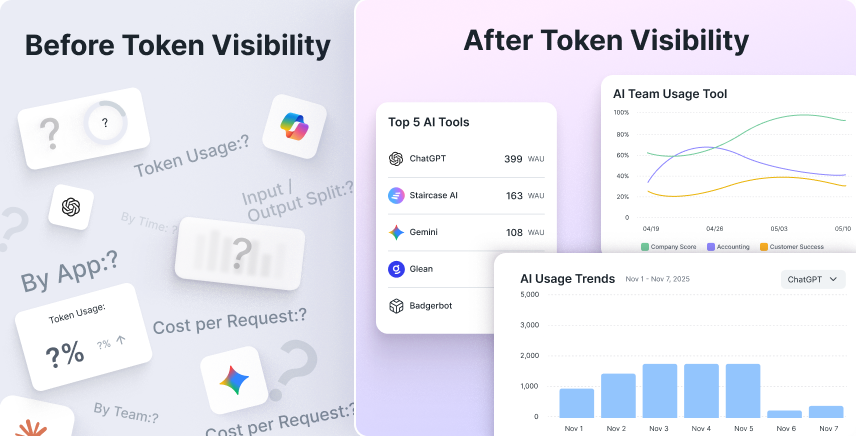
Comprehensive token visibility requires multi-dimensional AI usage analytics across several key areas:
Team-Level Tracking
Team-level analytics reveal who consumes tokens, at what volumes, and for which purposes. This enables finance to identify power users, spot unusual consumption patterns, allocate costs accurately, and benchmark normal usage ranges by role.Only 51% of organizations can track AI ROI effectively, according to CloudZero's State of AI Costs 2025. Team-level tracking closes this gap by connecting spending to specific work patterns.
Application-Level Measurement
Application-level analytics show which tools and workflows drive consumption. A simple chatbot might consume 500 tokens per interaction, while document analysis could consume 50,000 tokens. AI usage analytics reveal which tools deliver value proportional to cost, identify applications consuming excessive tokens, and expose redundancy where consolidation could reduce spending.
Temporal Patterns and Model Selection
Time-based analysis reveals when consumption spikes occur and why. Tracking which AI models organizations use for different tasks provides critical financial visibility, since premium models cost significantly more, but may not deliver proportionally better results for all use cases.
Comparative Analytics
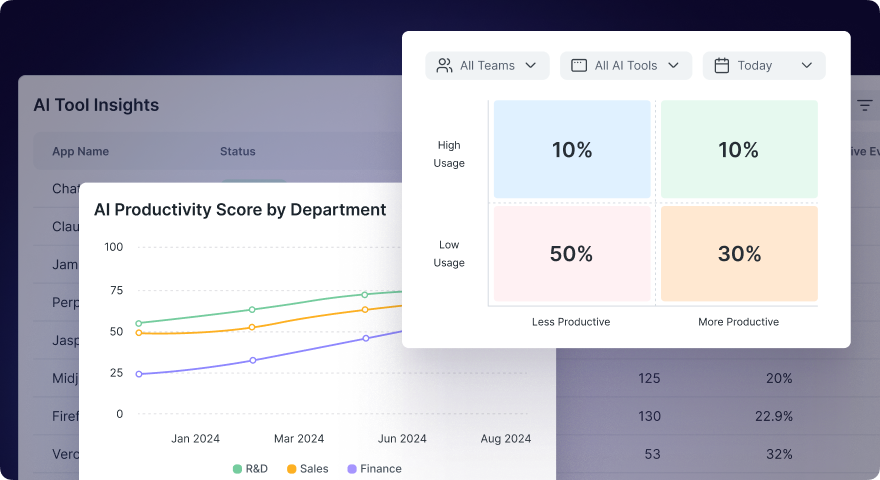
The real power of token visibility emerges from comparative analysis. How does Team A's consumption compare to Team B's for similar work? Which department uses AI most efficiently? According toMcKinsey's State of AI 2025, just 39% of organizations report EBIT impact at the enterprise level despite widespread use. Comparative analytics help finance leaders identify efficiency patterns and replicate them.
Building Token Visibility
Organizations can achieve basic token visibility within days through browser-based AND desktop monitoring that captures AI usage across web applications. Browser-based monitoring typically requires approximately one day for initial implementation. Desktop agents providing deeper visibility can be deployed within a few additional days.
While organizations cannot directly access token-level data from external AI providers, AI usage analytics platforms track application usage patterns, frequency, and duration to build proxy metrics to estimate consumption. These estimates are validated against billing data and provide sufficient visibility for financial management and comparative analysis.
Organizations implementing comprehensive AI measurement discover 3-5x more AI usage than initially expected, according to Larridin deployment data. This discovery phase is essential for accurate baseline establishment.
Using Visibility for Cost Management
Token consumption visibility creates the foundation for cost management through several strategic applications.
Identifying Cost Drivers
Comparative analytics reveal where spending concentrates and why. Finance teams can compare token consumption across teams performing similar work, analyze application-level spending to determine value proportional to cost, and examine temporal patterns to understand whether usage growth reflects business growth or inefficiency.
Benchmarking and Standards
Token visibility enables organizations to establish consumption benchmarks that define reasonable usage ranges. Finance can set standards for token consumption by role, create application-level benchmarks, and establish departmental budgets based on typical consumption.Average monthly AI spend reached $62,964 in 2024 and is projected to rise to $85,521 in 2025, a 36% increase according to CloudZero.
Anomaly Detection and Accountability
AI usage analytics enable automated anomaly detection. Finance teams can identify consumption spikes that exceed normal ranges, investigate specific applications or teams driving unexpected costs, and intervene before anomalies become sustained increases. Token visibility creates accountability by connecting spending to specific teams, enabling cost allocation frameworks, showback models, and eventually chargeback.
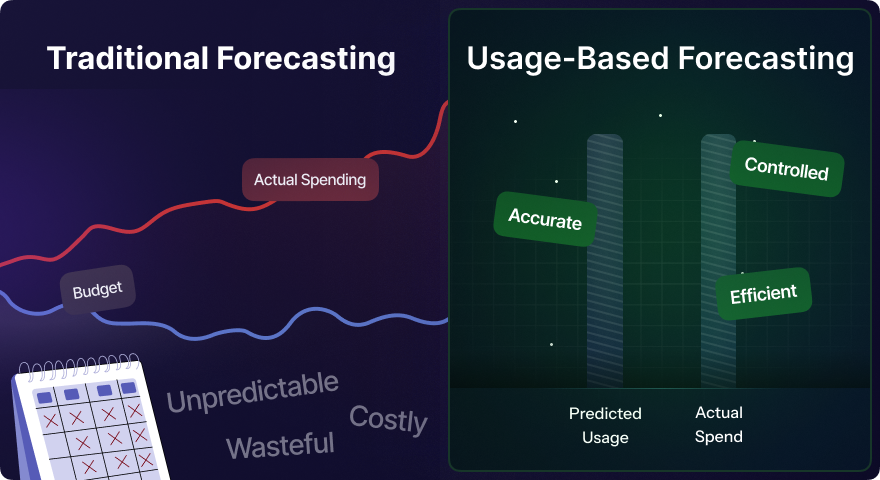
Usage-Based Forecasting
The most valuable application of token visibility is accurate forecasting. Finance teams can build forecasts by analyzing average tokens per role, measuring growth rates in adoption and consumption intensity, and identifying patterns that correlate with business metrics.85% of companies miss AI forecasts by more than 10%. Usage-based forecasting grounded in actual consumption data dramatically improves accuracy.
Strategic Benefits Beyond Cost Control
Token consumption visibility delivers value beyond immediate cost management.
- Informed Investment Decisions: Comprehensive visibility helps finance leaders invest in high-value AI tools, eliminate low-value applications, and negotiate effectively with actual usage data.
- Risk Management: Token visibility reveals shadow AI usage before it creates compliance problems and identifies data sharing patterns that might violate policies. 84% of leaders fear confidential data is being shared with public AI models, according to Larridin's research.
- Productivity Measurement: AI usage analytics reveal productivity patterns. Finance leaders can identify teams using AI most effectively, connect usage to business outcomes, and measure improvements attributable to AI adoption.
Frequently Asked Questions
How do organizations track token consumption across multiple AI tools?
Purpose-built AI usage analytics platforms deploy monitoring tools that track AI application usage across browsers and desktop applications. These platforms capture which AI tools employees access, how frequently, and for how long. By combining usage tracking with known pricing models and periodic validation against actual bills, organizations can estimate token consumption with sufficient accuracy for financial management. Larridin Scout provides this capability through browser plugins and desktop agents that discover and measure AI usage across the enterprise within days.
How accurate do token estimates need to be?
Token estimates just need to be accurate enough to identify material cost drivers, compare relative efficiency, detect anomalies, and build forecasts within 10-15% of actual spending. Precision is not necessary. Organizations should validate estimates periodically against actual bills and adjust models to maintain accuracy. Even estimates with 15-20% variance provide dramatically better visibility than having no usage data.
What should CFOs do first to gain token visibility?
CFOs should immediately deploy AI usage analytics that capture application-level usage across the enterprise. Start with discovering which AI tools employees use and how frequently. Browser-based monitoring can be implemented in approximately one day, providing immediate visibility into web-based AI usage. Desktop agents can be added within days. The key is starting immediately rather than waiting for perfect solutions.
How do organizations balance visibility with employee privacy?
Effective AI usage analytics track usage at the application and aggregate level rather than monitoring individual prompt content. Organizations should capture which AI tools employees access and when, measure token consumption patterns, and track spending allocation across teams. Organizations should not capture the specific content of employee prompts or responses, personal communications, or detailed screen monitoring. This provides comprehensive financial visibility while respecting privacy.
About Larridin
Larridin is the AI Measurement Company. We measure AI utilization, proficiency, and business value across your enterprise through our Scout AI usage analytics platform.
Finance leaders use Larridin to discover their complete AI landscape including shadow AI usage, establish comprehensive token consumption visibility across teams and applications, compare usage patterns to identify efficiency opportunities, and build accurate forecasts based on real consumption data.