

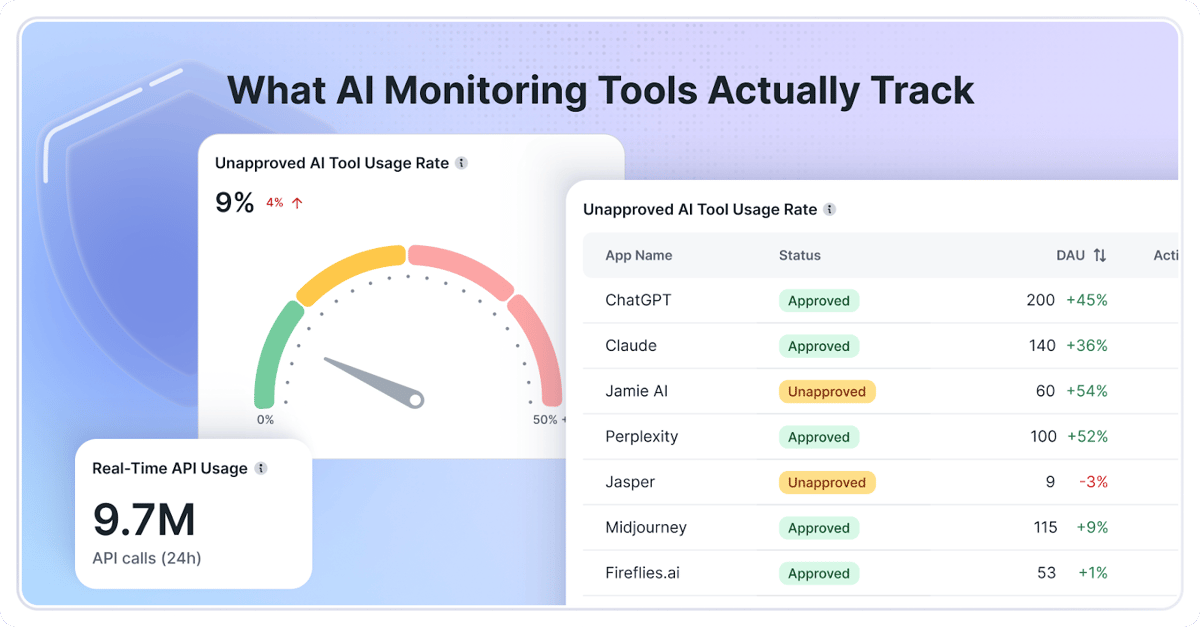

Your security team has approved three AI tools. Your employees are using thirty.
Key Takeaway
More and more organizations are undergoing informal or formal AI audits, with 84% of organizations discovering more AI tools in use than expected during such audits. This reveals a systematic breakdown in traditional IT governance (Larridin State of Enterprise AI Report) <link>. With 83% of employees shown to be installing AI tools faster than security teams can track, AI monitoring has become essential for visibility, security, and competitive advantage in the LLM era.
Quick Navigation
- The Shadow AI Problem
- What AI Monitoring Tools Actually Track
- Why This Matters for Decision-Making
- Building Your AI Monitoring Strategy
- Moving from Visibility to Action
- A Fast Path to Monitoring Excellence
Key Terms
- AI Monitoring: Continuous tracking and analysis of AI tool usage across an enterprise to identify both sanctioned and unauthorized applications, measure adoption patterns, and detect security risks in real-time.
- Shadow AI: Unauthorized AI applications, tools, and services operating within enterprise networks without IT oversight or approval, often deployed by employees to boost productivity or solve immediate business challenges.
- AI Discovery: The systematic process of identifying all AI tools and platforms being used across an organization, including browser-based applications, API connections, and embedded AI features in existing software.
- Data Flow Visibility: The ability to track what corporate information is being shared with which AI models and platforms, revealing potential compliance violations and security risks.
- Real-Time Governance: Dynamic AI policy enforcement that scales with adoption velocity, providing security oversight without blocking productivity or innovation.
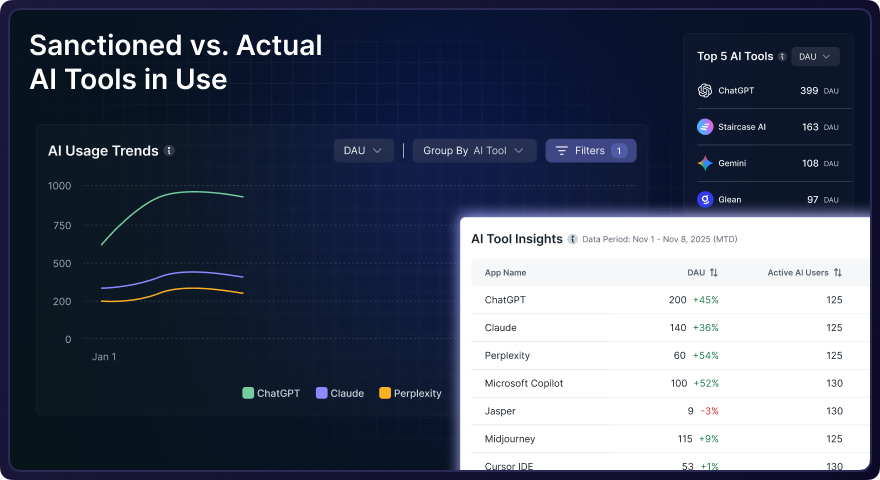
The Shadow AI Problem
According to the Larridin State of Enterprise AI Report, 84% of organizations discover more AI tools than expected during audits. Even worse, 83% report employees installing AI applications faster than security teams can track them. These AI applications run outside approved workflows, creating large blind spots in your AI deployment.
Shadow AI may be even more problematic than other shadow IT. Employees often use AI tools through personal accounts or unapproved apps, which can sit outside organizational controls and visibility. Worse, it’s all too easy for employees to use these tools on corporate data, without security controls.
This can result in company or even customer data getting exposed to the public or used to train the next generation of foundation models. Perhaps relatedly, IBM 2025 Cost of Data Breach Report found that AI-related breaches cost more than $650,000 per incident.
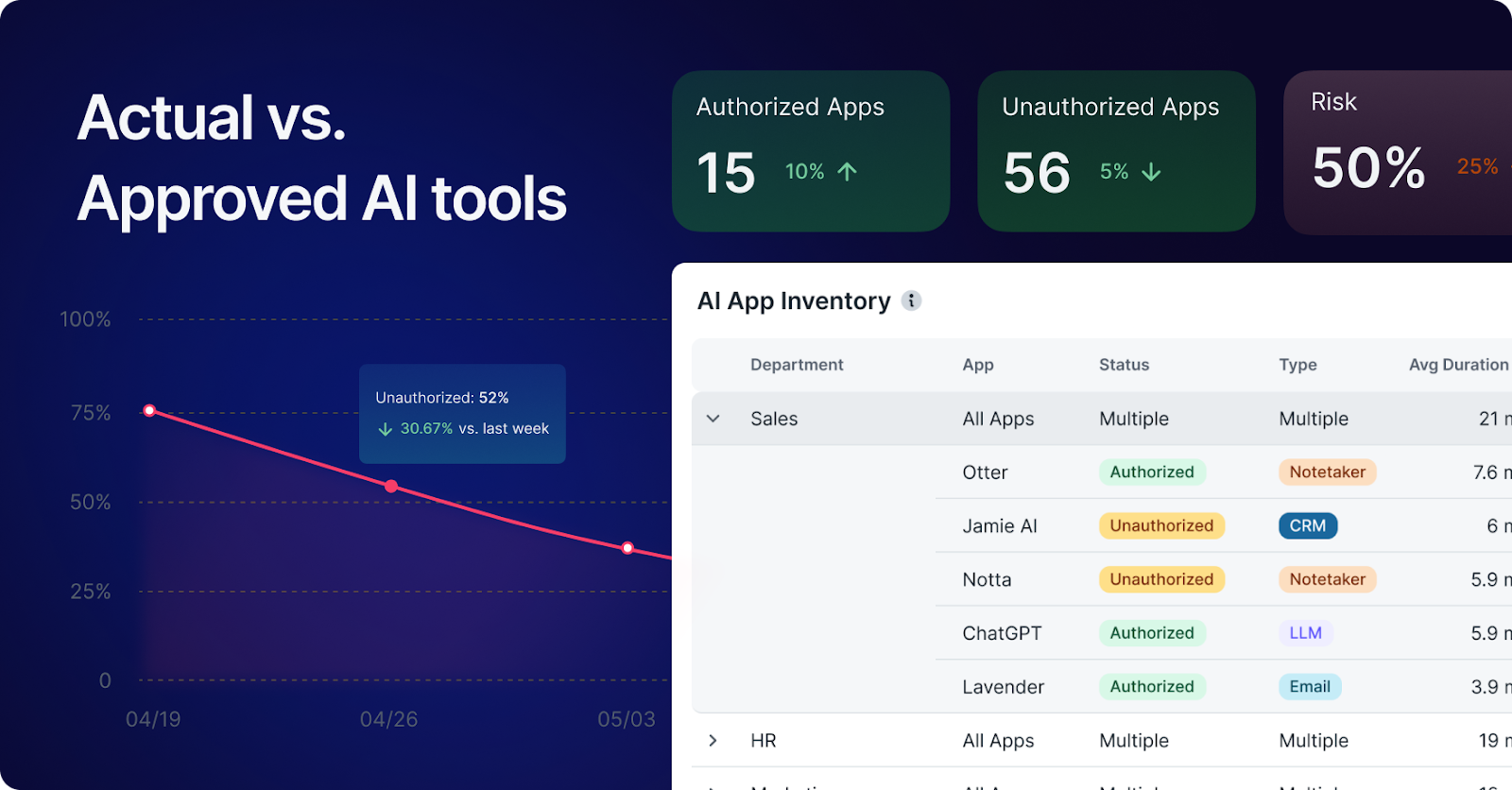
What AI Monitoring Tools Actually Track
Modern AI monitoring solutions use multiple methods to find hidden AI workloads in an organization.
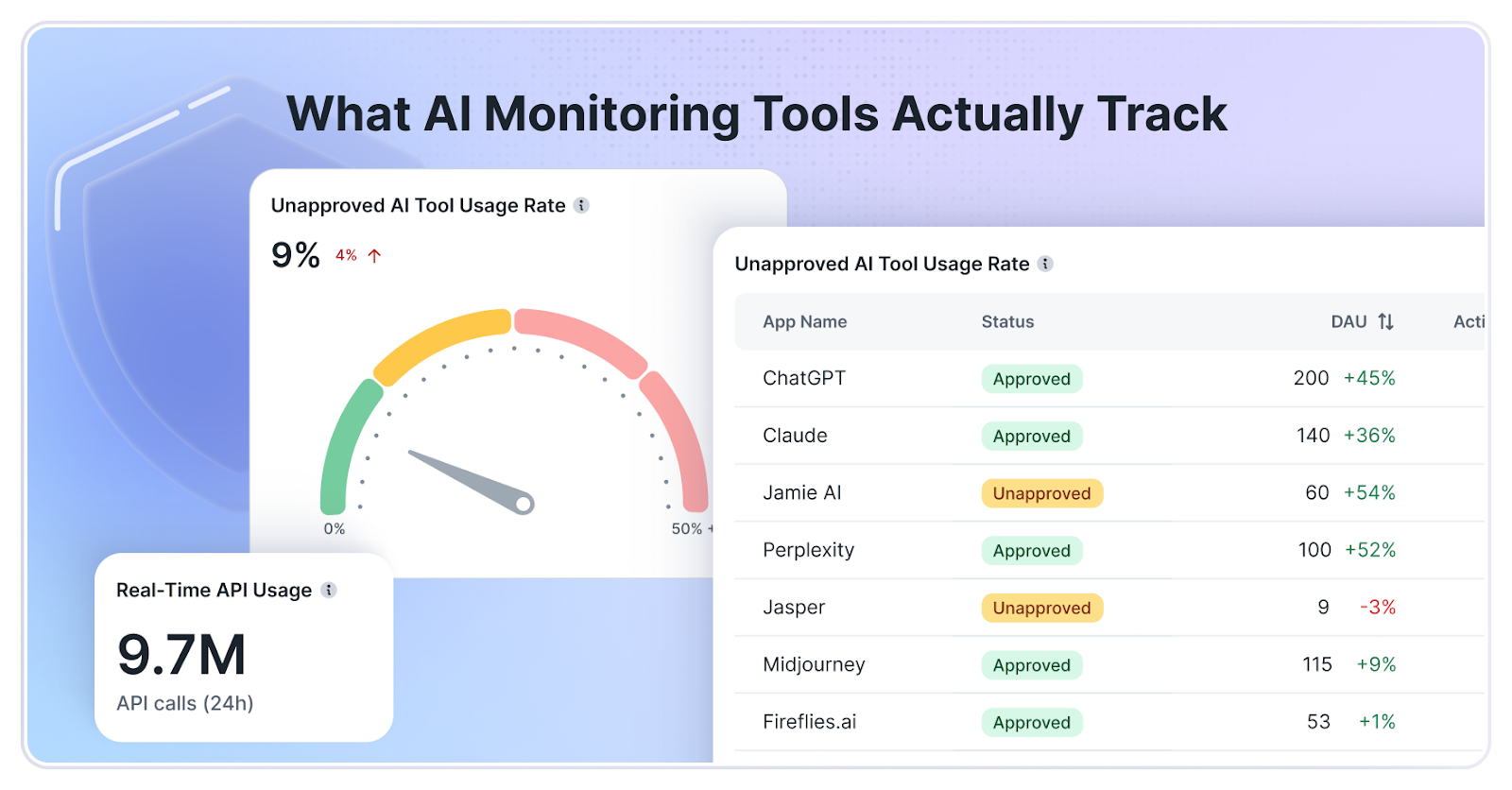
Real-Time API Monitoring
Monitoring tools track API calls to detect when employees connect to AI platforms such as OpenAI, Claude, or Copilot, especially through unapproved apps or personal accounts. These monitoring solutions track OAuth connections, analyze API call patterns, measure data ingestion volumes, and map which systems connect to external AI models.
Tracking API calls helps in finding what apps are in use, quantifying real usage levels, identifying unapproved connections, and understanding what data is flowing into external models.
Performance Metrics and Observability
AI observability goes beyond basic monitoring. Advanced platforms track model performance metrics including response times, latency issues, CPU and GPU utilization, and potential bottlenecks in AI pipelines.
Real-time monitoring dashboards provide visualization of AI agent activity, machine learning model accuracy, anomaly detection alerts, and end-to-end workflow tracking.
Data Flow and Privacy Tracking
Monitoring solutions track what data employees share with AI systems.ISACA research highlights data leakage and IP exposure as primary concerns. Effective tools support data privacy compliance, correlate data flows across systems, validate security thresholds, and troubleshoot potential issues before they cause disruptions.
Why This Matters for Decision-Making
AI monitoring enables better business decisions. The Larridin report shows 72% of AI investments destroy value through waste. Monitoring helps optimize spending, prevent outages, improve user experience, ensure that AI application use follows corporate governance standards, and scale successful use cases.
Since 85% of leaders think they have less than 18 months to “get on the train or die” with AI usage before permanently falling behind, AI visibility drives competitive advantage.
Building Your AI Monitoring Strategy
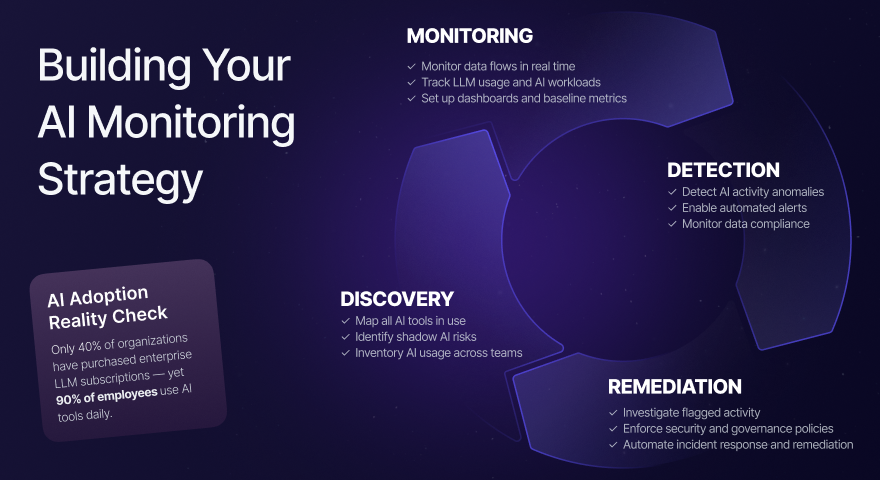
To build your AI monitoring strategy, start with discovery. Deploy monitoring tools that provide immediate visibility into AI applications, LLM usage, and AI-powered automation across your organization.
The MIT State of AI report found that while 40% of organizations purchased enterprise LLM subscriptions, more than 90% of employees use AI tools daily. This gap illustrates the extent of shadow AI.
Effective strategies include setting up dashboards for application monitoring, implementing anomaly detection for unusual AI workloads, establishing thresholds for automated alerts, tracking the complete AI lifecycle from deployment to output, enabling quick remediation when issues arise, and monitoring model drift that affects model accuracy over time.
Moving from Visibility to Action
Monitoring tools provide the data. You need to act on it. The Larridin State of Enterprise AI 2025 report shows that 67% of technology leaders have lost visibility into their AI infrastructure. With 88% believing that measurement determines market leaders across industry sectors, monitoring becomes strategic.
Organizations using AI monitoring solutions can optimize AI deployment based on real metrics, troubleshoot performance issues before they cause downtime, validate that AI models meet accuracy thresholds, identify root cause of AI system failures quickly, improve scalability by understanding actual workloads, and ensure data privacy across all AI applications.
The choice is simple: implement monitoring now - or stay blind to what AI tools are running, how they perform, and what risks they create. In artificial intelligence, you cannot manage what you do not measure.
A Fast Path to Monitoring Excellence
Larridin provides industry-leading AI dashboards that measure progress and inform action. If you want to implement AI monitoring rapidly, to a high standard, and with less burden on internal teams, Larridin offers an interesting solution. If you’d like to learn more, connect with us for a demo.
Are you ready to discover what AI tools are actually running in your enterprise?